Hindu families drawn into Christianity through years of organised prayer meeting network in Uttar Pradesh
 Pratapgarh, Uttar Pradesh, India
  27 April, 2026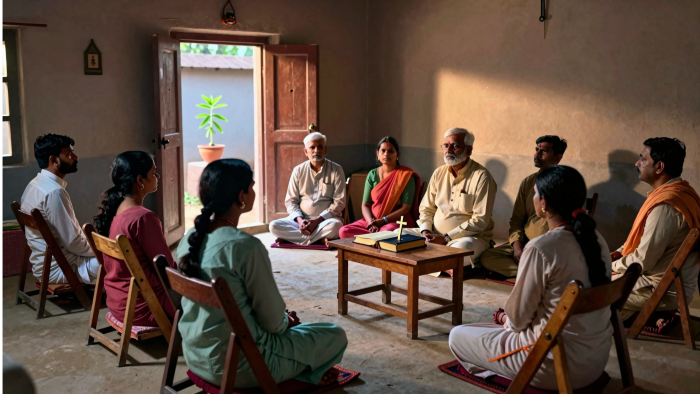
Case Summary
A Hindu man named Arvind Kumar from Ahina Bahariya, Mandhata, Uttar Pradesh filed a complaint with the Superintendent of Police [SP] office after discovering that his own mother, uncle, sister-in-law, and cousin brother, along with sixteen others from Sandila, Raigunj, had been drawn into Christianity through regular prayer meetings held at his uncle's home. The complaint exposed a sustained and organised conversion operation that had been running for several years under the leadership of a man named Manoj Kumar. Following a high-level investigation, police registered a case against 22 individuals under the Uttar Pradesh Prohibition of Unlawful Religious Conversion Act 2021. The discovery that his own family members had converted to Christianity compelled Arvind Kumar to approach SP Deepak Bhukar approximately one month before the police action. He disclosed that his uncle Basant Lal, his mother Nirmala Devi wife of the late Sant Lal, his sister-in-law Sarla Devi, his cousin Rajesh Kumar, and two other family members had left the Hindu faith. Regular prayer meetings were being held at Basant Lal's home, attended by sixteen individuals from Sandila, Raigunj, all of whom had also converted. Manoj Kumar of Sandila had been organising conversion meetings for several years and actively drawing Hindu people toward Christianity. The SP assigned the investigation to the Additional Superintendent of Police [ASP] West, who recorded statements and affidavits from multiple individuals before submitting his report. The investigation confirmed the substance of Arvind Kumar's complaint. Mandhata police registered a case against 22 individuals under section 173 of the Bharatiya Nagarik Suraksha Sanhita [BNSS] and sections 3, 5(1), and 11 of the Uttar Pradesh Prohibition of Unlawful Religious Conversion Act 2021. The accused included three brothers Manoj Kumar Gautam, Ramesh Kumar Gautam, and Dinesh Kumar Gautam, sons of Awadhesh Kumar Gautam, along with Awadhesh's wife Ramrati, his daughter Paro, Ramesh's wife Kalpana, Surendra son of Bhagauti Prasad, Karan son of Surendra, Sameer son of Neeraj, Rita Devi wife of Surendra, Dilip son of Rampal, Sudha wife of Dharmendra, Ajay Kumar, Sonu, Pradeep Gautam of Ugaipur Raigunj, Surendra son of Pirthi Lal of Ramnagar Raigunj, and from Arvind Kumar's own family, his mother Nirmala Devi, his sister-in-law Sarla Devi, his uncle Basant Lal, Rajesh Kumar son of Basant Lal, Kanchan Devi wife of Pramod Kumar, and Pramila Devi wife of Ramji. Circle Officer [CO] Raigunj Vinay Prabhakar Sahni confirmed that the case had been registered and that a thorough investigation was underway, with legal action to follow if involvement in conversion activities was established.
Why it is Hate Crime ?
The primary category for this case is "Predatory Proselytisation". The sub-category for this case is "Proselytisation by grooming, brainwashing, manipulation and subtle indoctrination". The tertiary category here is "Pattern of targeting Hindus". Religious brainwashing essentially means the often subtle and forcible indoctrination to induce someone to give up their religious beliefs to accept contrasting regimented ideas. Religious grooming or brainwashing also involves propaganda and manipulation. It involves the systematic effort, driven by religious malice and indoctrination, to persuade “non-believers’ to accept allegiance, command, or doctrine to and of a contrasting faith. Cases of such grooming or brainwashing are far more nuanced than direct threats, coercion, inducement and violence. In such cases, it is often seen that there is repeated, subtle and continual manipulation of the victim to induce disaffection towards their own faith and acceptance of the contrasting faith of the perpetrator. While subtle indoctrination is widely acknowledged as predatory, an element which is often understated in such conversions or the attempts of such conversion is the role of loyalty and trust which might develop between the perpetrator and the victim. Fiduciary relationships are often abused to affect such religious conversion. For example, an educator transmitting religious doctrine of a competing faith to a Hindu student. The Hindu student is likely to accept what the teacher is transmitting owing to existence of the fiduciary relationship. The exploitation of the fiduciary relationship to religiously indoctrinate victims would also be included in this category. Since the underlying animosity towards the victim’s faith forms the basis of predatory proselytization, such cases are considered religiously motivated hate crimes. This case qualifies as a religiously motivated hate crime in which an organised network of Christian missionaries in Mandhata, Uttar Pradesh conducted a sustained and systematic campaign of conversion targeting Hindu individuals and families through regular prayer meetings held over several years. The operation was structured, multi-generational in its reach, and sufficiently embedded within the social fabric of the targeted Hindu community to draw in an entire family network, including a complainant's own mother, uncle, sister-in-law, and cousin, before it was exposed. A case was registered against 22 individuals under the Uttar Pradesh Prohibition of Unlawful Religious Conversion Act 2021. The sustained and organised nature of the conversion operation is the primary religious marker of this case. Manoj Kumar of Sandila had been conducting conversion meetings for several years, systematically identifying and drawing Hindu individuals toward Christianity through regular gatherings held at Basant Lal's home in Ahina Bahariya. The operation was not the work of a single individual making occasional contact with a few people. It was a structured network spanning multiple villages, involving 22 individuals across Sandila, Raigunj, and Mandhata, and operating continuously over an extended period with sufficient effectiveness to convert an entire extended family network without the knowledge of one of its own members. The perpetrators chose the format of regular prayer meetings deliberately because it provided a socially acceptable framework within which Hindu individuals could be gradually drawn into Christian religious practice without triggering immediate community alarm. The deliberate targeting of Hindu family networks as the mechanism of conversion is the second religious marker. The conversion operation was most effective not at the level of individual outreach but at the level of family networks. By converting key members of a Hindu family, including a mother, an uncle, a sister-in-law, and a cousin, the operation embedded itself within the intimate social structure of a Hindu household and used those family relationships as the primary vehicle for further conversion. A Hindu person whose mother, uncle, and siblings have already converted is a Hindu person whose closest relationships are being used to apply sustained and intimate pressure toward their own conversion. The perpetrators chose to target family networks deliberately because the conversion of family members is the most effective mechanism available for overcoming the resistance of remaining Hindu individuals within the same household. The use of prayer meetings as the vehicle for gradual religious indoctrination is the third religious marker. The regular prayer meetings held at Basant Lal's home were not transparent Christian worship gatherings to which Hindu individuals were openly invited to explore another faith. They were the instrument through which Hindu individuals were gradually drawn into Christian religious practice through sustained and repeated exposure, with each meeting deepening the participant's engagement with Christian devotional content and progressively distancing them from their Hindu religious identity. The perpetrators chose the prayer meeting format deliberately because its gradual and incremental nature made resistance and detection both less likely, allowing the conversion process to proceed over an extended period before the community became aware of what was happening. The broader pattern of organised conversion operations targeting vulnerable Hindu communities across the district is the fourth and most significant religious marker. This case was not isolated. The district had witnessed a pattern of organised conversion operations targeting vulnerable Hindu communities through faith healing gatherings. In July 2025, police raided a conversion operation in Kacha Dubey Ka Purwa village in Jethwara police station area, arresting eight people including one woman and recovering religious posters, crosses, literature, and images of Jesus Christ. In the same month, four women were arrested and sent to jail for conversion activities at a faith healing gathering in Chanpurwa village, Hathigawan, Kunda area. In October 2025, four Hindu families who had been converted by exploiting their financial hardship and illness returned to Sanatan Dharma [the Hindu religious tradition] upon learning the full truth of what had been done to them. In February 2026, a Hindu man disclosed that he had been held captive for ten years, forced to perform labour, and subjected to forced conversion. The present case is the latest and most extensively documented instance of a pattern of organised predatory conversion targeting that has been operating across the district for an extended period, systematically identifying and exploiting vulnerable Hindu individuals and families through manufactured social and religious relationships. Given that this case met the parameters of a religiously motivated hate crime, the conduct of the conversion network reflected more than a community of individuals freely sharing their faith. By operating a sustained and structured conversion campaign across multiple villages over several years, embedding the operation within Hindu family networks, and using regular prayer meetings to gradually draw Hindu individuals away from their faith through incremental religious indoctrination, the perpetrators demonstrated a clear and deliberate disregard for the Hindu religious identity of every person they targeted. The Hindu individuals converted through this network were targeted specifically because they were Hindu, and every element of the operation was designed to exploit the social trust and family bonds of Hindu communities as the most effective mechanism for drawing them away from their faith without resistance or detection. Such predatory conduct stems from inherent hostility towards the victim's professed faith since Abrahamic faiths believe that any non-adherent to the faith is a subject to be dehumanised till they convert. Since such actions stem from doctrinal animosity towards the Hindu faith and its adherents, this case is being documented as a religiously motivated hate crime. Disclaimer: The Hinduphobia Tracker records the victim count based on confirmed figures available in the source. The source confirms a minimum of 22 Hindu individuals were converted through the prayer meeting network, comprising the six family members named in Arvind Kumar's complaint and the sixteen individuals from Sandila who attended the prayer meetings at Basant Lal's home. The total number of Hindu individuals affected by the conversion network over the full period of its operation is unconfirmed and likely higher. The figure of 22 has been used as the confirmed minimum victim count for documentation purposes. This was recorded for documentation purposes only. Disclaimer: The Hinduphobia Tracker records incident dates based on when the crime occurred rather than when it was reported or published. The source confirms that the conversion operation had been running for several years prior to its exposure, with Manoj Kumar Gautam conducting conversion meetings over an extended period, but no specific start date is confirmed. The publication date of 28 April 2026 has been used as the indicative incident date for documentation purposes as it reflects the most recent and documentable development of the case registration. This was recorded for documentation purposes only.
Victim Details
Total Victim
22
Deceased
0
Gender
- Male 2
- Female 2
- Third Gender 0
- Unknown 18
Caste
- SC/ST 0
- OBC 0
- General 0
- Unknown 22
Age Group
- Minor 0
- Adult 2
- Senior Citizen 0
- Unknown 20


Case Status
Complaint filed


Perpetrators Details
Perpetrators
Christian Extremists
Perpetrators Range
From 10 to 100
Perpetrators Gender
both
 Sources




