Sacred Hindu temple of Goddess Kali vandalised by miscreants in Hyderabad, Pakistan
 Hyderabad, Sindh, Pakistan
  26 April, 2026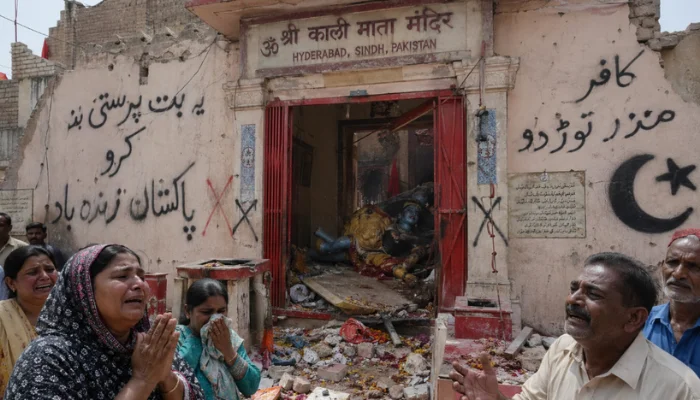
Case Summary
In Hyderabad, Sindh, Pakistan, a Hindu temple dedicated to Goddess Kali was targeted in a brutal attack by a few unidentified miscreants. This triggered significant religious tensions in the entire area, where Hindu minorities were outraged at the desecration of their sacred place of worship. According to media reports, unidentified individuals attacked the Kali Mata Temple located at Fatah Chowk, causing significant damage to the place of worship. The attackers vandalised parts of the temple during the incident, leading to strong reactions from the local Hindu community. In response, members of the Hindu community staged a protest demonstration and blocked nearby roads, demanding immediate action against those responsible and stronger protection for minority religious sites. Protesters called on authorities to ensure justice, improve security arrangements, and prevent such incidents in the future. Law enforcement agencies reached the scene to control the situation and negotiate with demonstrators to restore traffic flow. The incident raised concerns regarding interfaith harmony, minority rights, and the protection of the religious heritage sites of Hindus. Investigations were underway to identify and arrest the suspects involved in the attack. The incident is yet another grim example of the ongoing pattern of targeted abductions and coercive conversions of Hindu girls in Pakistan, particularly minors, underscoring the broader reality of relentless persecution faced by the Hindu minority. This community continues to endure systemic discrimination, violence, and forced conversions, with women and young girls being especially vulnerable to abduction, forced conversion to Islam, and marriage to Muslim men, often without any legal protection or recourse. Hindu temples are routinely vandalised or destroyed, and entire communities face deep social and economic marginalisation. Blasphemy laws are disproportionately used against Hindus, leading to false accusations and severe punishments. Many Hindu families are forced to flee their homes due to religious intolerance, living in constant fear of attacks. This sustained persecution highlights the dire conditions for Hindus in Pakistan, where their religious identity makes them targets of oppression.
Why it is Hate Crime ?
The first primary category selected in this case is- Attack on Hindu religious representations. The subcategory selected is- Attack on Temples. In Hinduism, a temple is the abode of the Deity. The Deity in the Temple is consecrated, thereby, making it a real, breathing entity. Hindus believe that not just the Deity but the temple premises itself are sacred to Hindus since Hindus hold the faith that the entire Temple space is an amalgamation of the divine energy of the deity. Given the central significance of Temples in Hindu Dharma, any attack against a Hindu Temple or its peripheral premises is an attack on the faith itself and is born out of animosity towards the faith, of which, the Temple is a central tenet. Any manner of attack against a Temple and/or its premises would therefore be considered a religiously motivated hate crime. The other subcategory selected is- Desecration of Hindu religious symbols. Icons and symbols or a religious representation of a spiritual ideal are widely revered in Hinduism. Iconography is of vital significance in the Hindu milieu. It helps connect people’s spiritual beliefs with the real world. Iconography within the Hindu faith takes several shapes and forms. Murtis are of most significance to Hindus, to which daily rituals, prayers and offerings are done. Besides the murtis, there are several other symbols which have deep significance in the Hindu faith – the Om and Swastika for example. Since these Hindu religious symbols hold paramount importance in Hinduism, any desecration of symbols, icons, murtis, religious representations and manifestations, is driven by animosity towards the faith itself which manifests itself through these murtis, icons and symbols. Therefore, any desecration of these Hindu religious symbols and representations is considered religiously motivated hate crimes under this category. This case is a clear example of a religiously motivated hate crime as the perpetrators vandalised the sacred Hindu temple of Goddess Kali in Hyderabad, Sindh, Pakistan. A Hindu place of worship was deliberately targeted for an attack, which squarely fits the definition of a hate‑motivated offence driven by hostility towards the Hindu community and their faith. The fact that an active temple, central to Hindu religious life, was singled out, rather than a random building, underlines the bias and religious animosity behind the act. In the first instance, the attack targeted a Hindu temple, which caused immense harm and hurt to the religious sentiments of the local Hindu community. Hindu temples are not merely places of stone and murtis; they are regarded as the abode of deities, where devotees seek spiritual solace, peace and strength through prayer. For many Hindus, visiting a temple and offering prayers is a deeply personal and emotional experience, and when such a space is attacked, it feels like a direct assault on their faith and identity. Targeting and attacking a Hindu temple amounts to the desecration of a sacred religious symbol of the Hindu community, sending a message of fear and humiliation. When temples are attacked in this manner, Hindu communities often feel threatened and insecure, living with the constant anxiety that their religious shrines can be targeted at any time. This heightens the vulnerability and marginalisation of the Hindu community, making the incident not only a physical crime but also a psychological and communal hate attack. The fact that this incident occurred in Pakistan further underscores its status as a religiously motivated hate crime. Pakistan is a country where Hindus are routinely persecuted and targeted, with Hindu temples frequently vandalised, properties damaged and religious practices obstructed. Hindu women are often subjected to forced abduction and conversion, and the community lives under the shadow of systemic discrimination. In this context, the attack on the Kali Mata Temple in Hyderabad is not an isolated event but part of a broader, recurring pattern of targeted Hindu persecution. The repeated targeting of Hindu religious sites, coupled with harassment of the community, reflects deep‑seated religious animosity and institutional bias against Hindus. This pattern indicates that the motivation is not random mischief but a manifestation of anti‑Hindu hostility embedded in the Pakistani Muslim society. In this specific case, even though the perpetrators remain unknown, the act is clearly motivated by deep‑seated religious animosity. The choice of a Hindu temple as the target, the deliberate damage to the temple structure and the strong communal reaction all point towards a religiously motivated offence. The lack of clear identification of the attackers does not dilute the religiously targeted nature of the crime; instead, it often deepens the sense of fear and helplessness among the Hindu community. Because the act is rooted in hostility towards Hindu religious identity rather than any personal or economic grievance, it qualifies as a religiously motivated hate crime. Given that this case meets the parameters of a religiously motivated crime, it is being added to the Hate Crime database of the Hinduphobia Tracker. Disclaimer: The Hinduphobia Tracker records the dates of incidents based on when the crime occurs rather than when the incident is first reported in the media. In this case, the available media reports do not specify the exact date on which the attack on the Kali Mata Temple took place. They only mention the date when the incident was first published, which is 27 April 2026. Therefore, this date has been selected as the indicative incident date and is recorded for documentation purposes only.


Case Status
Unknown


Perpetrators Details
Perpetrators
Unknown
Perpetrators Range
Unknown
Perpetrators Gender
unknown
 Sources




