Multiple Hindu women religiously profiled, trapped in relationships, sexually exploited, and blackmailed by Muslim man in Kolhapur
 Kolhapur, Maharashtra, India
  26 April, 2026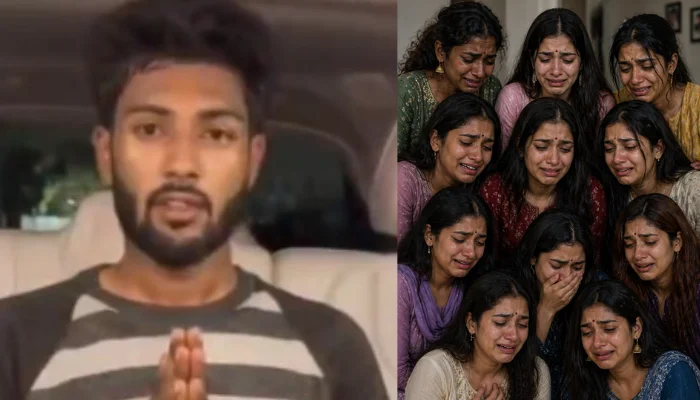
Case Summary
In Maharashtra's Kolhapur, ten Hindu women were religiously profiled, trapped in relationships, and sexually exploited and later blackmailed by a Muslim man named Shahid Sameer Sanadi. This incident came to light when, on 27 April 2026, Kolhapur Police arrested 22-year-old Shahid Sameer Sanadi for sexually exploiting 10 young Hindu women. Shahid made obscene videos of the victims and blackmailed them. He faced arrest following a police complaint by a 20-year-old woman who stated that he committed sexual exploitation and blackmail. Following this, the accused Shahid received a four-day police custody order from a local court. As this incident came to light on social media, a video of Shahid apologising also went viral, where he admitted to sexually exploiting multiple Hindu women and stated he would never touch a Hindu woman again. According to media reports, Shahid first befriended the Hindu victim through social media. He then took her to lodges in Kolhapur and Shiroli, where he raped her several times. The victim stated that Shahid had secretly recorded obscene videos of her and later shared them with his friends. The complainant further stated that Shahid used the videos to threaten and blackmail her. He warned her that if she informed anyone or approached the police, he would make the videos public. The matter came to light after one of Shahid’s close friends learned about the videos and exposed him. Following this, the victim gathered courage and filed a complaint with the police. Hindu organisations, including Shiv Pratishthan Hindustan and Bajrang Dal, submitted a memorandum to the police demanding a detailed investigation and strict action against the accused. Media reports also confirmed that Shahid targeted at least 10 young Hindu women, mostly between the ages of 18 and 22. The police examined digital evidence and tried to ascertain whether more women from Shiroli, Hupari and Hatkanangle faced targeting in a similar manner. The police also appealed to other victims to come forward and register complaints, assuring them that their identities would remain confidential. This case shared striking similarities with the Amravati case that came to light previously, where Mohammad Ayaz, alias Tanveer, along with his Muslim accomplices, sexually exploited 180 minor girls, mostly Hindu, and recorded more than 250 obscene videos. This incident was also reported by the Hinduphobia Tracker.
Why it is Hate Crime ?
The first primary category selected in this case is- Crimes against women in relationships or other sexual crimes. The subcategory selected in this case is- Brainwashed and/or Groomed. The tertiary category selected is- Rape and sexual assault/harassment. In our database, we have not added incidents where women have converted to another religion of their free will and no allegations of forced/involuntary conversion have been made. However, there are certain cases of conversion where the consent itself is a result of the brainwashing or grooming of a minor by the non-Hindu perpetrator trying to victimise a woman for her Hindu religious identity. The phenomenon of grooming points to non-Hindu perpetrators identifying their Hindu victims’ vulnerabilities and exploiting them over months and sometimes years, to extract the supposed ‘consent’ in order to convert their religion. In most cases of grooming, the victims are minors or the grooming started when the victim was a minor. In other cases of grooming, the non-Hindu perpetrator brainwashes and grooms a minor victim to extract their trust and then proceeds to rape them repeatedly with the intent of converting them to their faith. It is pertinent to understand here that when the victim is a minor, the ‘consent’ to convert or enter into a romantic relationship with an adult itself is redundant – addressed by POCSO. While every case of conversion of a minor and incidents of establishing a physical relationship with a minor by an adult is a crime, for the purpose of this database, a case would be considered a hate crime only if there is a distinct religious angle to the grooming. For example, in the UK, if a Hindu minor is targeted by Pakistani grooming gangs, it would be considered a hate crime because the victims are specifically targeted owing to their non-Muslim religious identity with the perpetrators being Muslim. In other cases, if a Hindu minor is brainwashed into entering a physical relationship with the non-Hindu adult perpetrator and the family alleges grooming/brainwashing of the minor to convert her religion, it would form a part of this database. If the victim is a Hindu adult, the case would form a part of this database only if the victim herself says that she was brainwashed/groomed to convert her religion. However, if the victim is deceased (murdered or otherwise), the case would form a part of this database if her family/friends provided testimony that the victim was brainwashed/groomed to convert her religion. Since these crimes have a distinct religious angle where the victim is being targeted owing to her Hindu religious identity, these cases are considered a hate crime. The second primary category selected is- Attack not resulting in death. The subcategory selected is- Attacked for Hindu identity. In several cases, Hindus are attacked merely for their Hindu identity without any perceived provocation. A classic example of this category of religiously motivated hate crime is a murder in 2016. 7 ISIS terrorists were convicted for shooting a school principal in Kanpur because they got ‘triggered’ seeing the Kalava on his wrist and tilak that he had put. In this, the Hindu victim had offered no provocation except for his Hindu religious identity. The motivation for the murder was purely religious, driven by religious supremacy. Such cases where Hindus are targeted merely for their religious identity would be documented as a hate crime under this category. This case stands as a clear example of a religiously motivated hate crime driven by anti-Hindu hatred, religious profiling, and animosity. The Muslim perpetrator, Shahid Sameer Sanadi, deliberately targeted multiple Hindu women for sexual exploitation, blackmail, and threats after trapping them in relationships under the pretext of love. The fact that all 10 victims were exclusively Hindu women, aged 18 to 22, with no non-Hindu or Muslim women involved, demonstrates blatant religious profiling. If the crime stemmed merely from sexual gratification for the Muslim perpetrator, Muslim women would have proven more accessible than Hindu women; yet he selectively targeted only Hindu women, showcasing that he chose them not for any other reason but for their religious identity. He did not select victims randomly but targeted them for their Hindu identity, exploiting it as a vulnerability rooted in communal animosity. This selective predation reflects deep-seated anti-Hindu hatred, where the women's faith marked them for violation, fulfilling key hate crime criteria of bias-motivated targeting against a religious group, in this case, Hindus. The perpetrator's tactic of first luring victims into loving relationships reveals a calculated facade designed for entrapment. Once trapped, he sexually exploited them through rape in lodges, recorded obscene videos, and used these for blackmail, actions far beyond mere personal gratification. This methodical humiliation served to assert religious dominance, degrading Hindu women as symbols of their community to inflict psychological and societal harm. By weaponising intimacy against their faith, he channelled anti-Hindu animosity into sexual violence, profiling them not as individuals but as representatives of Hinduism to be conquered and shamed. Such religiously profiled exploitation embodies a hate crime, where the motive stems from prejudice aiming to subjugate and demoralise an entire religious community. Targeting victims explicitly for their religious identity cements this as religiously motivated sexual violence fuelled by anti-Hindu hatred. Hindu women faced rape and exploitation because the perpetrator viewed them as objects to violate due to their faith, stripping them of humanity in his bias-driven worldview. This animosity manifested in secret recordings shared with friends and threats to publicise videos if they resisted, amplifying humiliation tied to their Hindu identity. Unlike neutral crimes, the religious profiling here, zero targeting of women of his own Muslim community, shows hatred directed outward to attack Hindu dignity, meeting hate crime definitions through intent to harm based on religion. The act of blackmail using obscene videos and photos extended the hate beyond individuals to the broader Hindu community, showcasing the perpetrator's intent to inflict lasting societal humiliation driven by anti-Hindu prejudice. The accused weaponised this material to threaten public exposure, eroding the victims' and their community's moral dignity while asserting dominance. This religiously profiled tactic, again, exclusive to Hindu women, ensured ongoing trauma linked to their faith, turning private violations into communal attacks. Such sustained degradation for religious reasons qualifies unequivocally as a hate crime motivated by animosity. The perpetrator's own viral apology video, where he admitted sexually exploiting multiple Hindu women and vowed never to "touch a Hindu woman again," provides damning evidence of selective religious targeting. This confession underscores that his actions were not random lust but a deliberate campaign rooted in anti-Hindu animosity, aimed at humiliating the Hindu community by violating its women. By framing his crimes around their faith and promising abstinence specifically from Hindus, he revealed profiling as central to his motive, exploiting and blackmailing to degrade Hindu moral standing. This self-incriminating declaration aligns perfectly with hate crime indicators, confirming religious hatred as the driving force. Given that this case satisfied multiple parameters of an anti-Hindu hate crime, it has been added to the hate crime database of the Hinduphobia Tracker. Disclaimer: The Hinduphobia Tracker records incident dates based on when the crime occurs or when the victims’ ordeal begins, rather than when the incident is reported by mainstream media. In this case, media reports have not stated the date when the victims’ ordeal began. They mention only the date on which the accused was arrested, that is, 27 April 2026. Hence, this date has been selected as the indicative incident date for documentation purposes only.
Victim Details
Total Victim
10
Deceased
0
Gender
- Male 0
- Female 10
- Third Gender 0
- Unknown 0
Caste
- SC/ST 0
- OBC 0
- General 0
- Unknown 10
Age Group
- Minor 0
- Adult 10
- Senior Citizen 0
- Unknown 0


Case Status
Arrested


Perpetrators Details
Perpetrators
Muslim Extremists
Perpetrators Range
One Person
Perpetrators Gender
male
 Sources




