Hindu residents induced to convert to Christianity, their sacred deities denigrated by missionaries in Jabalpur, Madhya Pradesh
 Jabalpur, Madhya Pradesh, India
  25 April, 2026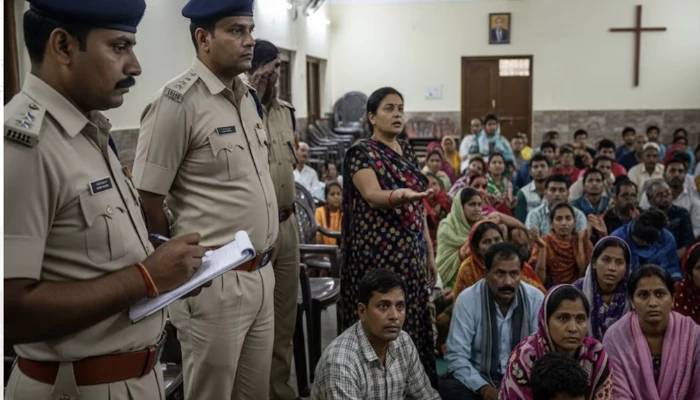
Case Summary
In Madhya Pradesh’s Jabalpur, vulnerable Hindu residents of Durga Nagar were lured to convert to Christianity under the pretext of prayer meetings. The victims were offered inducements to convert and their revered Hindu deities were denigrated by the missionaries. Residents and Hindu organisations stated that the gathering was being used as a cover to induce Hindus into religious conversion through material incentives. As information about the activity spread, tensions escalated in the locality, leading to public protests and site disruptions. The incident occurred on a Sunday morning, 26 April 2026, when a Christian prayer meeting was conducted at a house in Durga Nagar. At the same time, locals in the area became aware of the gathering and informed the Hindu organisation, Bajrang Dal. Upon reaching the location, they found that Christian religious conversion was taking place and that people were being influenced to adopt the Christian faith. This led to a confrontation, and the situation quickly became tense. Members of Vishwa Hindu Parishad and Bajrang Dal reached the house after receiving information and found a Christian man named Saurabh David conducting the prayer meeting, with Deepak Thakur present there. Upon questioning, he stated that he had been brought there through inducements for conversion and was being given false information about Hindu deities. This led to protests by the Hindu activists at the site. Subsequently, members of these organisations also gathered at the police station and carried out slogan‑raising demonstrations. The victim, Deepak Thakur, stated that he was lured to the gathering with incentives and was encouraged to change his religion. He further stated that objectionable remarks were made about Hindu deities during the interaction. Following these statements, the Bajrang Dal activists present at the spot became agitated and began protesting, which intensified the tension in the area. Residents stated that such prayer meetings had been taking place regularly at the same premises. According to them, individuals associated with the Christian faith attended these gatherings and attempted to convert economically vulnerable Hindus by offering clothes, money and other material benefits. It was further stated that several Hindus had begun visiting churches following these interactions. The house in Durga Nagar was described as a centre where such activities were conducted on a daily basis. Police arrived at the scene after receiving information about the disturbance and brought the situation under control. Based on the complaint, a case was registered against Saurabh David and a woman, identified as Chhaya Chaudhary, under the provisions of the Madhya Pradesh Freedom of Religion Act. Vishwa Hindu Parishad representative Sumit Singh stated that individuals, including Rameshwar Patel, Deepak Sonkar, Rakesh Singh and Ramesh Tiwari, were present during the protest.
Why it is Hate Crime ?
The primary category for this case is "Predatory Proselytisation". The sub-category for this case is "Conversion/attempts to convert by inducement". Predatory Proselytisation is not just limited to threat, harassment, force and violence, but it also has contours of stealth. In several cases, the Hindu victim is exploited to convert, with non-Hindus taking advantage of their poverty. In such cases, the Hindu victim who is suffering financially is offered monetary benefits, including lucrative offers for jobs, health treatment, education, etc, to induce the victim into changing his/her religion. In such cases, the religious identity of the victim and the aim to disenfranchise him from his faith form the heart of the crime. Also, taking advantage of and exploiting an individual’s economic vulnerabilities is widely acknowledged as exploitation, forms of which are often penalised by law. Such cases, therefore, are considered religiously motivated hate crimes since the victim’s religious identity forms the very heart of the crime itself. The other subcategory selected is- "Attempting to convert/converting by denigrating Hinduism". In several cases, Hindus are converted, or an attempt is made to convert Hindus by denigrating their faith, Hinduism. In such cases, the Hindus associate with the non-Hindu perpetrators often by choice and then the attempt to convert them by insulting their faith, showing the faith down, etc., begins. An example of this would be a non-Hindu gathering where the Hindus are attending the gathering of their own free will. However, once they attend the gathering, there is an explicit attempt to convert them by abusing their faith and hailing the faith of the perpetrator. The denigration of the Hindu faith is often based on misrepresentation of the Hindu faith, its doctrine and scriptures and insult to espoused traditions, if not blatant lies about Hindu beliefs and ways. Such conversions or attempts at conversions are driven by animosity towards the Hindu faith and are therefore documented as religiously motivated hate crimes. The other sub-category selected for this case is - "Proselytisation by grooming, brainwashing, manipulation or subtle indoctrination". Under this, the tertiary category is- "Victim says was brainwashed/groomed" and "Pattern of targeting Hindus". Religious brainwashing essentially means the often subtle and forcible indoctrination to induce someone to give up their religious beliefs to accept contrasting, regimented ideas. Religious grooming or brainwashing also involves propaganda and manipulation. It involves the systematic effort, driven by religious malice and indoctrination, to persuade “non-believers’ to accept allegiance, command, or doctrine to and of a contrasting faith. Cases of such grooming or brainwashing are far more nuanced than direct threats, coercion, inducement and violence. In such cases, it is often seen that there is repeated, subtle and continual manipulation of the victim to induce disaffection towards their own faith and acceptance of the contrasting faith of the perpetrator. While subtle indoctrination is widely acknowledged as predatory, an element which is often understated in such conversions or the attempts of such conversion is the role of loyalty and trust which might develop between the perpetrator and the victim. Fiduciary relationships are often abused to affect such religious conversion. For example, an educator transmitting religious doctrine of a competing faith to a Hindu student. The Hindu student is likely to accept what the teacher is transmitting owing to the existence of the fiduciary relationship. The exploitation of the fiduciary relationship to religiously indoctrinate victims would also be included in this category. Since the underlying animosity towards the victim’s faith forms the basis of predatory proselytisation, such cases are considered religiously motivated hate crimes. This case is a clear example of a religiously motivated hate crime because the Christian perpetrators attempted to convert Hindus to Christianity by offering them inducements, denigrating their Hindu deities and issuing false information against them, while systematically manipulating a large number of Hindus for conversion over a prolonged period. Regular prayer meetings were used as a platform to proselytise and pressure vulnerable Hindus into abandoning their faith, turning what should have been a spiritual space into a tool of religious coercion. The sustained, organised nature of these gatherings, combined with material incentives and derogatory narratives about Hindu deities, shows that the targeting of Hindus was not random but deliberate and bias‑driven. This pattern of manipulation and denigration aimed directly at Hindu religious identity makes this a clear case of a religiously motivated hate crime. First, it is important to state that luring people under the garb of a prayer meeting itself amounts to religious animosity. In this case, Hindu residents of Durga Nagar were invited to attend Christian prayer meetings, which were presented as spiritual gatherings for worship and reflection. However, the prayer meetings were in fact exploited as a deceptive tool to pull Hindus in under the false promise of religious fellowship. Instead of genuine spiritual engagement, the accused used the meetings to brainwash and indoctrinate these Hindus with Christian theology and to pressure them into converting. Hindu deities were denigrated, and false information was circulated about them, which poisoned the attendees’ perception of their own faith. The deliberate targeting of economically vulnerable Hindus, using prayer meetings as a cover, underlines the religiously motivated nature of this hate crime and exposes the pretence of “religious outreach” behind what is in reality anti‑Hindu proselytisation. The use of inducements to lure Hindus to convert further demonstrates that these actions were not motivated by compassion or altruism but by a calculated strategy to exploit religious vulnerability. The Christian perpetrators offered material benefits to economically vulnerable Hindus, effectively using incentives as a lever to pressure them into changing their faith. This tactic amounts to a religiously motivated hate crime because it singles out Hindus precisely on the basis of their religious and socio‑economic fragility. Targeting those who are desperate for assistance and coercing them to convert to Christianity showcases the religiously motivated nature of the incident. These inducements are not charity; they are instruments of coercion designed to engineer unwilling or half‑informed conversions, and they are part of a wider pattern where Christian missionary groups specifically target socially and economically vulnerable Hindus to further their conversion agenda through offering inducements. This systematic targeting, rooted in religious prejudice, makes the act a religiously motivated hate crime. Denigrating Hindu deities and spreading false information about them is another clear indicator of a religiously motivated hate crime. In this case, Hindu deities were mocked and defamed during the prayer meetings, and false narratives were presented to the Hindu devotees to make them feel that their gods and goddesses were immoral, evil or inferior. This tactic is a classic form of psychological manipulation, designed to erode faith and self‑respect. By presenting Hindu deities as false or bad and Christianity as the only true religion, the missionaries sought to break down the victims’ religious confidence and make conversion appear as the only “correct” choice. Such organised denigration of the Hindu faith is not incidental; it is a deliberate method to manufacture uninformed, non‑consensual and coerced conversions. When Hindu religious identity is systematically degraded to push people into another religion, it becomes a religiously motivated hate crime, as the core aim is the humiliation and erasure of Hinduism as a belief system and as a community. Since such incidents of prayer meetings and enforced conversions were occurring regularly at the same house in Jabalpur, this case showcases that the activity was not an isolated event but part of a regular pattern of forced conversion of Hindus to Christianity. The house in Durga Nagar functioned as a persistent centre for missionary activity, where prayer meetings were held on a daily basis, and vulnerable Hindus were repeatedly targeted. This continuity shows that the Hindu‑to‑Christian conversion drive was premeditated and sustained, with the apparent goal of slowly altering the religious demographics of the locality. Such patterns of organised proselytisation are not random acts of religious outreach; they are structured campaigns rooted in doctrinal hostility towards Hinduism. The idea that the Hindu faith is incomplete or inferior unless replaced by Christianity reflects a deep‑seated religious animosity and a dehumanising view of non‑Christian believers. By treating Hindus as objects to be converted rather than equal religious agents, this proselytisation manifests as a religiously motivated hate crime. Therefore, this case is being added to the hate‑crime database of the Hinduphobia Tracker. Disclaimer: The Hinduphobia Tracker notes that in this case, although multiple victims were targeted, only one victim, Deepak Thakur, was explicitly specified in the report. Therefore, the victim count is recorded as "1". This is a conservative estimate and is recorded for documentation purposes only.
Victim Details
Total Victim
1
Deceased
0
Gender
- Male 1
- Female 0
- Third Gender 0
- Unknown 0
Caste
- SC/ST 0
- OBC 0
- General 1
- Unknown 0
Age Group
- Minor 0
- Adult 1
- Senior Citizen 0
- Unknown 0


Case Status
Complaint registered


Perpetrators Details
Perpetrators
Christian Extremists
Perpetrators Range
From 2 To 5
Perpetrators Gender
both
 Sources




