Hindu individuals targeted with fake miracle healing at illegal Christian prayer meeting in Pune
 Pune, Maharashtra, India
  25 April, 2026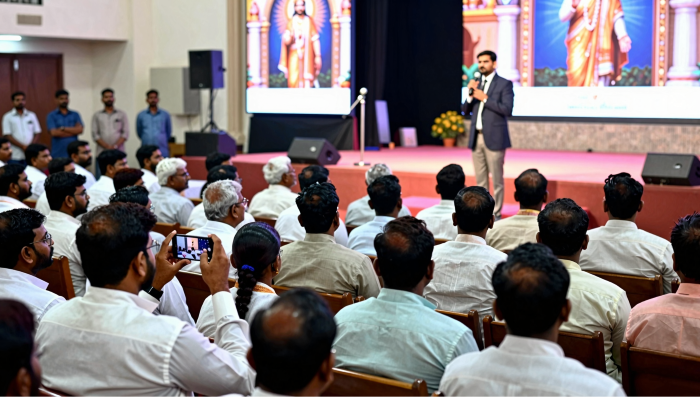
Case Summary
Hindu individuals in Kalewadi, Pune, Maharashtra were being drawn into an illegal prayer gathering at Jesus Is Lord Church through false promises of miraculous healing, where they were being gradually nudged toward conversion to Christianity. When a social worker named Sindhdat Shahuraj Chavan began documenting the proceedings, Pastor Kenneth Silvey ordered the lights switched off and directed a group of men to beat him and throw him out. Chavan and two associates who tried to intervene were assaulted, kicked, abused, and dragged out. A First Information Report [FIR] was registered and Pastor Silvey and five to six unidentified individuals were booked under multiple legal provisions. On 24 April 2026, Chavan, a 35-year-old social worker and member of Andhashraddha Mukti Mission Maharashtra [an organisation dedicated to eradicating superstition and black magic], came across an Instagram reel from an account named kennethsilwayministries claiming that incurable diseases could be healed through prayer and inviting people to a prayer meeting at Kalewadi, Pune on 26 April 2026. Concerned by what he saw, he attended the gathering himself. On 26 April 2026, Chavan reached the venue, identified as Jesus Is Lord Church at Rajwade Nagar in Kalewadi, at approximately 11:30 AM. Between 400 and 500 men and women had gathered inside a hall equipped with chairs, a large screen, and electronic equipment. Pastor Kenneth Silvey addressed the audience. Testimonies followed, with a woman taking the stage to declare that another woman who had been unable to use her left arm for a year and had been advised angiography by doctors had been completely cured after attending a prayer session the previous week. The crowd watched as the woman walked off the stage, reinforcing the narrative of divine healing. Pastor Silvey then called those suffering from illnesses to come closer to the stage. Several people stepped forward. He instructed everyone to place their left hand on the affected part of their body, stating that he was going to lay hands on them and all their diseases would be cured. Chavan, who had seen similar patterns before, began recording the proceedings on his mobile phone. At approximately 2:30 PM, Pastor Silvey noticed Chavan filming. He ordered the lights to be switched off and instructed a group of individuals to beat him and throw him out. Within moments, seven to eight unidentified men surrounded Chavan, assaulted him, kicked him, abused him, and dragged him out of the premises. Even outside, the violence continued. Two of Chavan's acquaintances, Vilas Kharade and Vaibhav Santosh Sawant, who attempted to intervene, were also beaten and abused. Chavan called emergency number 112 and was taken to Kalewadi police station where his statement was formally recorded. Chavan stated after the incident that the pastor had been forcing Hindus to leave their religious practices and slowly become Christians under the guise of medical treatment. He stated that Hindu women who began attending these gatherings progressively stopped wearing bindis [devotional forehead marks], mangalsutra [sacred Hindu marriage necklace], and sindoor [vermillion worn by married Hindu women], discarded their idols of Hindu gods and goddesses, and began worshipping Jesus. He noted that many converts retained their Hindu names, making the religious shift less visible externally. An FIR numbered 179/2026 was registered at Kalewadi police station, Pimpri Chinchwad, against Pastor Kenneth Silvey and five to six unidentified individuals. They were booked under section 3(2) of the Maharashtra Prevention and Eradication of Human Sacrifice and other Inhuman, Evil and Aghori Practices and Black Magic Act 2013, sections 115(2), 189(2), 223, 352, and 49 of the Bharatiya Nyaya Sanhita [BNS] 2023, and sections 135, 37(1), and 37(3) of the Maharashtra Police Act 1951. The FIR confirmed that the gathering was conducted without a licence.
Why it is Hate Crime ?
The primary category for this case is "Predatory Proselytisation". The sub-category for this case is "Conversion/attempts to convert by inducement". Predatory Proselytisation is not just limited to threat, harassment, force and violence, but it also has contours of stealth. In several cases, the Hindu victim is exploited to convert, with non-Hindus taking advantage of their poverty. In such cases, the Hindu victim who is suffering financially is offered monetary benefits, including lucrative offers for jobs, health treatment, education, etc, to induce the victim into changing his/her religion. In such cases, the religious identity of the victim and the aim to disenfranchise him from his faith form the heart of the crime. Also, taking advantage of and exploiting an individual’s economic vulnerabilities is widely acknowledged as exploitation, forms of which are often penalised by law. Such cases therefore are considered religiously motivated hate crimes since the victim’s religious identity forms the very heart of the crime itself. Another sub-category for this case is "Proselytisation by grooming, brainwashing, manipulation and subtle indoctrination". The tertiary category here for this case is "Pattern of targeting Hindus". Religious brainwashing essentially means the often subtle and forcible indoctrination to induce someone to give up their religious beliefs to accept contrasting regimented ideas. Religious grooming or brainwashing also involves propaganda and manipulation. It involves the systematic effort, driven by religious malice and indoctrination, to persuade “non-believers’ to accept allegiance, command, or doctrine to and of a contrasting faith. Cases of such grooming or brainwashing are far more nuanced than direct threats, coercion, inducement and violence. In such cases, it is often seen that there is repeated, subtle and continual manipulation of the victim to induce disaffection towards their own faith and acceptance of the contrasting faith of the perpetrator. While subtle indoctrination is widely acknowledged as predatory, an element which is often understated in such conversions or the attempts of such conversion is the role of loyalty and trust which might develop between the perpetrator and the victim. Fiduciary relationships are often abused to affect such religious conversion. For example, an educator transmitting religious doctrine of a competing faith to a Hindu student. The Hindu student is likely to accept what the teacher is transmitting owing to existence of the fiduciary relationship. The exploitation of the fiduciary relationship to religiously indoctrinate victims would also be included in this category. Since the underlying animosity towards the victim’s faith forms the basis of predatory proselytization, such cases are considered religiously motivated hate crimes. The other category selected is- Attack not resulting in death, and within this, the subcategory selected is- Attacked for opposing radicals or trying to save victim. In several cases, Hindus are attacked for opposing religiously motivated crimes being committed against a fellow Hindu or simply for voicing an opinion opposing radical elements, who either have in the past or continue to persecute Hindus. In such cases, the initial attack against the victim, against which the Hindu was trying to defend the victim, would also need to be classified as a religiously motivated hate crime. Since the initial crime itself was religiously motivated and the subsequent crime of attempting to save the victim or speaking against the radical elements ends up inviting a violent attack, it would also be classified as a religiously motivated hate crime under this category. This case qualifies as a religiously motivated hate crime in which a Christian Pastor conducted an illegal prayer gathering where vulnerable Hindu individuals were drawn in through false promises of miraculous healing and gradually nudged toward conversion to Christianity. When social worker Sindhdat Chavan began documenting the proceedings, Pastor Silvey ordered the lights switched off and directed a group of men to physically assault him and throw him out. The operation was not a genuine act of Christian worship. It was a structured and deliberate campaign of predatory conversion targeting Hindu people through the manufactured authority of false faith healing. The use of false healing claims to draw vulnerable Hindu individuals into a conversion programme is the primary religious marker of this case. The Instagram account kennethsilwayministries explicitly claimed that incurable diseases could be healed through prayer, targeting individuals who were suffering from serious medical conditions and who were in a state of physical and emotional vulnerability as a result. The choice of healing as the conversion inducement was deliberate. In the Hindu tradition, the pursuit of healing and relief from suffering is deeply embedded in devotional practice, with Hindu devotees regularly approaching temples, priests, and sacred sites for divine intervention in matters of health and wellbeing. The perpetrators exploited this deeply rooted Hindu devotional instinct deliberately, using the promise of miraculous healing to draw Hindu individuals into a Christian religious environment under the false impression that they were seeking and receiving divine assistance within a framework compatible with their own faith. The staged testimonies of miraculous healing as a mechanism of psychological manipulation is the second religious marker. At the gathering, a woman took the stage and declared that another woman who had been unable to use her left arm for a year and had been advised angiography by doctors had been completely healed after attending a prayer session the previous week. The theatrical staging of this testimony, with the supposedly healed woman walking off the stage in front of the crowd, was a calculated act of psychological manipulation designed to lower the critical resistance of the 400 to 500 Hindu individuals present and establish Pastor Silvey's authority as a conduit of divine healing power. The perpetrators chose this specific format deliberately because the combination of a credible personal testimony and a live visual demonstration of healing would be most effective in convincing vulnerable Hindu individuals that the Christian prayer framework being offered to them was genuinely capable of delivering what their own devotional practices had not. The gradual erosion of Hindu identity as the documented outcome of the conversion process is the third religious marker. Chavan stated that Hindu women who began attending these gatherings progressively stopped wearing bindis, mangalsutra [the sacred Hindu marriage necklace worn by married Hindu women as a symbol of their marital status and devotional identity], and sindoor. They discarded their idols of Hindu gods and goddesses and began worshipping Jesus. The bindi, mangalsutra, and sindoor are not merely cultural accessories. They are among the most sacred and intimate expressions of Hindu women's religious and marital identity, worn as daily acts of devotion and as public markers of their belonging to the Hindu tradition. The progressive abandonment of these symbols by Hindu women who attended the gatherings confirms that the conversion process was working systematically to strip away the visible markers of Hindu identity and replace them with Christian ones. The perpetrators chose this gradual approach deliberately because the incremental erosion of Hindu identity is less likely to trigger resistance or family alarm than an immediate and explicit conversion demand. The physical assault on Chavan and his associates for documenting the proceedings is the fourth religious marker. When Pastor Silvey noticed Chavan filming, he ordered the lights switched off and directed seven to eight men to beat him, kick him, abuse him, and drag him out. The violence continued outside the premises, where two of Chavan's associates who attempted to intervene were also beaten and abused. The immediate and coordinated deployment of physical violence against a man who was doing nothing more than recording a public gathering reflects an institutional awareness that the proceedings being documented were indefensible and that their exposure would bring the operation to an end. The perpetrators chose violence as their response to documentation deliberately, because the destruction of the evidence and the physical removal of the witness was the most effective means of protecting a conversion operation that could not withstand public scrutiny. Given that this case met the parameters of a religiously motivated hate crime, the conduct of Pastor Kenneth Silvey and his associates reflected more than an unlicensed religious gathering. By using false healing claims to draw vulnerable Hindu individuals into an illegal conversion programme, staging theatrical testimonies to manipulate their religious instincts, systematically eroding the Hindu identity of converts through the progressive abandonment of sacred symbols, and deploying organised physical violence against a social worker who attempted to document the proceedings, their actions demonstrated a clear and deliberate disregard for the Hindu religious identity of every person they targeted. The Hindu individuals drawn to the gathering were targeted specifically because they were Hindu, and every element of the operation was designed to exploit the specific vulnerabilities and devotional instincts of Hindu people in order to draw them away from their faith and into Christianity. This reflects an underlying hostility toward Hindu religious identity since Abrahamic faiths believe that any non-adherent to the faith is a subject to be dehumanised till they convert. Since such predatory actions stem from doctrinal animosity towards the Hindu faith and its adherents, this case is being documented as a religiously motivated hate crime. Disclaimer: The exact number of individuals who physically assaulted Sindhdat Chavan and his associates has not been confirmed beyond a range of seven to eight men as stated in the First Information Report [FIR]. For documentation purposes, the perpetrator count has been recorded as 8. This was recorded for documentation purposes only. Disclaimer: The exact number of victims have not been confirmed beyond a range of 400-500 men as stated in the First Information Report [FIR]. For documentation purposes, the perpetrator count has been recorded as 500. This was recorded for documentation purposes only.
Victim Details
Total Victim
500
Deceased
0
Gender
- Male 0
- Female 0
- Third Gender 0
- Unknown 500
Caste
- SC/ST 0
- OBC 0
- General 0
- Unknown 500
Age Group
- Minor 0
- Adult 0
- Senior Citizen 0
- Unknown 500


Case Status
Complaint registered


Perpetrators Details
Perpetrators
Christian Extremists
Perpetrators Range
From 5 to 10
Perpetrators Gender
unknown
 Sources




