Hindu female students forced to remove their kalavas to write CUET examinations, while Muslim students allowed to wear burqas
 West Delhi, Delhi, India
  26 April, 2026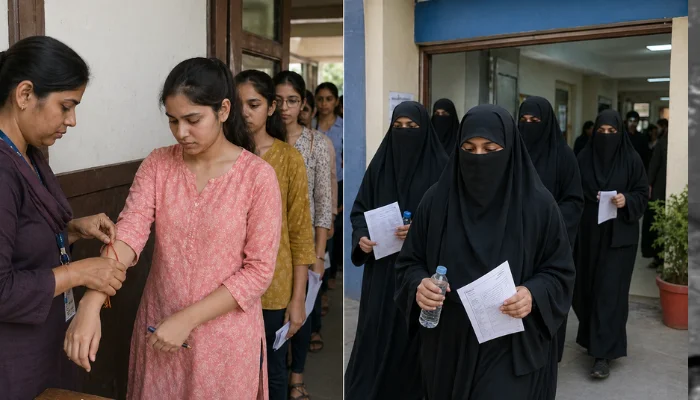
Case Summary
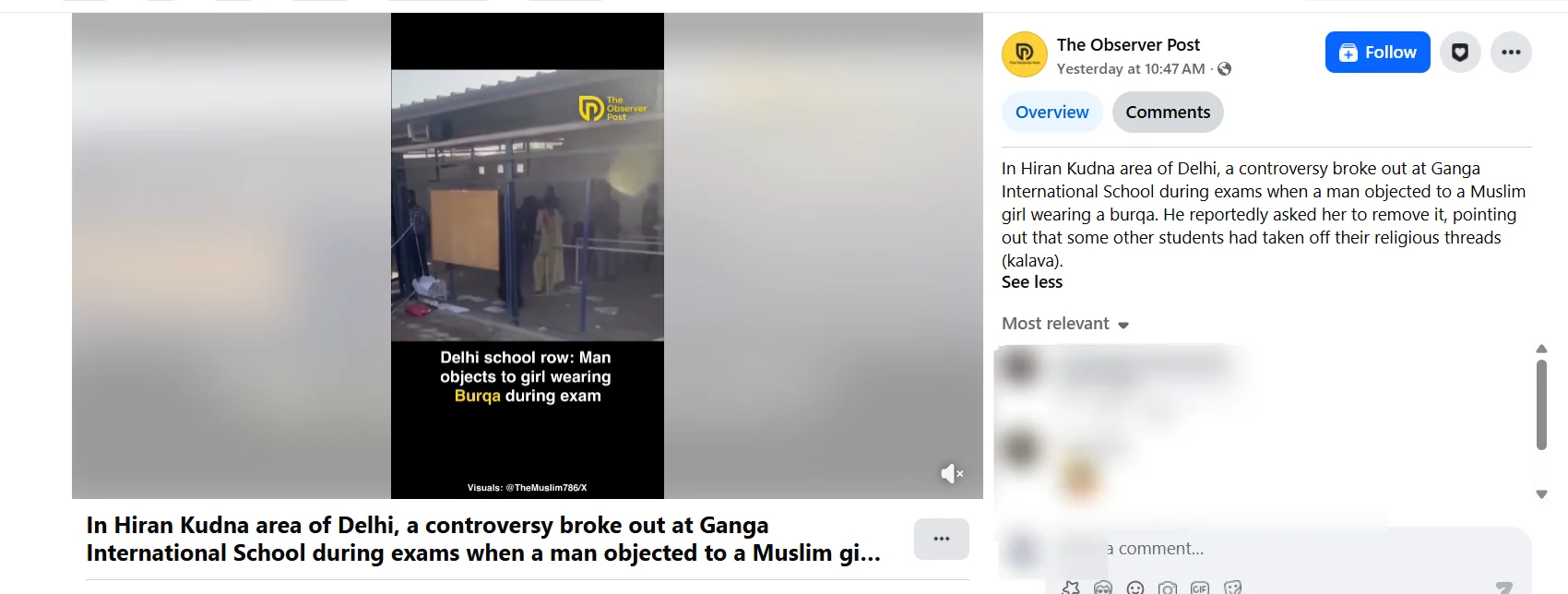
In Ganga International School, located in Hiran Kudna, Delhi, Hindu female students were forced to remove their kalavas (sacred threads) if they wanted to write the Common University Entrance Test (CUET) examinations. However, Muslim female students were allowed to wear burqas to write the same exam. According to reports, this incident came to light when a video of the incident went viral on social media. In the video, recorded by a Hindu man, it was seen that exam authorities were forcibly removing the kalavas of Hindu female students under the pretext of "security checks", while at the same time they were letting Muslim women enter the exam hall and give their exams while they were wearing burqas. The Hindu man who was recording the video confronted the school authorities, saying, “You are allowing Muslim girls to wear burqas and write the exam, but you are forcibly removing and pressuring Hindu girls from wearing kalavas and even earrings.” This further led to a heated exchange between the Hindu man and the school authorities. This incident led to severe religious tensions in the school. The viral video received a large number of views and outraged Hindu users on social media. Hindu users called this an act of religious discrimination against the Hindu faith. They also demanded that common rules be applied to students of all faiths, rather than selectively discriminating against Hinduism. Following this, Ganga International School issued a statement on this incident by claiming, “This information is fake and baseless. No incident like this has occurred in the school premises.”
Case Images
Why it is Hate Crime ?
The first primary category selected in this case is- Restriction/ban on Hindu practices. The subcategory selected is- Restriction on expression of Hindu identity. An example of the state-affected prejudicial and targeted orders against the Hindu community would be a government denying the right of a Hindu or a group of Hindus to hold a religious procession owing to the animosity of non-Hindu groups. Denial of the religious right of the Hindus to assuage the non-Hindu group which harbours animosity to a point where it could lead to violence against Hindus is not only a failure of law and order but is a prejudicial order against Hindus, denying them their fundamental rights to express their religious identity. An example of a hate crime against Hindus by a non-Hindu would be a non-Hindu institution forcing its Hindu employees to abandon religious symbols that a Hindu would wear as an expression of faith owing to inherent prejudice against the faith professed by the victim or a non-Hindu group of people restricting a Hindu group from constructing a place of worship simply because the demography of the area in which the temple is being built is dominated by non-Hindus. Such actions are driven by religious animosity and/or prejudice against Hindus and their faith and would therefore be categorized as a hate crime. The second primary category selected is- Attack on Hindu religious representations. The subcategory selected is- Desecration of Hindu religious symbol. Icons and symbols or a religious representation of a spiritual ideal are widely revered in Hinduism. Iconography is of vital significance in the Hindu milieu. It helps connect people’s spiritual beliefs with the real world. Iconography within the Hindu faith takes several shapes and forms. Murtis are of most significance to Hindus, to which daily rituals, prayers and offerings are done. Besides the murtis, there are several other symbols which have deep significance in the Hindu faith – the Om and Swastika for example. Since these Hindu religious symbols hold paramount importance in Hinduism, any desecration of symbols, icons, murtis, religious representations and manifestations, is driven by animosity towards the faith itself which manifests itself through these murtis, icons and symbols. Therefore, any desecration of these Hindu religious symbols and representations is considered religiously motivated hate crimes under this category. This case qualified as a religiously motivated hate crime because Hindu female students were first pressured to remove their kalavas (sacred threads) and, later, their kalavas were forcibly removed by exam authorities, purely on the basis that they were Hindu girls wearing visible religious symbols. While this was happening, Muslim female students were allowed to wear burqas and sit for the Common University Entrance Test (CUET) examination without any similar restriction. The fact that the Hindu community’s religious symbol was treated as a security risk and forcibly removed, while the Muslim community’s religious dress was not only permitted but accepted, makes this incident a clear example of a religiously motivated hate crime. The Hindu female students were not treated as equal exam‑takers; they were singled out because of their religious identity and subjected to an act that degraded that identity in a public, institutional setting. In this case, the exam authorities imposed a restriction first and foremost on Hindu female students, one that was directly tied to a core Hindu religious practice: wearing the kalava. The authorities enforced this restriction under the threat that the Hindu girls would not be allowed to write the CUET exam if they refused to remove their kalavas. The act targeted the students’ religious identity at a moment of extreme vulnerability, while they were about to enter the examination hall, after years of preparation. The nature of the compulsion, the forcible removal of multiple kalavas, and the public humiliation involved clearly demonstrated that religious hostility and contempt for Hindu identity were central to the harm inflicted. This was not a neutral administrative formality; it was a targeted, discriminatory act that privileged one religion’s visible expression while suppressing another’s in the same secular‑claimed space. The kalava is not merely a piece of thread or an accessory. In the Hindu tradition, it is a sacred, identity‑affirming symbol that carries religious and ritual significance. For all Hindu families, wearing the kalava is an integral part of religious observance, tied to prayers, rituals, and family tradition. By forcing Hindu female students to remove their kalavas under the pretext of “security checks,” the authorities converted a sacred object into something to be discarded, associating it with suspect status, while allowing Muslim women to enter with fully covered burqas without any comparable interference. This is symbolically violent. It communicated not only a rejection of the kalava, but also a message that Hindu religious expression was less acceptable and less worthy of protection than Muslim religious expression in the same institutional setting. The act was not just about a piece of string; it was about marking Hindu faith as inferior and conditional in its right to be visible. For these Hindu female students, wearing the kalava was not an optional stylistic choice but an integral part of their religious identity and observance. The authorities chose to impose a condition that directly interfered with this practice, despite the fact that any genuine security‑based policy should apply equally to all religious symbols. They did this at a critical moment, right before the CUET examination, when the students had no realistic alternative: they could either surrender their religious symbol or be excluded from writing the exam. This revealed that the authorities deliberately targeted a Hindu religious practice while simultaneously exempting a Muslim religious practice, demonstrating an intent to subordinate Hindu religious expression within the exam‑venue structure. The power imbalance was stark: the authorities controlled whether the girls could even enter the hall, and they used that power to punish them indirectly for adhering to their Hindu faith in a visible way. The forcible removal of the kalavas, especially in front of other students and recorded on video, amounts to the symbolic desecration of a Hindu religious symbol. The kalava is treated with reverence by Hindus; cutting or tearing it in a disrespectful, public manner and reducing it to a thing to be discarded is an affront to the deepest sentiments of the Hindu community. When a sacred object tied to faith and identity is treated as disposable while another religious symbol is allowed to remain, it sends a clear message that Hindu religious symbols are less valued and more disposable in that space. The compulsory removal of the kalavas under threat of exclusion from the exam, combined with the video‑evident targeting of Hindu girls only, makes this a clear case of a religiously motivated hate crime. It is a hate crime not only because it targeted Hindu religious identity, but because it did so through the selective, symbolic violation of one community’s sacred religious symbols while leaving another untouched. Forcibly removing the kalavas in a non‑ritualistic, institutionalised setting stripped the girls of their religious dignity and robbed the moment of any sanctity. In a genuinely religious context, even the removal of a kalava would be done with care, respect, and understanding; here, it was treated as something to be discarded. This reduced a sacred object, the kalava, into a disposable item and severed its religious meaning. The authorities enforced this removal in a setting where religious considerations were ignored, compelling the Hindu girls to act against their beliefs and openly demonstrating a disregard for the sacred nature of the Hindu symbol. The coercion did not just cause emotional and spiritual distress to the students; it created a condition in which the Hindu faith was forced to bend before administrative convenience, reinforcing the perception that Hindu religious symbols could be overridden, disrespected, and selectively regulated without meaningful accountability. Here, it is important to mention that in 2022, a massive controversy had erupted in Karnataka, which took a national form, after Muslim women had insisted that they should be allowed to wear Burqas and Hijabs in their schools and classrooms. That time, the argument that was given by several politicians, social commentators, Hindu activists and even the Judiciary was that schools have the right to enforce uniform rules, since wearing uniforms brings harmony and equality in the classroom, and therefore, schools not allowing girls to wear hijab in the classroom is not religious discrimination, but merely an enforcement of widely accepted uniform norms. The pseudo-seculars and leftist groups may argue that a similar line of reasoning should be applied in this case. However, it becomes important to highlight that, firstly, while the Common University Entrance Test (CUET) exam expects simple, non‑deceptive attire to prevent malpractices, it does not require the removal of religious symbols such as the kalava. There is no official CUET directive stating that Hindu girls must remove their kalavas in order to write the examination, whereas security restrictions are typically confined to metal‑based items such as earrings or nose rings, not cloth‑based religious markers. Even from a security standpoint, the wearing of a burqa makes examination‑venue security more problematic than a kalava, as it allows large fabric coverings under which cheat sheets or other written material, as well as other prohibited items, can be hidden. Despite this, exam authorities did not treat the burqa as a security risk, while the kalava, which poses no such practical danger, was targeted under the pretext of “security reasons.” This discrepancy shows that the security argument was a mere justification to single out and suppress a Hindu religious symbol, not a genuine, evenly applied safeguard. Moreover, the kalava, a sacred thread traditionally worn around the wrist in Hindu practice, neither violates CUET dress‑code expectations nor poses any security risk. Examination authorities may regulate outer clothing or accessories that can potentially be used to conceal prohibited materials, but what a student wears as a religious symbol on the body, especially something as minimal as the kalava, should not be subject to arbitrary control. Forcing Hindu female students to remove their kalavas while simultaneously allowing Muslim female students to wear burqas in the same exam setting is not a neutral application of rules; it is a selective, faith‑based restriction. Compelling this removal without any clear, written justification amounts to a clear violation of religious freedom. It sends a deeply exclusionary message, singling out Hindu customs for unnecessary scrutiny, humiliation, and symbolic desecration in a space that is supposed to be secular and equal for all. Overall, since this case meets several parameters of a religiously motivated offence, it is being added to the hate crime database of the Hinduphobia Tracker. Disclaimer: The Hinduphobia Tracker records the dates of incidents based on when the crime occurs rather than when it is reported by the media. In this case, media reports have not stated the exact date on which the crime occurred; they only mention the incident itself. Henceforth, the date when it was first reported in the media, 27 April 2026, has been selected as the indicative incident date. This date is recorded for documentation purposes only. In this case, the total number of Hindu victims and the number of perpetrators have not been clearly specified in the available information. Henceforth, the perpetrator count and victim count for this incident have been marked as "Unknown" in the tracker’s documentation.


Case Status
Unknown


Perpetrators Details
Perpetrators
Unknown
Perpetrators Range
Unknown
Perpetrators Gender
unknown
 Sources




