Revered Hindu God mocked and depicted in a derogatory manner through an online post by ex-Supreme Court Judge
 Delhi, Delhi, India
  24 April, 2026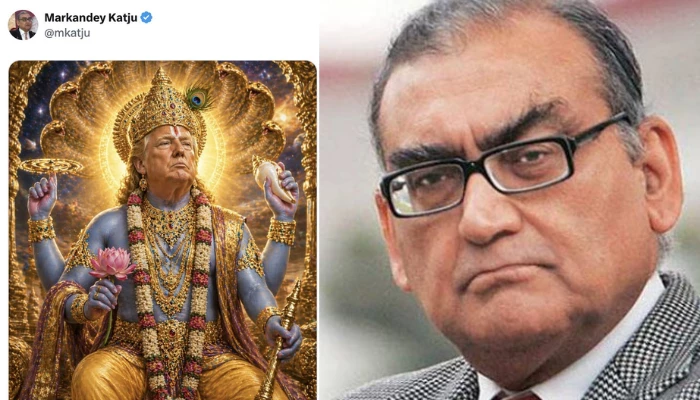
Case Summary
Hindu deity Lord Vishnu was mocked and misrepresented by a former judge of the Supreme Court. On 25 April 2026 at 11:23 PM, Mr Markandey Katju, former Judge of the Supreme Court of India, posted on his verified X account (@mkatju) a digitally altered image depicting the sacred form of Bhagwan Vishnu with the face of Mr Donald Trump superimposed upon it. The image included core divine attributes associated with Bhagwan Vishnu, such as blue skin, Sheshnag, peacock feather crown, Shankha, Chakra, Lotus, and Gada. A screenshot of the said post was preserved and circulated. Following the upload, the post triggered widespread public outrage, with thousands of users across X and other social media platforms condemning the depiction as offensive and derogatory towards Hindu religious beliefs. Despite the backlash, Mr Katju reposted the same image, which further intensified public reaction and criticism. Subsequently, a legal notice was issued by Advocate-on-Record Amita Sachdeva, calling upon Mr Katju to immediately remove the offending content. The notice stated that the act constituted a deliberate insult to the religious sentiments of Hindus and invoked provisions under the Bharatiya Nyaya Sanhita, including Sections 299 and 199, along with other relevant provisions and the Information Technology Act, 2000. The legal notice further referred to the Supreme Court’s order in Ashwini Kumar Upadhyay vs. Union of India, where the Court directed authorities to register suo motu FIRs in cases involving acts that outrage religious feelings. The notice demanded deletion of the posts within 24 hours, issuance of a public unconditional apology on the X platform, and an undertaking to refrain from similar acts in the future. Following the controversy and the notice, Justice Katju apologised and deleted the post.
Why it is Hate Crime ?
This case has been added to the tracker under the primary category - Attack on Hindu religious representations. Within this, the subcategory selected is - Iconoclastic representation of Hindu Gods/Goddesses. An icon is a symbol of someone or something that is revered, or a religious representation of a spiritual ideal. Iconography is of vital significance in the Hindu milieu. It helps connect people’s spiritual beliefs with the real world. Iconography within the Hindu faith takes several shapes and forms. Murtis are of most significance to Hindus, to which daily rituals, prayers and offerings are done. Besides the murtis, there are several other symbols which have deep significance in the Hindu faith – the Om and Swastika, for example. Any iconoclastic representation of these symbols, images and murtis is an affront to the religious beliefs and faith of the Hindu community itself since the symbols and icons are deeply religious in nature. In this sub-category of crime, we would record hate crimes and iconoclastic representations, in words, art, or any other form of representations of symbols that hold religious significance for the Hindu community. Since these symbols, icons and murtis are central to the Hindu faith, any iconoclastic representation of these symbols is born out of animosity towards the faith itself, manifesting itself through these symbols, and therefore, these representations would be considered religiously motivated hate crimes. Another primary category selected in the case is Hate speech against Hindus. Within it, the sub-category selected is - Anti-Hindu slurs, mocking faith. Anti-Hindu slurs and the deliberate mocking of the Hindu faith owing to religious animosity involve the usage of derogatory terms, stereotypes, or offensive references to religious practices, symbols, or figures. One of the common anti-Hindu slurs used against Hindus is “cow-worshipper” and “cow piss drinker”. The intention of using this term is to demean and mock Hindus as a group and their religious beliefs since Hindus consider the cow holy. Additionally, some symbols and the slurs attached to them have a historical context that exacerbates the insult, hate, stereotyping, dehumanisation and oppression against Hindus. Cow worship has been used for centuries to denigrate Hindus, insult their faith and oppress Hindus specifically as a religious group. There has been overwhelming documentation about how cow slaughter has been used to persecute Hindus, with cow meat being thrown in temples and places of worship. There has also been overwhelming documentation where cow meat (beef) has been force-fed to Hindus to either forcefully convert them to Islam or denigrate their faith. Apart from cow worship, the Swastika – which holds deep religious significance for the Hindus – has also been misinterpreted and distorted to use as a slur against Hindus. Similarly, the worship of the Shivling has been used by supremacist ideologies and religions to denigrate Hindus owing to religious animosity. Such slurs and denigration stem from inherent animosity and hate towards Hindus and their faith; therefore, it is categorised as hate speech targeted at Hindus specifically owing to their religious identity. This case was added to the Hinduphobia tracker because the derogatory act by the ex-Supreme Court Judge amounted to a direct affront to Hindu religious beliefs, as it equated a revered deity with a contemporary political figure, reducing a sacred form to a subject of mockery. First and foremost, in Hindu tradition, the form of Bhagwan Vishnu is not ornamental or symbolic alone but carries deep theological and devotional significance rooted in scriptures and lived faith. He is worshipped as the preserver of the universe, and his iconography holds deep spiritual meaning for devotees. By superimposing the face of a contemporary political figure onto a sacred form, the post reduced a revered deity into an object of comparison and ridicule, thereby mocking Hindu beliefs and striking directly at the faith of devotees. Drawing such a comparison stripped the deity of sanctity and trivialised beliefs held sacred by millions, thereby causing deep emotional and spiritual injury. Secondly, the gravity of the offence was further intensified by the stature of the individual involved. A person who held one of the highest positions in the judicial system was expected to uphold constitutional values with sensitivity towards all faiths. When such a figure engages in conduct that mocks a revered deity, it deepens the sense of hurt, as the act carries the weight of authority and signals disregard for someone entrusted with upholding justice and balance. Even though the post was later deleted and an apology was issued, the initial act remained deliberate. The content was consciously created and shared in a public domain, and at no stage was it denied that the post did not originate from the individual’s own account or any hack attempt. This made it clear that the act was intentional at the time it was carried out. In such circumstances, a subsequent apology appeared as a formal response to public backlash rather than a reflection of genuine remorse, especially when weighed against the nature of the original act. Thirdly, the conduct also reflected deliberation rather than inadvertence. The continuation of the act despite visible public outrage demonstrated a conscious disregard for the religious sentiments of Hindus. This persistence reinforced the perception that the act was intended to provoke and offend, rather than being an isolated or unintended expression. Finally, the public dissemination of such content amplified its impact. Circulated on a widely accessible platform, it reached a broad audience and exposed Hindu devotees to material that demeaned their faith in a shared public space. This transformed the act from an individual expression into a collective injury affecting the dignity and religious confidence of the community. Taken together, the deliberate religious mockery underscores the deep-rooted hatred the accused harboured towards Hinduism. Given that the fundamental motivation behind this incident is contempt for the Hindu religion, this instance has been added to the tracker under the following category.


Case Status
Unknown


Perpetrators Details
Perpetrators
Others
Perpetrators Range
One Person
Perpetrators Gender
male
 Sources




