Hindu child beaten with iron rod by Muslim teacher for wearing tilak in Uttar Pradesh
 Bahraich, Uttar Pradesh, India
  26 March, 2026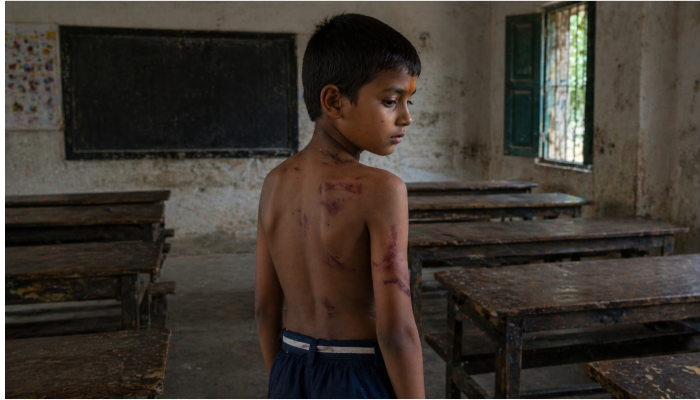
Case Summary
A Hindu Class 5 student named Raman Gupta, son of Sanjay Gupta, a resident of Materiya village, Tejwapur block, Bahraich district, Uttar Pradesh, was beaten with an iron rod by his Muslim teacher Ayesha Khatun, also known as Tabassum, for wearing a tilak, a significant religious marker in Hinduism, to school. The child disclosed to his family that students who came to school wearing chandan [sacred sandalwood paste applied to the forehead as a mark of Hindu devotional identity] or tilak were routinely targeted and singled out by the teacher, who also made insulting remarks against Hindu festivals. A video of the child's injuries went viral. The family filed complaints with senior authorities, and a human rights organisation moved the National Human Rights Commission [NHRC], demanding an immediate probe. Raman Gupta is a Hindu student in Class 5 at Pravik Materiya Primary School in Materiya village. His teacher, Ayesha Khatun, beat him with an iron rod, leaving injury marks across his body. Following the assault, the child was mentally and physically distressed. He disclosed to his family that the teacher specifically targeted students who came to school wearing chandan or tilak, singling them out for punishment and making insulting remarks against Hindu festivals. The family filed written complaints with the Basic Education Officer [BEO] and the District Magistrate [DM] demanding strict action against the teacher. The BEO sent the school principal to the scene for an inquiry and stated that a report would be forwarded to higher authorities and that no one had the right to beat a student. When officials investigated, the school principal claimed that two children had been fighting and that the teacher had intervened, a version of events that the family's and the child's accounts contradicted. The accused teacher, Ayesha Khatun, when approached for comment, stated that the matter had been resolved, a response that raised serious questions about whether she had ever acknowledged the gravity of her actions. Rashtra Jyoti, a Hindu rights organisation, moved the NHRC with material documenting the assault, the child's injuries, and the teacher's pattern of targeting Hindu students wearing chandan and tilak. The complaint sought details of the action taken by the Bahraich police and demanded compensation for the victim. A video of the child's injuries, recorded in March, had gone viral on social media and drew widespread attention to the case.
Why it is Hate Crime ?
The primary category for this case is "Attack not resulting in death". The sub-category for this case is "Attacked for Hindu identity". In several cases, Hindus are attacked merely for their Hindu identity without any perceived provocation. A classic example of this category of religiously motivated hate crime is a murder in 2016. 7 ISIS terrorists were convicted for shooting a school principal in Kanpur because they got ‘triggered’ seeing the Kalava on his wrist and tilak that he had put. In this, the Hindu victim had offered no provocation except for his Hindu religious identity. The motivation for the murder was purely religious, driven by religious supremacy. Such cases where Hindus are targeted merely for their religious identity would be documented as a hate crime under this category. The other selected primary category: Restriction/ban on Hindu practices. Under this, the selected secondary category is: Restriction on expression of Hindu identity. An example of the state-affected prejudicial and targeted orders against the Hindu community would be a government denying the right of a Hindu or a group of Hindus to hold a religious procession owing to the animosity of non-Hindu groups. Denial of the religious right of the Hindus to assuage the non-Hindu group which harbours animosity to a point where it could lead to violence against Hindus is not only a failure of law and order but is a prejudicial order against Hindus, denying them their fundamental rights to express their religious identity. An example of a hate crime against Hindus by a non-Hindu would be a non-Hindu institution forcing its Hindu employees to abandon religious symbols that a Hindu would wear as an expression of faith owing to inherent prejudice against the faith professed by the victim or a non-Hindu group of people restricting a Hindu group from constructing a place of worship simply because the demography of the area in which the temple is being built is dominated by non-Hindus. Such actions are driven by religious animosity and/or prejudice against Hindus and their faith and would therefore be categorized as a hate crime. The last primary category selected here is: Predatory Proselytisation. Under this, the sub-category selected is: Proselytisation by grooming, brainwashing, manipulation or subtle indoctrination, with the tertiary category being: Conversion of minor. This case can be considered a religiously motivated hate crime due to the following factors: Firstly, the trigger for the violence was directly linked to a visible marker of Hindu religious identity. The victim was assaulted for wearing a tilak, a sacred symbol that represents devotion and is an integral part of Hindu religious expression. The punishment was not related to academic conduct or discipline but was instead tied to the child’s display of his faith, placing religion at the centre of the violence. Secondly, the nature of the assault reflects extreme and disproportionate use of force. The child was beaten with an iron rod, resulting in visible injuries and physical trauma. Such a level of violence goes far beyond any acceptable disciplinary measure and indicates targeted aggression rather than corrective intent. The severity of the punishment underscores that the act was not incidental but deliberate. Thirdly, the incident was not isolated but part of a broader pattern of behaviour. The victim disclosed that students wearing chandan or tilak were routinely singled out and targeted by the teacher. This establishes a consistent pattern of discrimination, where Hindu students were specifically identified and treated differently based on their religious markers. The reported remarks against Hindu festivals further reinforce the presence of sustained bias rather than a one-time incident. Fourthly, the element of coercion and vulnerability significantly aggravates the seriousness of the case. The victim is a minor studying in Class 5, placed under the authority of a teacher who is expected to ensure safety and guidance. Instead, this authority was used to inflict harm and suppress religious expression. Children, due to their age and dependence, lack the ability to resist or challenge such treatment, making the abuse of power particularly severe. By forcibly penalising the display of such symbols, the act goes beyond individual misconduct and enters the realm of identity-based targeting. It creates an environment where a child’s religious expression is treated as unacceptable within an institutional space that is otherwise expected to be neutral and protective. Repeatedly singling out children for visible markers like tilak or chandan conditions them to associate their faith with punishment, humiliation, and risk. In the case of minors, this has deeper implications. Children in primary school are still forming their sense of identity and rely heavily on authority figures for validation and guidance. When that authority is used to stigmatise a specific religious identity, it exerts psychological pressure to conform by abandoning or concealing that identity. Over time, such pressure can lead to internalised shame, reluctance to practise one’s faith, and gradual disengagement from cultural and religious practices. This pattern of behaviour, where specific religious markers are targeted, ridiculed, or punished, creates a coercive environment that pushes children away from their inherited beliefs and practices. Even in the absence of explicit instructions to adopt another faith, the sustained discouragement and suppression of one’s own religious identity functions as a form of indirect coercion. It narrows the child’s space to practise their faith freely and normalises the idea that their religious identity is something to be hidden or abandoned. By forcibly removing or punishing these symbols, the teacher not only disrespected the children’s religious identity but also undermined their confidence in expressing it. Such conduct reflects hostility towards the victim’s professed faith and constitutes a serious violation of their rights and dignity. Here, it is important to mention that in 2022, a massive controversy erupted in Karnataka, India, which took a national form, after Muslim women insisted that they should be allowed to wear burqas and hijabs in their schools and classrooms. At that time, the argument given by several politicians, social commentators, Hindu activists, and even the judiciary was that schools have the right to enforce uniform rules, since wearing uniforms brings harmony and equality in the classroom, and therefore, schools not allowing girls to wear hijab in the classroom is not religious discrimination, but merely an enforcement of widely accepted uniform norms. The pseudo-seculars and leftist groups may argue that a similar line of reasoning should be applied in this case. However, it becomes important to mention here that most uniform codes focus on standardising clothing and accessories like shoes, belts, and hair. A tilak does not change the appearance of the uniform itself. This religious symbol is benign and does not cause disruption or harm, raising serious concerns about the motivations behind such enforcement. When an ostensibly secular institution, such as a school, imposes restrictions specifically targeting Hindu religious symbols, it reflects institutional prejudice against Hinduism. This form of targeted suppression echoes broader patterns where Hindu practices are curtailed under the guise of neutrality or discipline, often to appease other religious groups. The actions of the school teacher amounted to religious discrimination and are consistent with the framework of a hate crime, where Hindus are penalised solely for adhering to their Hindu religious practices. Since this case satisfied multiple parameters of a religiously motivated hate crime, including targeted discrimination, psychological harassment, exclusion, and violation of protected religious rights, it has been included in the hate crime database of the Hinduphobia Tracker.
Victim Details
Total Victim
1
Deceased
0
Gender
- Male 1
- Female 0
- Third Gender 0
- Unknown 0
Caste
- SC/ST 0
- OBC 0
- General 0
- Unknown 1
Age Group
- Minor 1
- Adult 0
- Senior Citizen 0
- Unknown 0


Case Status
Complaint not filed


Perpetrators Details
Perpetrators
Muslim Extremists
Perpetrators Range
One Person
Perpetrators Gender
female
 Sources




