Hindu man's wife and in-laws tear down Hindu deity photos and uproot sacred tulsi plant, pressure him to adopt Christianity
 Gumla, Jharkhand, India
  26 April, 2015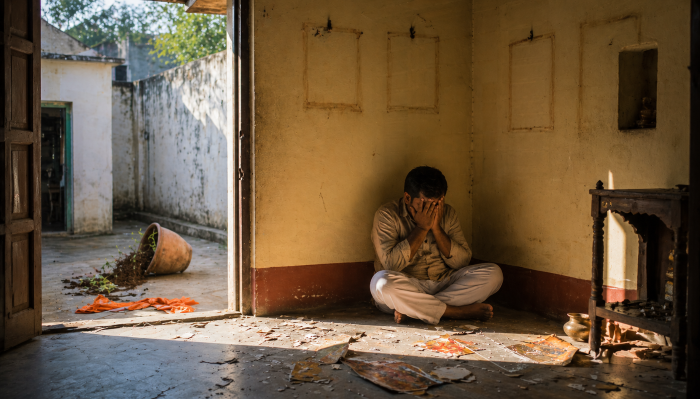
Case Summary
A Hindu man named Shivkumar Sahu from Basia Road, Sisai, Jharkhand filed a written complaint at Sisai police station against his wife and her family. They had subjected him to sustained pressure to convert to Christianity. They offered him a job as an inducement and denied him access to his own children when he refused. On 21 April, his wife entered his home and tore down and destroyed photographs of Hindu gods and goddesses. She uprooted the tulsi [sacred basil plant revered in the Hindu tradition as a manifestation of the divine, kept in Hindu homes as a symbol of protection and piety] plant from the courtyard and removed the Bajrang Bali [Lord Hanuman] flag. Hindu organisations expressed outrage and demanded strict action. Shivkumar Sahu stated that in 2015, Shalivahan Mahato, a resident of Pipra Toli in Khunti district, had his daughter Khushbu Kumari marry Shivkumar through Hindu rituals and a court marriage, concealing the fact that the entire family had already converted to Christianity. Shalivahan Mahato, his wife Anita Devi, Khushbu, and her elder sister Sandhya Kumari had all previously converted to Christianity. Khushbu and Sandhya were active Christian missionaries. After the marriage, Khushbu began pressuring Shivkumar to read the Bible and attend church. It was only at this point that he discovered his wife and her entire family were Christian. His mother-in-law Anita Devi offered him employment as an inducement to convert. When he refused, the family denied him access to his two sons. Khushbu had been taking the couple's two sons to church regularly. On 21 April, Khushbu came to the family home in Basia Road, Sisai, and tore down and destroyed all the photographs of Hindu gods and goddesses in the house. She uprooted the tulsi plant from the courtyard and removed the Bajrang Bali flag. The sustained harassment and religious coercion had begun to affect Shivkumar's mental health. Hindu Jagran Manch state conversion chief Sanjay Verma condemned the incident and described it as part of a broader pattern of conversion activities in the state carried out through fake faith healing, marriage deception, and intimidation. Sisai police station in-charge Neeraj Kumar stated that the matter fell within the jurisdiction of Khunti police station and that an application had been submitted to Sisai police station for information purposes. An inquiry was underway.
Why it is Hate Crime ?
The primary category for this case is "Men attacked for being associated with non-Hindu women". The sub-category for this case is "Forced to convert after marriage". The tertiary category here is "Forced to follow non-Hindu practices". In such cases, a non-Hindu woman marries a Hindu man and the force/pressure against the Hindu man to convert to Islam begins after marriage. In such cases, the marriage is consensual in most cases and often, there is no element of the non-Hindu woman hiding her religious identity. The marriage could be under the Special Marriages Act where neither parties are required to convert their religion for the marriage to be considered legitimate. While the victim in such cases enters matrimony assuming that religious identity is not a barrier, the non-Hindu woman starts to pressure the Hindu man to convert to Islam after marriage. In such cases, there is application of force/pressure by the perpetrator, including, denial of the man’s religious rights. Some of the means by which the man is forced/pressured to convert include forcing/pressurizing the man to involuntarily consume beef, pressurizing/forcing to read the Kalma, forced circumcision, forced to go to the mosque, etc. There are several instances where after marriage, the man voluntarily converts to Islam. Such cases are often argued to be a result of religious brainwashing, however, for the purpose of documenting religiously motivated hate crimes, in the absence of the victim complaining of forced conversion, such cases do not form a part of the database. Another sub-category for this case is "Blackmailed to convert". When Hindu men are in a relationship with non-Hindu women, there are cases where the man is blackmailed to convert his religion. Such relationships may be consensual with the religious identity of the non-Hindu man known to the victim, however, there could be cases where the relationship is not consensual and the non-Hindu woman starts blackmailing a Hindu man to convert his religion. In these cases, it is often seen that the Hindu man is blackmailed with intimate photos and/or videos, threats of harm to his family, threats of violence etc. Such cases are driven by specific religious motivations and against the religious identity of the victim and are therefore qualified as hate crimes. One other sub-category for this case is "Attacked by non-Hindu partner or/and her family" When Hindu men are in a relationship with non-Hindu women, there are cases where the man is forced to convert his religion and upon his refusal to do so, the partner or/and her family attacks the victim. Such relationships may be consensual with the religious identity of the non-Hindu woman known to the victim. Somewhere along the relationship, the non-Hindu woman or her family starts forcing/pressurizing the Hindu man to convert. In some of these cases, the association could be non-consensual as well or, the religious identity of the non-Hindu woman could be previously unknown to the Hindu victim. In such cases, the Hindu man is first forced/pressurized to change his religion by the non-Hindu woman or her family. The force/pressure could involve threats. The trigger for directing violence against the Hindu man is in these cases his refusal to comply and change his religion under threat and/or force. In other cases that have been documented, it is also seen that the Hindu partner is assaulted by the non-Hindu woman or her family simply for his relationship with the non-Hindu woman and by virtue of him following the Hindu faith and not the religion of the non-Hindu woman. In such cases, the relationship is consensual in most cases and the religion of both partners is known to the other. Often, in such cases, there is no direct force/pressure to convert either, however, the attack is a result of the Hindu man being in a relationship with the non-Hindu partner and not following her religion/following Hinduism specifically. Such cases are driven by specific religious motivations and against the religious identity of the victim and are therefore qualified as hate crimes. Another primary category for this case is "Attack on Hindu religious representations". The sub-category here for this case is "Desecration of Hindu religious symbols". Icons and symbols or a religious representation of a spiritual ideal are widely revered in Hinduism. Iconography is of vital significance in the Hindu milieu. It helps connect people’s spiritual beliefs with the real world. Iconography within the Hindu faith takes several shapes and forms. Murtis are of most significance to Hindus, to which daily rituals, prayers and offerings are done. Besides the murtis, there are several other symbols which have deep significance in the Hindu faith – the Om and Swastika for example. Since these Hindu religious symbols hold paramount importance in Hinduism, any desecration of symbols, icons, murtis, religious representations and manifestations, is driven by animosity towards the faith itself which manifests itself through these murtis, icons and symbols. Therefore, any desecration of these Hindu religious symbols and representations is considered religiously motivated hate crimes under this category. This case qualifies as a religiously motivated hate crime in which a Hindu man named Shivkumar Sahu in Sisai, Jharkhand was deceived into marriage with a Christian woman whose family had concealed their Christian identity, subjected to sustained pressure to convert to Christianity, blackmailed through the denial of access to his own children, and subjected to the deliberate physical desecration of the Hindu sacred objects in his home. The crime was structured around the systematic erasure of Shivkumar's Hindu religious identity within his own household, carried out by a family that had entered his life through religious deception and was determined to complete a conversion they had been planning since before the marriage. The concealment of the family's Christian identity to facilitate marriage to a Hindu man is the primary religious marker of this case. Shalivahan Mahato arranged his daughter Khushbu's marriage to Shivkumar through Hindu rituals and a court marriage in 2015, deliberately concealing that he, his wife, his daughter, and her elder sister had already converted to Christianity. The use of Hindu marriage rituals to solemnise a union between a Hindu man and a Christian woman without the Hindu man's knowledge of his wife's faith is a deliberate act of religious fraud. The perpetrators chose Hindu rituals specifically because they knew that Shivkumar would not have agreed to the marriage had he known Khushbu was Christian. The Hindu ritual was the instrument of deception, used to manufacture a union that Shivkumar's informed consent would never have produced. The post-marriage pressure to read the Bible and attend church is the second religious marker. Following the marriage, Khushbu began pressuring Shivkumar to read the Bible [the sacred scripture of Christianity] and attend church [the Christian place of worship]. The Bible and the church are not neutral cultural objects. They are the two most fundamental expressions of Christian religious identity and practice. The demand that Shivkumar engage with them was a demand that he begin the process of replacing his Hindu religious identity with a Christian one. The perpetrators chose these specific demands deliberately because they represent the entry points into Christian religious practice, the first steps through which a person is drawn into the Christian devotional framework and away from their own faith. The use of employment inducement and denial of access to his children as instruments of blackmail is the third religious marker. Anita Devi offered Shivkumar employment as a material inducement to convert. When he refused, the family denied him access to his two sons. The denial of a father's access to his own children is among the most devastating forms of coercion available within a family context. The perpetrators chose this instrument deliberately because they understood that Shivkumar's love for his sons was the most powerful leverage available to them. A Hindu father who is told that he can only see his children if he converts to Christianity is being presented with a choice between his faith and his children, a choice that no parent should ever be forced to make. The employment offer and the child access denial were deployed simultaneously and in combination, ensuring that Shivkumar faced both a material inducement and a devastating emotional threat at the same time. The deliberate desecration of the Hindu sacred objects in Shivkumar's home on 21 April is the fourth religious marker. Khushbu entered the family home and tore down and destroyed every photograph of Hindu gods and goddesses in the house. She uprooted the tulsi plant from the courtyard and removed the Bajrang Bali flag. Each of these acts targeted a specific and deeply significant element of the Hindu domestic sacred space. The photographs of Hindu deities are the visual centre of a Hindu home's devotional life, the objects before which daily puja is performed and through which the divine is invited into the household. The tulsi plant is one of the most sacred objects in the Hindu tradition, revered as a living manifestation of the divine and a symbol of the spiritual protection of the household. The Bajrang Bali flag is a devotional marker of Lord Hanuman's protective presence in the home. Khushbu did not accidentally disturb these objects. She systematically identified every element of the Hindu sacred space within her husband's home and deliberately destroyed each one. The perpetrator chose to destroy these specific objects because she understood their religious significance and chose them precisely because their destruction would cause maximum religious injury to a Hindu man in his own home. The forcing of Shivkumar's children to attend church is the fifth religious marker. Khushbu had been regularly taking the couple's two sons to church. The children of a Hindu man were being introduced to Christian religious practice without their father's consent and against his wishes, as part of a deliberate strategy of converting the next generation even if the father himself could not be fully broken. The perpetrators understood that drawing the children into church attendance would progressively distance them from their Hindu heritage and align them with the Christian religious identity of their mother's family, ensuring that the conversion campaign's reach extended across generations. Given that this case met the parameters of a religiously motivated hate crime, the conduct of Khushbu and her family reflected more than a marital or domestic dispute. By concealing their Christian identity to facilitate marriage to a Hindu man, using that marriage as the platform for a sustained campaign of conversion pressure, blackmailing a Hindu father through his own children, and physically desecrating the Hindu sacred objects in his home, their actions demonstrated a clear and deliberate disregard for Shivkumar's Hindu religious identity and his right to maintain that identity freely within his own household. Shivkumar was targeted specifically because he was Hindu, and every instrument of coercion deployed against him was chosen because it would be most effective in compelling a Hindu man to abandon his faith within the space where that faith should have been most protected, his own home. This reflects an underlying hostility toward Hindu religious identity that cannot be characterised as anything other than religiously motivated. Given that this case met the parameters of a religiously motivated hate crime, it was added to the hate crime database of the tracker. Disclaimer: The Hinduphobia Tracker records incident dates based on when the crime occurred rather than when it was reported or published. This case involves a sustained course of conduct beginning in 2015, when Khushbu's family concealed their Christian identity to facilitate her marriage to Shivkumar through Hindu rituals. The conversion pressure, blackmail, and denial of access to his children continued over the years that followed. The most recent and acute act, the deliberate desecration of the Hindu sacred objects in Shivkumar's home, took place on 21 April 2026. The publication date of 27 April 2015 has been used as the primary incident date for documentation purposes.
Victim Details
Total Victim
1
Deceased
0
Gender
- Male 1
- Female 0
- Third Gender 0
- Unknown 0
Caste
- SC/ST 0
- OBC 0
- General 0
- Unknown 1
Age Group
- Minor 0
- Adult 1
- Senior Citizen 0
- Unknown 0


Case Status
Complaint filed


Perpetrators Details
Perpetrators
Christian Extremists
Perpetrators Range
From 2 To 5
Perpetrators Gender
both
 Sources




