Hindus participating in religious event targeted, stone pelted over volume of loudspeaker by Muslim mob in Jamtara, Jharkhand
 Jamtara, Jharkhand, India
  21 April, 2026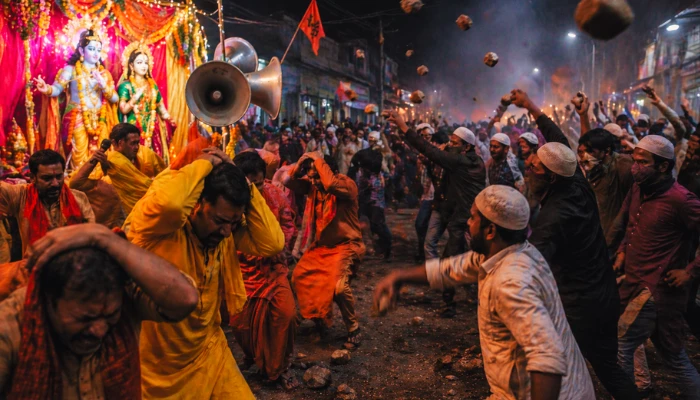
Case Summary
In Manjhladih village, under the Narayanpur police station area, Hindus were attacked and stoned by a Muslim group for playing a bhajan during a three-day Hari Ram Kirtan event on Wednesday night, 22 April, 2026. According to reports, a three-day Hari Ram Kirtan programme was being organised in the village, during which a Muslim group objected to playing Kirtan and disputed the volume, demanding that the sound be lowered. The argument escalated into a confrontation between the two groups, resulting in a tense clash. As the situation worsened, Hindus were pelted with stones and injured. Upon receiving information, police officials, including SDPO Vikas Anand Lagori, Jamtara; Station in-charge Manoj Kumar; and Narayanpur Station in-charge Murad Hasan, reached the spot along with additional police personnel and IRB personnel from the Jhilua camp. The officers intervened and brought the situation under control after speaking to members of both sides. As a precautionary measure, the police took bonds from both parties to prevent further incidents. Following the clash and in view of the prevailing tension, police personnel were deployed in the village on the final day of the Kirtan on 23 April 2026 (Thursday).
Why it is Hate Crime ?
The primary category for this case is "Attack not resulting in death". The sub-category for this case is "Attack against Hindu devotees". Hindu devotees are a few of the easiest targets of religiously motivated hate crimes because, during the festival/procession/puja, etc., for non-Hindus, it is easy to profile their victims based on religion. Hindu devotees come under attack on several occasions by individual non-Hindus or mobs of non-Hindus owing to their animosity against Hinduism, its symbols and tradition/practices. There are several instances of Hindu devotees being attacked while they worship in temples or temporary religious structures, during religious processions, doing bhajan/kirtan/puja in their own homes, in the residential society, etc. These attacks are perpetrated by non-Hindus primarily because of their animosity towards Hindus and their faith. In some cases, the trigger for the violence may be non-religious; however, two elements make these hate crimes. First, the Hindus who come under attack are attacked violently while indulging in religious activity. Whether they are in a place of worship or not is immaterial to the crime. When individuals are attacked while indulging in religious practices, the attack in itself is a hindrance to their freedom to practice religion and therefore constitutes a hate crime. Secondly, religious supremacist doctrines and ideologies deem religious practices of Hindus to be offensive ab initio since they are considered “sinful” by these ideologies, worthy to be annihilated by force or coercion. Driven by these religious supremacist ideologies and doctrines, the attacks against Hindu devotees stem from intrinsic animosity towards Hinduism. In some cases, the trigger for the violence may be non-religious; however, it develops into a religiously motivated crime during the course of the violence. Since these attacks stem from animosity towards Hindus and Hinduism, they are considered religiously motivated hate crimes under this category. The other subcategory selected is- Communal Clash/Attack. Communal clash is a form of collective violence that involves clashes between groups belonging to different religious identities. For a communal clash between Hindus and non-Hindus to qualify as a religiously motivated hate crime, the trigger of the violence itself would have to be anti-Hindu in essence. For example, if there is a Hindu religious procession that comes under attack from a non-Hindu mob and after the initial attack, Hindus retaliate in self-defence, leading to a communal clash between the two religious communities. While at a later stage, both communities are involved in the clash/violence, the initial trigger of the violence was by the non-Hindu mob against the Hindus, and therefore, it could safely be termed as an anti-Hindu violence. Further, the trigger would also have to be religiously motivated. In the cited example, the attack by the non-Hindu mob was against religious processions and therefore can be concluded to be religiously motivated. In some cases, the trigger may be non-religious; however, it develops into religious violence against Hindus at a later stage. In such cases, too, the foundational animosity towards Hindus becomes the motivating factor of the crime, and therefore, it would be classified as a religiously motivated hate crime against Hindus under this category. This incident showed how a simple religious activity became the reason for a hate crime and anti-Hindu conflict. The Kirtan was a routine Hindu devotional gathering, yet it drew objections and resistance. What could have remained a minor issue over sound instead turned into a confrontation because the activity itself was a visible Hindu religious event. Thus, the trigger was not just noise, but the nature of the gathering. Further, the situation escalated quickly and disproportionately. Instead of being resolved through discussion, it turned into a clash involving stone-throwing and injuries. This shift from objection to violence indicated that the aim was not merely to reduce volume but to disrupt and overpower the ongoing religious practice. Therefore, the reaction went beyond a normal civic disagreement. Here, it is important to understand that a Bhajan or Kirtan in Hindu tradition is inherently collective and expressive. It involves singing in praise of the divine, often with instruments, and is meant to create a shared spiritual atmosphere. The sound is an essential part of the practice, not an optional element. Hence, expecting it to be reduced to very low volume would alter its very nature and undermine its religious purpose. Moreover, Bhajans or kirtans are typically held as occasional devotional gatherings at specific times, such as festivals, ceremonies, or community events. They are not continuous or routine throughout the day. In contrast, the Azaan is a regular, scheduled religious practice, traditionally observed five times daily in Islam, and in many places it is broadcast over loudspeakers as part of that practice. “If one form of amplified religious expression is accepted as a legitimate practice in public space, then similar expressions by other communities should also be treated with parity. Therefore, selective objections to bhajans are constraints on the equal right of Hindus to practise and express their religion. Moreover, attacking individuals for performing or playing bhajans is an act of hostility directed at their faith and religious identity. The attack, in this case, was unprovoked as the benign Hindu devotee was merely playing bhajans. However, the Muslim perpetrators, out of their animosity for the Hindu religion, found it disturbing and launched a vicious attack on the victim. Since intrinsic animosity towards Hindus and their religious beliefs became the motivating factor of the crime, this case has been documented as a religiously motivated hate crime in this tracker.


Case Status
Unknown


Perpetrators Details
Perpetrators
Muslim Extremists
Perpetrators Range
Unknown
Perpetrators Gender
unknown
 Sources




