Hindu villagers lured and pressured into Christian conversion through inducement, forced to abandon tilak and rituals
 Khargone, Madhya Pradesh, India
  22 April, 2026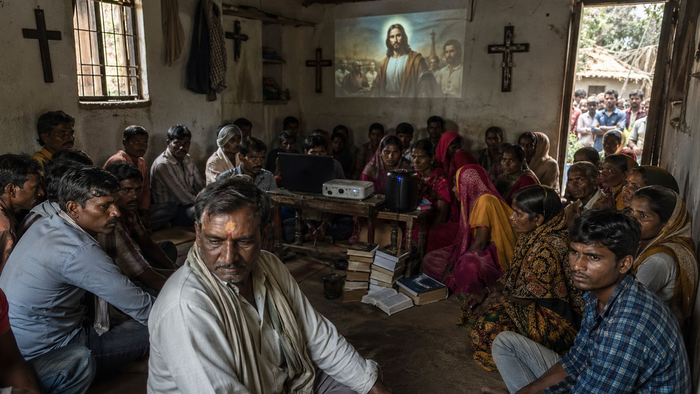
Case Summary
A Hindu victim was taken to a gathering in Khargone, Madhya Pradesh, where he was made to sit through a Christian prayer meeting and pressured to abandon his religious identity. He was handed religious material and told to give up his Hindu practices. What appeared to be a routine gathering concealed a coordinated effort to influence and convert Hindu individuals. The incident unfolded in Bamnala village in Khargone district under the Bhikangaon police station area. On 23rd April 2026, Bablu Dangode, a Hindu man aged 29, arrived at a house on Selda Road around noon. He was seated inside a room where a prayer meeting was already underway. He was handed a Bible and exposed to religious messaging. During this interaction, he was told that he could be healed of his illnesses if he abandoned Hindu practices. He was specifically instructed to remove his tilak and give up traditional rituals. He was also told that he had already been converted. Inside the same location, approximately 20 Hindu villagers were present. Religious content was being displayed through digital means, including a projector and a laptop. The room had been decorated to create an inviting environment. The use of visual media and a group setting was intended to influence those present. The gathering included members from tribal Hindu communities who had been brought to the location. Information about the gathering spread in the area, after which local Hindu residents and organisations reached the spot. A large number of people gathered, and protests began. Police were informed and arrived at the location. Upon entry, they found materials related to religious conversion activities. Police seized 13 Bibles, 8 pieces of missionary literature, a projector, a laptop, a sound system, a microphone, and a register containing committee records. The register was linked to the organisation and coordination of these activities. The use of digital devices indicated organised efforts to conduct and expand the outreach. Four perpetrators were identified and taken into custody. They were identified as Raju Roopsingh Badole, Pankaj Ramesh Baria, Bablu Jamre, and Setu Medha. They were linked to organising and conducting the gathering and influencing Hindu individuals present at the site. A case was registered under the Madhya Pradesh Freedom of Religion Act against the four perpetrators. The individuals were produced before a court and sent to judicial custody. Police began further investigation to identify additional individuals involved and to determine the duration and extent of the network operating behind these Christian-linked conversion activities.
Why it is Hate Crime ?
This case has been added to the tracker under the primary category - Predatory proselytisation. Within this, the subcategory selected is - Conversion/ attempts to convert by inducement. Predatory Proselytisation is not just limited to threat, harassment, force and violence, but it also has contours of stealth. In several cases, the Hindu victim is exploited to convert, with non-Hindus taking advantage of their poverty. In such cases, the Hindu victim who is suffering financially is offered monetary benefits, including lucrative offers for jobs, health treatment, education, etc, to induce the victim into changing his/her religion. In such cases, the religious identity of the victim and the aim to disenfranchise him from his faith form the heart of the crime. Also, taking advantage of and exploiting an individual’s economic vulnerabilities is widely acknowledged as exploitation, forms of which are often penalised by law. Such cases therefore are considered religiously motivated hate crimes since the victim’s religious identity forms the very heart of the crime itself. The other sub-category selected for this case is - Proselytisation by grooming, brainwashing, manipulation or subtle indoctrination. Under this the tertiary category is - Pattern of targeting Hindus. Religious brainwashing essentially means the often subtle and forcible indoctrination to induce someone to give up their religious beliefs to accept contrasting regimented ideas. Religious grooming or brainwashing also involves propaganda and manipulation. It involves the systematic effort, driven by religious malice and indoctrination, to persuade “non-believers’ to accept allegiance, command, or doctrine to and of a contrasting faith. Cases of such grooming or brainwashing are far more nuanced than direct threats, coercion, inducement and violence. In such cases, it is often seen that there is repeated, subtle and continual manipulation of the victim to induce disaffection towards their own faith and acceptance of the contrasting faith of the perpetrator. While subtle indoctrination is widely acknowledged as predatory, an element which is often understated in such conversions or the attempts of such conversion is the role of loyalty and trust which might develop between the perpetrator and the victim. Fiduciary relationships are often abused to affect such religious conversion. For example, an educator transmitting religious doctrine of a competing faith to a Hindu student. The Hindu student is likely to accept what the teacher is transmitting owing to existence of the fiduciary relationship. The exploitation of the fiduciary relationship to religiously indoctrinate victims would also be included in this category. Since the underlying animosity towards the victim’s faith forms the basis of predatory proselytization, such cases are considered religiously motivated hate crimes. The other subcategory selected is- Attempting to convert/converting by denigrating Hinduism. In several cases, Hindus are converted or an attempt is made to convert Hindus by denigrating their faith, Hinduism. In such cases, the Hindus associate with the non-Hindu perpetrators often by choice and then, the attempt to convert them by insulting their faith, showing the faith down etc begins. An example of this would be a non-Hindu gathering where the Hindus are attending the gathering of their own free will. However, once they attend the gathering, there is an explicit attempt to convert them by abusing their faith and hailing the faith of the perpetrator. The denigration of the Hindu faith is often based on misrepresentation of the Hindu faith, its doctrine and scriptures and insult to espoused traditions if not blatant lies about Hindu beliefs and ways. Such conversions or attempts at conversions are driven by animosity towards the Hindu faith and are therefore documented as religiously motivated hate crimes. This case qualified as a religiously motivated hate crime because a Hindu man was deliberately targeted and pressured to abandon his religious identity through organised conversion activity. The perpetrators used inducements, religious messaging, and controlled settings to influence him. The actions were directed specifically at altering his Hindu beliefs and practices. The deliberate focus on his faith showed that religion was the central motivating factor behind the incident. The first religious marker was the use of inducement to attempt conversion. The Hindu victim was told that his illnesses would be cured if he abandoned his religion. This was religiously significant because faith, rituals, and personal suffering are deeply intertwined in Hindu belief systems, and exploiting illness directly targets a vulnerable aspect of a Hindu individual’s life. The perpetrators did not offer neutral help but tied healing explicitly to religious conversion. This showed a deliberate strategy to weaponise the victim’s vulnerability to push him away from Hinduism. This choice revealed a clear intent to manipulate a Hindu man’s circumstances to force a religious shift to Christianity, demonstrating that he was targeted because of his identity as a Hindu. The second religious marker was grooming and psychological manipulation aimed at erasing Hindu identity. The Hindu victim was seated in a controlled environment, handed a Bible, and exposed to continuous religious messaging. He was specifically instructed to remove his tilak and abandon Hindu rituals. The tilak is a visible and sacred marker of Hindu identity, representing devotion and spiritual alignment. Forcing its removal is not a neutral act but a direct attack on the outward expression of Hindu faith. The perpetrators created an immersive environment using digital media and group influence to normalise this shift. By telling him that he had already converted, they attempted to override his agency and redefine his identity without consent. This showed a calculated effort to dismantle his Hindu identity step by step. This choice revealed a deliberate intent to break his connection to Hinduism and replace it with another faith through sustained psychological pressure. The third religious marker was the pattern of targeting multiple Hindus in a coordinated setting. Around 20 Hindu villagers were present in the same room and were exposed to the same religious content and influence. This was religiously significant because it showed that the act was not isolated to one individual but directed at a group sharing the same faith identity. The use of projectors, laptops, and organised gatherings demonstrated planning and scale. The perpetrators created an environment where multiple Hindu individuals could be influenced simultaneously, amplifying the impact. This was not incidental but structured outreach aimed specifically at Hindus. This choice revealed a broader intent to systematically target Hindu individuals as a group, indicating that their religious identity was the basis for selection and influence. This incident was not an isolated occurrence but part of a broader pattern where Hindu individuals were deliberately targeted through organised gatherings, inducements, and psychological manipulation for religious conversion. The targeting was directed specifically at Hindus, as seen in the coordinated effort to gather and influence multiple Hindu villagers in a controlled setting. Such actions reflected a structured attempt to erode Hindu religious identity by pressuring individuals to abandon their beliefs and practices. The methods used, including inducements tied to healing and the removal of visible Hindu symbols like the tilak, demonstrated a clear intent to weaken and replace the victim’s faith. This pattern indicated a deliberate and repeated focus on Hindus as a group, showing that their religious identity was the basis for selection and sustained targeting. Such predatory actions are rooted in hostility toward the victim’s professed faith, where non-adherents are often viewed through a lens of religious otherness and inferiority until they convert. As a result, the conduct is not merely personal but reflects a broader ideological animosity toward Hinduism and its adherents, which is why this case is being classified as a religiously motivated hate crime and added to the hate crime database of the tracker.
Victim Details
Total Victim
21
Deceased
0
Gender
- Male 1
- Female 0
- Third Gender 0
- Unknown 20
Caste
- SC/ST 0
- OBC 0
- General 0
- Unknown 21
Age Group
- Minor 0
- Adult 1
- Senior Citizen 0
- Unknown 20


Case Status
Arrested


Perpetrators Details
Perpetrators
Christian Extremists
Perpetrators Range
From 2 To 5
Perpetrators Gender
male
 Sources




