Hindu women singled out, stalked and terrorised by Muslim man through repeatedly trespassing into homes at night in Dehradun, Uttarakhand
 Dehradun, Uttarakhand, India
  13 March, 2025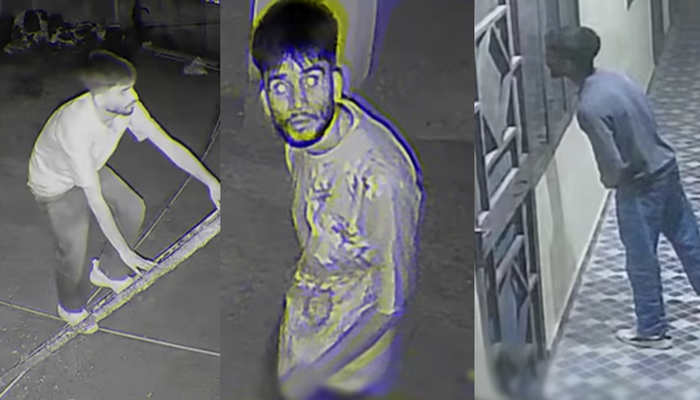
Case Summary
In Dehradun, Uttarakhand, several Hindu women were stalked, harassed and targeted by a Muslim man known as Shoaib Hussain. The accused had been stalking Hindu women for an extended period and repeatedly entering residential premises during late night hours. The case came to light after CCTV footage surfaced showing the accused entering a house of a Hindu women at night, peeping into rooms, and performing obscene acts. The footage captured him climbing structures such as ladders to access higher floors and look into windows from outside. On 18 April 2026, at around 3:00 am, the accused followed a Hindu woman to her residence after she returned from work. He entered the premises and used a ladder to reach an upper level, from where he attempted to look into her room. The woman noticed his presence and raised an alarm, after which he fled. In another incident on 17 April, the accused entered a paying guest accommodation near the Graphi Era University area. He attempted to open a locked door on one floor and then moved to another level, where he reached a Hindu woman’s room and kicked the door twice. The residents alerted each other over the phone upon sensing danger. In a video captured on a CCTV camera on March 14, 2025, Shoaib was seen following a Hindu woman into her house at night. After the woman entered her room, Shoaib tried to peek in through the window, but suddenly ran away upon hearing some movement. In another video of the same house, captured on September 23, 2025, Shaoib was seen entering the house again and trying to peek into the Hindu woman's room. Failing to catch a glimpse of the room through the window, Shoaib lay on the floor and tried to peek through the door mesh. While peeking into the room, her puts his hand inside his pants and performs an obscene act. In another CCTV clip, Shoaib Hussain was seen riding a bike through a lane. He parked the bike on the side and started peeking into the houses nearby. In another CCTV footage of a house, Shoaib was captured entering through the main door at night. He climbed the stairs of the house and went to the first floor. Multiple women from the area reported similar incidents, stating that the accused repeatedly entered residential spaces at night and attempted to peep into rooms. Several CCTV recordings from different locations documented a recurring pattern of such behaviour targeting Hindu women. According to the report, Shoaib Hussain was a resident of the Ranger colony in the Mohobewala area of Dehradun. He and his family caused a regular nuisance to their neighbours. He was detained by the police after the Hindu women submitted a complaint to the local police. However, he was released after his family claimed that he was a lunatic.
Why it is Hate Crime ?
This case has been added to the tracker under the primary category- Attack not resulting in death. Within this, the subcategory selected is- Attacked for Hindu identity. In several cases, Hindus are attacked merely for their Hindu identity without any perceived provocation. A classic example of this category of religiously motivated hate crime is a murder in 2016. 7 ISIS terrorists were convicted for shooting a school principal in Kanpur because they got ‘triggered’ seeing the Kalava on his wrist and the tilak that he had put. In this, the Hindu victim had offered no provocation except for his Hindu religious identity. The motivation for the murder was purely religious, driven by religious supremacy. Such cases where Hindus are targeted merely for their religious identity would be documented as a hate crime under this category. In this case, the pattern here was too deliberate to be dismissed as a coincidence. The Muslim accused consistently targeted only Hindu women, entering their paying guest accommodations and houses under the cover of night. This selective focus was not incidental. It showed careful identification and targeting of Hindu households, indicating that the victims were chosen not merely as individuals but as representatives of a specific religious community. At the outset, the trigger lay in the vulnerability of Hindu women living independently in rented accommodations. However, the conduct went far beyond opportunistic harassment. The repeated stalking, unlawful entry, and obscene acts demonstrated a clear intention to intimidate, degrade, and psychologically unsettle the victims. By intruding into their private spaces at night, the accused sought to create a constant atmosphere of fear, making the women feel unsafe within their own homes. The underlying objective appeared to be to harass them to such an extent that they would be compelled to leave the area, reinforcing a sense that they were defenceless against such targeted aggression. The persistence of these acts across multiple locations further established that this was not an isolated incident but a sustained campaign. Each act of trespass and harassment was a message, carefully delivered to instil fear not only in the immediate victims but also in the wider Hindu community residing in the area. The calculated nature of the behaviour, including the use of ladders to access rooms and repeated attempts to peer into private spaces, reflected premeditation rather than impulsive conduct. This transformed what might otherwise appear to be individual acts of misconduct into a broader pattern of targeted intimidation rooted in identity. It is also important to address the claim made by the accused’s family that he was mentally unstable, which was cited as a reason for the police initially letting him go. This explanation does not align with the observed pattern of behaviour. If the actions were truly driven by mental instability, the targeting would have been random and indiscriminate. Instead, the accused repeatedly focused only on Hindu women. This raises a critical question: if his actions were a result of a disoriented mental state, why was there consistent religious profiling in his choice of victims? Why were Muslim women or other households not similarly targeted? The selective nature of the acts points away from randomness and towards a conscious bias. It is also important to address the frequent tendency to attribute such acts to the mental instability of the accused. In several cases involving crimes against Hindu individuals or institutions, a familiar narrative emerges where the perpetrator is described as “mentally ill” or “unstable,” thereby diverting attention from any underlying religious hostility. Law enforcement agencies and sections of the media have, at times, relied on this explanation to prevent communal tension or to deflect scrutiny from administrative lapses. However, this reasoning raises a fundamental question. If the actions were purely a result of mental instability, the targeting would be random and indiscriminate. In this case, as in many others, the conduct was anything but random. The accused did not target all households or individuals uniformly; instead, he repeatedly focused on Hindu women and their residences. This selective pattern strongly indicated that the acts were guided by a specific bias rather than a disoriented mental state. The recurring use of the “mental illness” explanation in such contexts risks obscuring the real motive and diluting the seriousness of targeted harassment against Hindus. It creates a narrative that normalises or minimises the harm, while the victims continue to bear the psychological burden of fear, invasion of privacy, and social insecurity. Taken together, the repeated targeting, calculated intrusion, and selective victim profiling indicate a deliberate attempt to intimidate Hindu women and create fear within the community. The pattern reflects not just criminal misconduct but sustained, identity-based hostility, placing the incident within the scope of a religiously motivated hate crime. Disclaimer: The Hinduphobia Tracker records the incident date as the date the victim’s ordeal began. In this case, the earliest available video was dated 14 March 2025; therefore, this date has been recorded as the incident date for documentation purposes. Further, media reports stated that Hindu victims were targeted by a Muslim man; however, the total number of victims was not specified. Only five victim accounts were detailed. Accordingly, the victim count has been recorded as five (5). This remains a conservative estimate, as the actual number of perpetrators or victims may be higher.
Victim Details
Total Victim
5
Deceased
0
Gender
- Male 0
- Female 5
- Third Gender 0
- Unknown 0
Caste
- SC/ST 0
- OBC 0
- General 0
- Unknown 5
Age Group
- Minor 0
- Adult 0
- Senior Citizen 0
- Unknown 5


Case Status
Perpatrator released by Police


Perpetrators Details
Perpetrators
Muslim Extremists
Perpetrators Range
One Person
Perpetrators Gender
male
 Sources




