Hindu teenage girl abducted and forcibly converted to Islam in Sindh, given Muslim name and married against her will
 Hyderabad, Sindh, Pakistan
  20 April, 2026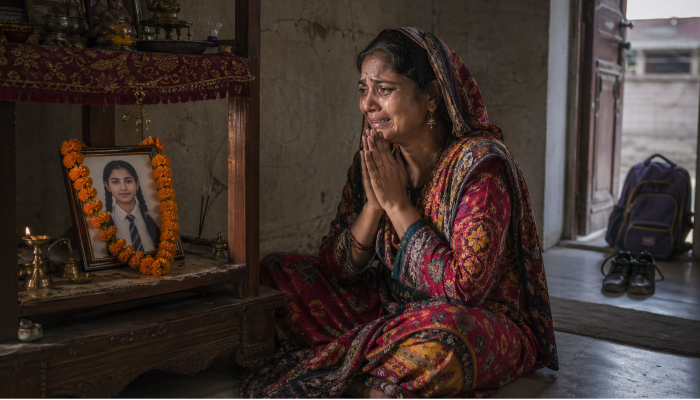
Case Summary
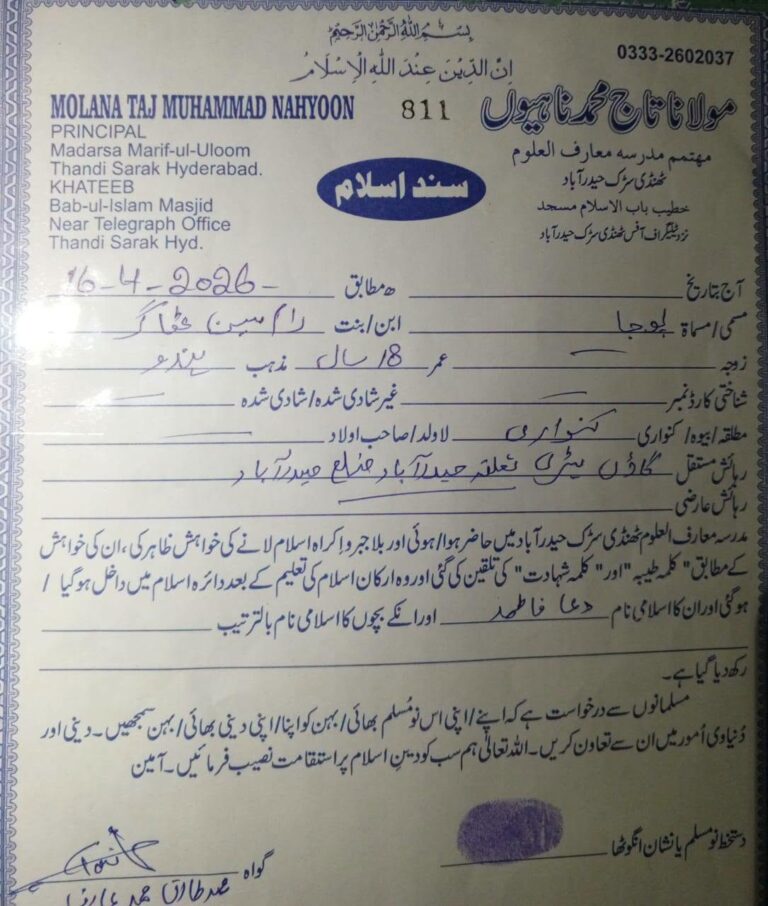
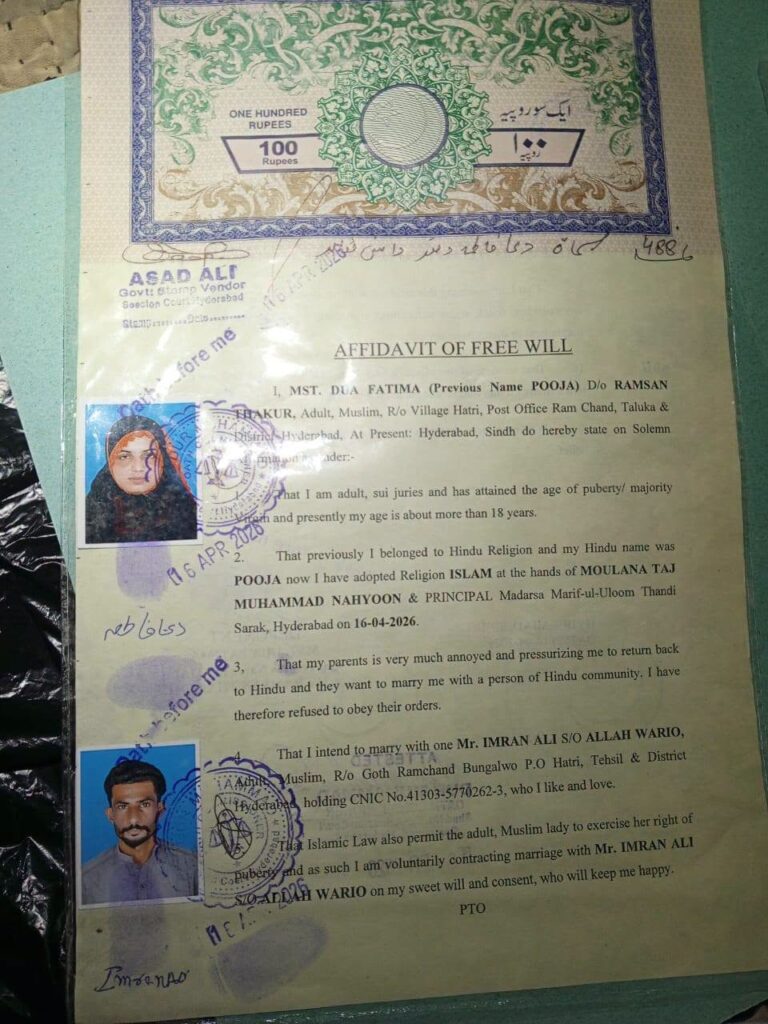
A Hindu ninth-grade student named Pooja, daughter of Ramsun Thakur from Hyderabad, Sindh, Pakistan, was abducted, raped, forcibly converted to Islam, stripped of her Hindu name, and married through nikah [Islamic marriage ceremony] to a Muslim man named Imran Ali against her will. Her Hindu name was replaced with the Muslim name Dua Fatima. The case triggered widespread outrage among minority rights organisations and on social media, with Voice of Pakistan Minority [a Pakistani minority rights organisation] describing the act as inhuman and calling for strict government action. Pooja was a ninth-grade student living with her family in Hyderabad, Sindh. She was abducted from her family. Her family stated that money and jewellery left the home at the time of her disappearance, pointing to possible material inducement or manipulation having preceded the abduction. Following the abduction, Pooja was raped. She was then subjected to forced conversion to Islam and her Hindu name was replaced with the Muslim name Dua Fatima. She was subsequently married through nikah to Imran Ali, son of Allah Wario, without her consent or that of her family. Her parents described the ordeal as a process of manipulation and terror, stating that their daughter had been taken against her will and subjected to threats no child could withstand. They expressed serious fears for her safety and wellbeing and appealed to authorities for immediate intervention and the safe return of their daughter. The family's anguish spread rapidly across social media and among minority rights organisations, intensifying concerns about the safety of Hindu girls in Sindh. Voice of Pakistan Minority condemned the incident in the strongest terms, describing it as an inhuman act that stripped the girl of her identity and forced her into a life she had never chosen. The organisation stated that forced conversions in Pakistan were not isolated incidents but a persistent and worsening problem, particularly in Sindh, where Hindu families lived in constant fear that their daughters would be abducted, brainwashed, and forcibly married in the name of love or religion. The organisation demanded a transparent investigation, strict protective measures for victims, and concrete steps to prevent such incidents from recurring. No official police statement or court ruling had been publicly confirmed as of the source date. Human rights organisations called for stronger enforcement of laws regarding child marriage and forced religious conversion in Sindh. The matter remained unresolved with no formal legal proceedings confirmed as of the source date.
Case Images

Why it is Hate Crime ?
The primary category for this case is "Predatory Proselytisation".The sub-category here is "Harassment, threats, coercion for conversion". Harassment covers a wide range of behaviours of an offensive nature. It is commonly understood as behaviour that demeans, humiliates, and intimidates a person, including threats and coercion. Harassment and threats, in this case, find their root on discriminatory grounds which has the effect of nullifying a person’s rights or infringing upon his freedom to exercise his right specifically owing to the victim’s religious identity. Verbal and physical threats and psychological or physical harassment are often used against Hindu victims because they choose to practice their professed religion. Religious harassment also includes forced and involuntary conversions by harassment, threats or coercion. Coercion includes intimidatory tactics like force-feeding a Hindu victim beef to convert to another religion, forceful circumcision etc. In several cases documented, non-Hindu perpetrators or those who harbour specific animosity towards Hinduism, harass victims simply based on their religious identity. Such cases often also include harassment to ensure the Hindu victim abandons his/her professed religion and adopts the religion of the perpetrator. Such cases where Hindu victims are harassed to convert to the perpetrator’s religion are rooted in animosity towards the victim’s religious identity and are therefore documented as religiously motivated hate crimes. Another primary category for this case is "Crimes against women in relationship and other sexual crimes". The sub-category here is "Forced conversion before marriage". The tertiary category here is "Forced to do Nikah". In such cases, a non-Hindu man is in a relationship with a Hindu woman when the pressure to convert her religion begins to manifest. In such cases, typically, two patterns emerge. First, when the relationship is consensual, and the religious identity of the perpetrator is known to the Hindu woman in the relationship, however, at some point during the relationship, the non-Hindu man starts to force the victim to convert her religion and give up her Hindu religious identity. The second is when the woman gets into a marriage with the man pretending to share her faith. Later, when the truth is revealed, the man starts pressuring the woman to convert her religion and give up her religious identity. In both the situations, the methods used to force the victim to convert her religion often revolve around force-feeding beef, forcing her to wear hijab, forcing her to read the Kalma or even pressurizing the victim to do ‘Nikah’, which is marriage under Islamic law, with a prerequisite being conversion to Islam. Cases where a Hindu woman consensually converts to Islam in a relationship will be left out of the hate crime database, even though it could be argued in several cases that the conversion was a result of religious brainwashing. This case qualifies as a religiously motivated hate crime in which a Hindu ninth-grade student named Pooja from Hyderabad, Sindh, Pakistan was abducted, raped, forcibly converted to Islam, stripped of her Hindu name, and married through nikah to a Muslim man without her consent. The crime was directed specifically at a Hindu minor girl and was structured around the deliberate erasure of her Hindu religious identity and its forcible replacement with an Islamic one through abduction, sexual violence, coercion, and forced religious transformation. The deliberate targeting of a Hindu minor girl for abduction is the primary religious marker of this case. Pooja was a ninth-grade student, a minor whose age placed her entirely outside the bounds of any legally or morally valid consent to marriage or religious conversion. The perpetrator chose a Hindu minor girl as his target deliberately. In Sindh's minority Hindu community, a Hindu girl occupies a position of extreme vulnerability, lacking the institutional protection, legal access, and social power available to members of the majority community. The perpetrator exploited this vulnerability deliberately, selecting a Hindu girl whose minority status, age, and social marginalisation made her the least able to resist or seek recourse. He chose her specifically because she was Hindu, and because her Hindu identity in a Muslim-majority province made her the most accessible and least protected target available to him. The rape of the victim following her abduction is the second religious marker. Following her abduction, Pooja was raped before being subjected to forced conversion and forced nikah. The sexual violence was not incidental to the crime. It was deployed as an instrument of total domination over a Hindu girl who had been removed from her family and placed entirely within the perpetrator's control. The rape was designed to break her resistance completely before the conversion and nikah were imposed, ensuring that she had no remaining capacity to refuse the religious transformation that followed. The perpetrator chose to use sexual violence specifically because it is the most devastating instrument of physical and psychological domination available, and because its use against a Hindu minor girl in a position of complete isolation would most effectively eliminate any remaining resistance to his religious objectives. The use of threats and coercion to compel the forced conversion is the third religious marker. The family confirmed that Pooja was subjected to threats as part of the process through which she was forced to convert to Islam. The coercion was applied to a minor girl who had already been abducted and raped, leaving her in a state of total physical and psychological vulnerability. The perpetrator chose to combine physical violence with explicit threats because he understood that a Hindu minor girl in this condition had no means of resistance remaining and that the threatened consequences of refusal would be more than sufficient to compel her compliance. The coercion was the instrument through which the perpetrator converted his physical dominance over the victim into a formal religious transformation. The forced conversion to Islam and the erasure of the victim's Hindu name is the fourth religious marker. Following the rape and coercion, Pooja was subjected to a forced conversion to Islam. Her Hindu name, the most immediate and intimate marker of her Hindu religious identity, was replaced with the Muslim name Dua Fatima. The deliberate replacement of a Hindu name with a Muslim one is not a bureaucratic formality. It is an act of religious identity erasure, designed to extinguish the victim's Hindu identity at its most personal level and replace it with an Islamic one. The perpetrator chose to impose a new name specifically because the name is the most visible and immediate expression of a person's religious and community identity, and its replacement was the clearest possible declaration that the victim's Hindu identity had been annihilated and replaced by an Islamic one imposed without her consent. The forced nikah as the culmination of the religious transformation is the fifth religious marker. The nikah conducted following the forced conversion formalised Pooja's absorption into an Islamic household and simultaneously imposed on her the legal and social status of a Muslim wife, replacing her Hindu identity with an Islamic religious and marital identity without her consent or that of her family. The forced nikah was the culmination of a process that began with abduction and proceeded through rape, coercion, and forced conversion, with each step designed to progressively eliminate the victim's Hindu identity and consolidate the perpetrator's claim over her person. The perpetrator chose to conduct the nikah immediately following the conversion because formalising the marriage through an Islamic ceremony was the most effective way of making the religious transformation legally and socially irreversible. Given that this case met the parameters of a religiously motivated hate crime, the conduct of the perpetrator reflected more than a personal criminal act. By abducting a Hindu minor girl, raping her to break her resistance, subjecting her to coercion and threats to compel her conversion, erasing her Hindu name, and marrying her through an Islamic ceremony without her consent or that of her family, his actions demonstrated a clear and deliberate disregard for her Hindu religious identity and her right to maintain that identity freely. Pooja was targeted specifically because she was Hindu, and every act committed against her was designed to erase that identity and replace it with an Islamic one imposed through violence, coercion, and religious fraud. This reflects an underlying hostility toward Hindu religious identity that cannot be characterised as anything other than religiously motivated. Given that this case met the parameters of a religiously motivated hate crime, it was added to the hate crime database of the tracker. Disclaimer: The Hinduphobia Tracker records incident dates based on when the crime occurred rather than when it was reported or published. The source does not specify the exact date on which the abduction took place. The publication date of 21 April 2026 has been used as the indicative incident date for documentation purposes. This was recorded for documentation purposes only.
Victim Details
Total Victim
1
Deceased
0
Gender
- Male 0
- Female 1
- Third Gender 0
- Unknown 0
Caste
- SC/ST 0
- OBC 0
- General 0
- Unknown 1
Age Group
- Minor 1
- Adult 0
- Senior Citizen 0
- Unknown 0


Case Status
Complaint filed


Perpetrators Details
Perpetrators
Muslim Extremists
Perpetrators Range
One Person
Perpetrators Gender
male
 Sources




