Hindu man and his daughter brutally attacked while participating in rally amid election campaign in West Bengal, accused raise “Mini Pakistan Zindabad”, “Nare Takbir” slogans
 Kolkata, West Bengal, India
  20 April, 2026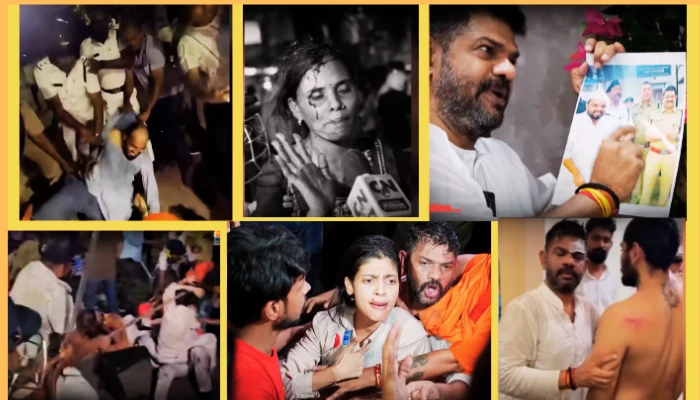
Case Summary
In Kolkata, West Bengal, Hindu political candidate Rakesh Singh (of the Bharatiya Janata Party), his daughter and members of the Hindu community were brutally attacked during an election rally. The incident occurred when Rakesh Singh organised a meeting on Hassan Shah Road after obtaining the necessary permission from the Election Commission. The gathering was intended as part of his campaign outreach during the ongoing elections in the state. During the course of the meeting, a group of Muslim men assembled at the location and began raising provocative slogans, including “Mini Pakistan Zindabad”, “Nare Takbir”, and calling out “hijra Rakesh Singh ko bulao” (Call that eunuch Rakesh Singh here). The situation escalated rapidly as hostility turned into physical aggression directed at Rakesh Singh, his supporters, and accompanying Hindu members present at the site. Rakesh Singh stated that he contacted IPS officer Hare Krishna Pai and the District Collector (Division 2), who were located approximately 1 kilometre away, to seek immediate police intervention. However, no timely assistance reached the spot. As the situation deteriorated, Rakesh Singh and other Hindu members proceeded towards the Iqbalpur police station for safety. He stated that individuals identified as TMC supporters were already present in the area, and as per his complaint, the police personnel acted under instructions of the IPS officer in coordination with the Muslim men Shehbaz and Amanullah. The mob carried out physical assaults on those present, including a violent attack on Rakesh Singh’s daughter. Despite the presence of law enforcement, no effective intervention was made to protect the victims, and no women police personnel came forward to assist the female victims during the assault. Several individuals sustained injuries in the incident, and around 22 men and women were admitted to the hospital for treatment. Following the incident, instead of initiating action against the identified attackers, the police registered an FIR against Rakesh Singh and his associates. Additionally, a photograph surfaced showing one of the rioters in proximity to an IPS officer, raising concerns about the conduct and neutrality of the police during the incident. The events unfolded against a broader and deeply troubling pattern of post-poll violence in West Bengal following the 2021 Assembly elections, where a series of targeted attacks were made against BJP workers and supporters, most of whom were Hindus. The period between May and July 2021 witnessed widespread incidents of killings, assaults, arson, sexual violence, and forced displacement, creating an atmosphere of fear and retribution in several parts of the state. These incidents were not isolated but reflected a continuing cycle of politically driven aggression, often intersecting with communal fault lines. Within this pattern, cadres and supporters linked to the All India Trinamool Congress were repeatedly accused of orchestrating violence aimed at silencing political opposition and consolidating local dominance. The targeting frequently extended beyond political rivalry, with Hindu individuals and families bearing the brunt of intimidation, suggesting an undercurrent where political hostility overlapped with religious identity. Numerous instances illustrate the severity of this violence. BJP worker Avijit Sarkar was lynched in Kolkata shortly after documenting vandalism at his residence. Homes of party workers, such as Bishwanath Dhar, were looted and destroyed, while others were brutally assaulted within their own houses. In several cases, victims were attacked with crude bombs, beaten to death, or found under suspicious circumstances, as seen in the deaths of individuals like Joy Prakash Yadav and Anil Barman. Women were not spared, with reports of molestation, threats of rape, and in one case, Chandana Haldar being beaten to death. There were also incidents of extreme coercion and fear, including forced religious conversions, missing persons, and families fleeing their homes to escape violence. Even security personnel and their families were targeted, and complaints emerged of police inaction or complicity, further eroding confidence in institutional protection. These incidents showed a repeated pattern where supporters linked to the All India Trinamool Congress engaged in sustained violence against BJP workers, creating an atmosphere of fear, coercion, and targeted hostility.
Why it is Hate Crime ?
This case is being added to the tracker under the primary category, Hate Speech against Hindus. Within this, the subcategory selected is- Violent threats. Violent threats, explicit, implicit or implied, is the most dangerous form of hate speech since it goes beyond discriminatory and prejudicial language to express the intent of causing harm to an individual or a group of people based on their religious identity and faith. There could be several different kinds of threats that are issued to Hindus based on religious animosity. An explicit threat would mean the direct threat of violence towards an individual Hindu, a group of Hindus or Hindus at large. Physical violence, death threats, threats of destruction of property belonging to Hindus and threats of genocide would mean explicit threats against Hindus for their religious identity. Implicit threats may not be a direct threat but implied through the use of symbols of actions – for example – in the Nupur Sharma case, other than explicit threats, there were also implicit threats when Islamists took to the streets to burn and beat her effigies. It implies that they want to do the same to Nupur Sharma – thereby is considered an implicit threat. Violent threats can be delivered in person, through letters, phone calls, graffiti, or increasingly through social media and other online platforms. It would be important to understand that a threat – explicit or implicit, online or offline – to an individual who happens to be a Hindu does not qualify as a religiously motivated threat. Such a threat, while vile and dangerous, could be owing to non-religious reasons and/or personal animosity. To qualify as a religiously motivated threat, it would need to exhibit an indication that the individual is being targeted for religious reasons and/or owing to his/her religious identity as a Hindu. The other category selected here is- "Attack not resulting in death". The subcategory selected is- Attacked for supporting/being part of a perceived Hindu party/org or working for the Hindu community. In several cases, Hindus are attacked specifically or tangentially for their association with parties or organisations perceived to be pro-Hindu and/or for working in favour of the Hindu community. One of the classic cases was the attack against a Bharatiya Janata Party Yuva Morcha (BJYM) worker, Praveen Nettaru. Nettaru was attacked and hacked to death for his association with Hindu organisations and his work for the Hindu community. He was murdered by PFI, a terror organisation that aimed to commit a genocide of Hindus, target Hindu leaders specifically and turn India into an Islamic Nation. In such cases, the immediate trigger for the violence may be non-religious, either according to the perpetrator or the police. However, there are surrounding circumstances from which the conclusion can be reached that the victim was attacked for his association with a Hindu organisation. In a similar case, Rinku Sharma was attacked by radicals. He was a member of Bajrang Dal and regularly worked for the Hindu community. While the police cited a different non-religious trigger for the attack, he was indeed associated with a Hindu organisation, and the family of Rinku Sharma specifically attributed his gruesome murder to his working for Bajrang Dal and raising Jai Shree Ram slogans. Such cases are intrinsically driven by religious hate and would therefore be documented as a hate crime under this category. The second sub-category is " Attacked for opposing radicals or trying to save a victim". In several cases, Hindus are attacked for opposing religiously motivated crimes being committed against a fellow Hindu or simply for voicing an opinion opposing radical elements, who either have in the past or continue to persecute Hindus. In such cases, the initial attack against the victim, against which the Hindu was trying to defend the victim, would also need to be classified as a religiously motivated hate crime. Since the initial crime itself was religiously motivated and the subsequent crime of attempting to save the victim or speaking against the radical elements ends up inviting a violent attack, it would also be classified as a religiously motivated hate crime under this category. This case can be considered a religiously motivated hate crime due to the presence of explicit religious markers that preceded and accompanied the violence. The most immediate indicator is the use of slogans such as “Mini Pakistan Zindabad” and “Nare Takbir” during the gathering of the mob. These are not neutral political expressions but carry clear religious connotations. Such slogans invoke a sense of religious identity that extends beyond local or civic affiliation and instead emphasises collective solidarity rooted in faith. Their use in this context signals that the mobilisation was not merely political but was framed through a religious lens, in which identity played a central role. It may be said that the slogan of Pakistan Zindabad can be considered anti-India and pro-Pakistan, but not anti-Hindu. However, raising slogans such as Pakistan Zindabad does not only show pro-Pakistan sentiments, but also anti-Hindu sentiments. It is pertinent to note that Muslim extremists harbour specific animosity towards Hindus and their faith and also view India as a Hindu collectivity. The very basis of the partition of India was that the Muslims believed that Islam was a nation unto itself, which could not survive with a Hindu collectivity like India. Further, this would also mean that the slogan Pakistan Zindabad is about hailing a Muslim collectivity and an expression of transnational loyalty and anti-Hindu sentiments. For that reason, any slogan which expresses transnational loyalty, faith in the Ummah, is automatically a slogan against Hindus and the Hindu collectivity. This becomes even more significant when viewed in light of the nature of the target. The individuals attacked were not random participants but included a political candidate associated with the Bharatiya Janata Party and members of the Hindu community present at the rally. Given that the BJP is widely perceived in public discourse as a party associated with Hindu identity and Hindutva politics, the convergence of religious slogans with violence against its supporters indicates that the attack cannot be understood as purely political rivalry. The religious signalling suggests that the victims were targeted not only for their political affiliation but also for their perceived religious identity. The sequence of events further reinforces this interpretation. The escalation from slogan shouting to physical assault, including attacks on women present at the site, demonstrates that the hostility was not limited to verbal expression but translated into targeted violence. The absence of timely intervention and the subsequent filing of an FIR against the victims raise additional concerns about how such incidents are handled, particularly when identity-based targeting is involved. This incident also reflects a broader pattern of post-election violence in West Bengal, where supporters of political opposition parties have faced sustained attacks. In several documented instances following the 2021 Assembly elections, individuals associated with the BJP, many of whom were Hindus, were subjected to violence, intimidation, and displacement. While these incidents are often framed as political clashes, the overlap between political identity and religious identity in these cases suggests that the targeting cannot always be neatly separated along purely political lines. In this context, the present case fits into a pattern where religious identity, political affiliation, and local power dynamics intersect. The use of explicitly religious slogans, the targeting of individuals associated with a party identified with Hindu interests, and the subsequent violence together indicate that religion was not incidental but a contributing factor in the attack. Taken together, these elements establish that the incident involved identity-based targeting where religious markers played a significant role in mobilisation and execution. It is therefore documented as a religiously motivated hate crime in the tracker. Disclaimer: Media reports stated that the Hindu victims were targeted by a mob, and complaints were made against four perpetrators; however, the total number of perpetrators was not specified. Therefore, the perpetrator count was recorded as four (4). This is a conservative estimate, as the total number of perpetrators could be higher.
Victim Details
Total Victim
22
Deceased
0
Gender
- Male 0
- Female 0
- Third Gender 0
- Unknown 22
Caste
- SC/ST 0
- OBC 0
- General 0
- Unknown 22
Age Group
- Minor 0
- Adult 0
- Senior Citizen 0
- Unknown 22


Case Status
Complaint filed


Perpetrators Details
Perpetrators
State and Establishment
Perpetrators Range
From 2 To 5
Perpetrators Gender
male
 Sources




