Hindu devotees find temple idols altered with Islamic symbols, religious desecration triggers protest
 Nashik, Maharashtra, India
  19 April, 2026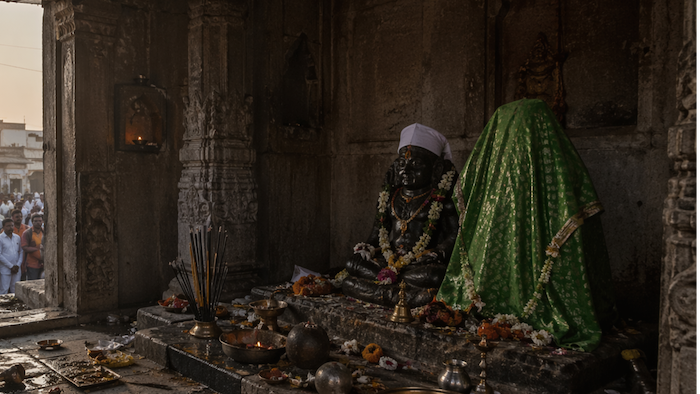
Case Summary
Hindu devotees discovered that idols inside a temple in Nashik, Maharashtra, had been altered in a disturbing manner. Religious symbols not associated with Hindu worship, such as a Muslim-style cap and green drapes, had been placed on the deities. The act caused immediate distress among Hindu residents. The incident quickly escalated into tension in the area. On the night of 20th April 2026, at the Satya Baba Temple located in the Chandanpuri area of Malegaon, Nashik, Hindu devotees found that the idols of the village deities had been tampered with. During the night, unidentified perpetrators entered the temple premises and altered the idols' appearance. A green chadar was placed over the idol of Aai Mauli. A Muslim-style cap was placed on the idol of Gramdevata Satya Baba. These items were not part of Hindu ritual practice and were associated clearly with the Muslim community. The act directly affected the sanctity of the temple and the form in which the deities were worshipped by Hindu devotees. The idols, which were central to daily religious practice, had been tampered with without consent within the temple premises. On the morning of 21st April 2026, Hindu devotees and local residents became aware of the act. The discovery led to anger and distress among the Hindu community. Activists from Hindu organisations gathered at the temple premises and began protesting against the incident. The protest took the form of a sit-in demonstration outside the temple. Hindu residents demanded identification and punishment of those responsible for altering the idols. The gathering reflected the community's collective response to the incident. Police reached the temple after receiving information about the incident and deployed a heavy force to maintain order in the area. A formal case was registered against unidentified perpetrators under relevant sections of the Indian Penal Code. Police initiated an investigation and began examining closed-circuit television footage to identify those involved. Senior officials reviewed the situation and directed maintenance of peace. No arrests had been made at the time of the last update, and the investigation remained ongoing.
Why it is Hate Crime ?
This case has been added to the tracker under the primary category - Attack on Hindu religious representations. The subcategory selected within this is - Desecration of Hindu religious symbol. Icons and symbols or a religious representation of a spiritual ideal are widely revered in Hinduism. Iconography is of vital significance in the Hindu milieu. It helps connect people’s spiritual beliefs with the real world. Iconography within the Hindu faith takes several shapes and forms. Murtis are of most significance to Hindus, to which daily rituals, prayers and offerings are done. Besides the murtis, there are several other symbols which have deep significance in the Hindu faith – the Om and Swastika for example. Since these Hindu religious symbols hold paramount importance in Hinduism, any desecration of symbols, icons, murtis, religious representations and manifestations, is driven by animosity towards the faith itself which manifests itself through these murtis, icons and symbols. Therefore, any desecration of these Hindu religious symbols and representations is considered religiously motivated hate crimes under this category. This case qualified as a religiously motivated hate crime because Hindu devotees found that the idols of their deities had been deliberately altered inside a functioning temple, using Islamic symbols that are clearly not associated with Hindu worship. The act was carried out within a sacred space and directly interfered with the form in which the deities are worshipped. The choice of method, altering rather than merely damaging, showed an intent to distort Hindu religious representation itself. Religion was central to both the target and the manner of the act. For Hindu devotees, these idols are not mere decorations but sacred embodiments of the divine, worshipped in a specific, established form. The perpetrators placed a Muslim-style cap on one idol and draped a green chadar over another, altering their appearance in a way that was incompatible with Hindu ritual practice. This act was significant because it did not simply damage the idols but changed how the deities were presented to worshippers. The perpetrators deliberately chose to impose external religious markers onto Hindu deities, thereby exploiting the visual and ritual sanctity of the idols to create maximum offence. This choice revealed a clear intent not only to distort and disrespect Hindu religious identity by interfering with how the divine is represented and experienced in worship, but also to mock the devotees, targeting their faith at its core. In the other religious marker, the act constituted desecration of a Hindu religious symbol through deliberate alteration within a consecrated temple space. Desecration in this context was not limited to destruction; it also involved violating the idol's sanctity and prescribed form. For Hindu devotees, the purity and integrity of an idol are essential to its religious significance, and any unauthorised modification disrupts its sanctity. The perpetrators entered the temple and carried out the act in a controlled manner, placing specific items that carried religious meaning outside Hindu practice. This demonstrated that the act was not random but involved conscious selection of objects and method. By doing so, the perpetrators ensured that the temple space itself became a site of violation, where the sacred had been deliberately altered. This revealed an intent to provoke, offend, and unsettle Hindu devotees by targeting a symbol that holds deep spiritual value, using its desecration as a means to inflict religious and emotional harm. This sort of attack specifically targeting Hindus stems from a deep-seated animosity that Islamists harbour towards the Hindu faith, which is why this case has been categorised as a religiously motivated hate crime and added to the hate crime database of the tracker. It is important to note that even though the perpetrators remained unidentified at the time of the last update, the nature of the act itself, involving the deliberate alteration of Hindu idols within a temple, demonstrated hostility towards Hinduism.


Case Status
Complaint filed


Perpetrators Details
Perpetrators
Unknown
Perpetrators Range
Unknown
Perpetrators Gender
unknown
 Sources




