Hindu festival targeted; Indian company vilifies Holi while glorifying namaz in its advertisement
 India
India  26 February, 2019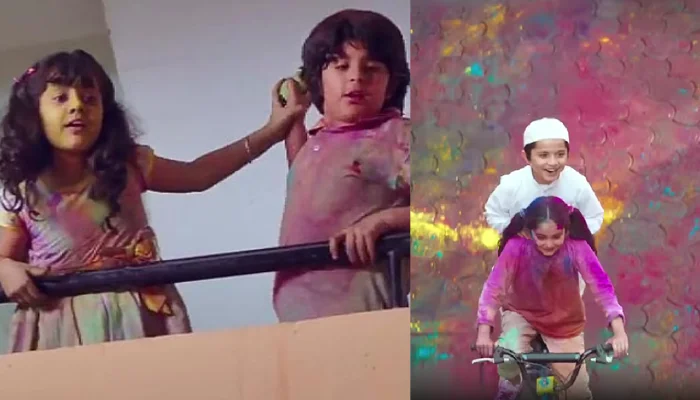
Case Summary
Hindu sentiments were outraged as Surf Excel company released an advertisement where the Holi festival was vilified and maligned in a subtle manner. This advertisement received major flak from Hindus on social media who called this an anti-Hindu propoganda. According to media reports, this advertisement was uploaded on YouTube by the Surf Excel company on 27 February 2019. This one-minute advertisement was titled ‘Rang Laaye Sang’ (colours bring us together). The advertisement depicted a young Hindu girl helping a Muslim boy avoid being stained by Holi colours so he could reach a mosque in “clean” clothes for Namaz. Essentially, in this advertisement, other Hindu kids were shown as ruthless who tried to forcibly stain people with colours, including the Muslim boy. Hindu critics slammed the narrative for subtly portraying the vibrant Hindu tradition of colours as a nuisance or something that “dirtied” others, while elevating Islamic rituals like Namaz as superior and deserving of protection. Following this, the hashtag #BoycottSurfExcel trended globally on X, as users stated the multinational corporation used Hindu festivals to peddle an agenda of minority appeasement and moral superiority.
Why it is Hate Crime ?
This case is being added to the tracker under the primary category- Hate Speech against Hindus. The subcategory selected is- Anti-Hindu subversion and prejudice. Hate speech is defined as any speech, gesture, conduct, writing, or display that is prejudicial against a specific individual and/or group of people, which is leading to or may lead to violence, prejudicial action or hate against that individual and/or group. Media plays a specific and overarching reach in perpetuating prejudicial attitudes towards a community owing to unfair, untrue coverage and/or misrepresentation/misinterpretation, selective coverage and/or omission of facts of/pertaining to issues affecting a specific religious group. This type of bias can dehumanise the victim group, making it easier for others to justify harmful actions against them, which aligns with the objectives of hate speech laws aimed at preventing such harm. It is often observed that the media takes a prejudicial stand against the Hindu community driven by their need to shield the aggressor community which happens to be a numeric minority, however, is the one perpetrating violence against Hindus. For example, the media is often quick to contextualise religiously motivated crimes against Hindus, omit or misrepresent facts that point towards religiously motivated hate crimes, justify and/or downplay religiously motivated hate crimes or simply present fake news to stereotype Hindus. Such media bias leads to the denial of persecution and is often used to dehumanise Hindus, leading to justification for violence against them. For example, the media covered several fake allegations of Hindus targeting Muslims and forcing them to chant Jai Shree Ram. Most of these cases were proved false and fabricated after police investigation. These fake news reports were subsequently never retracted or clarified. Such fake news led to the justification of violence and dehumanisation of Hindus based on the argument that since Hindus targeted Muslims and forced them to chant Jai Shree Ram, the dehumanisation of Hindus and violence against them was par for the course and merely a retaliation. Such media bias leads to prejudicial portrayal of Hindus and offers a justification for violence against them and therefore, is considered hate speech under this category. This case exemplifies a religiously motivated hate offence, as the Surf Excel company released an advertisement that subtly vilified Holi as a festival where people were forcibly dirtied, portraying the event through aggressive scenes of Hindu children hurling colours at passersby to stain them against their will. The core narrative centred on a Muslim boy en route to namaz, whom these children targeted relentlessly as ruthless antagonists, their playful tradition twisted into a menacing assault on purity. A lone Hindu girl then intervened heroically, taking all the colours on herself to keep his clothes pristine, escorting him safely to the mosque where he performed namaz untainted. This framing clearly showcased anti-Hindu prejudice and bias by subtly casting Hindu children as villains and their festival as a barbaric nuisance that threatened others, embedding a narrative of Hindu aggression needing containment. The advertisement's double standards shone through its overt glorification of namaz as an immaculate ritual deserving utmost protection and reverence, contrasted sharply with the denigration of Holi, where even minor real-world incidents of enthusiastic colouring were exaggerated into a festival-wide evil of forcible dirtying. This selective lens ignored comparable overzealous moments in festivals across cultures, such as aggressive water-throwing or pranks elsewhere, yet zeroed in on Holi to generalise it as inherently violent and impure. Such a portrayal signified deep-seated bias against Hindu festivals, reducing a vibrant symbol of unity and joy to something savage and uncivilised, which constituted subtle propaganda designed to erode respect for Hindu cultural practices. This vilification of Holi alongside the elevation of namaz highlighted underlying Hinduphobia and deep-seated religious animosity towards Hindu traditions, embedding messages that positioned Islamic rituals as superior while subtly questioning and vilifying Hindu celebrations. The advertisement met key parameters of religiously motivated hate speech, including deliberate targeting of a faith group, intent to stir prejudice through symbolic degradation (colours equated to filth), and provocation of interfaith tension via inverted victimhood. The anti-Hindu propaganda disseminated through this advertisement reached millions via YouTube uploads and shares, embedding tropes of Hindus as ruthless, uncultured aggressors whose festivals posed threats. This widespread exposure normalised and amplified bias, encouraging viewers to view Hindu practices as inferior and disruptive, thereby fostering broader prejudice and division on a massive scale and confirming its classification as a religiously motivated hate crime. Given these clear indicators of animus and harm, the case qualified for inclusion in the Hate Crime Database of the Hinduphobia Tracker.


Case Status
Unknown


Perpetrators Details
Perpetrators
Others
Perpetrators Range
Unknown
Perpetrators Gender
unknown
 Sources




