Hindu employee targeted by Muslim doctor in Dehradun; restricted from wearing religious symbols, doing temple prayers, and threatened with job loss
 Dehradun, Uttarakhand, India
  21 January, 2024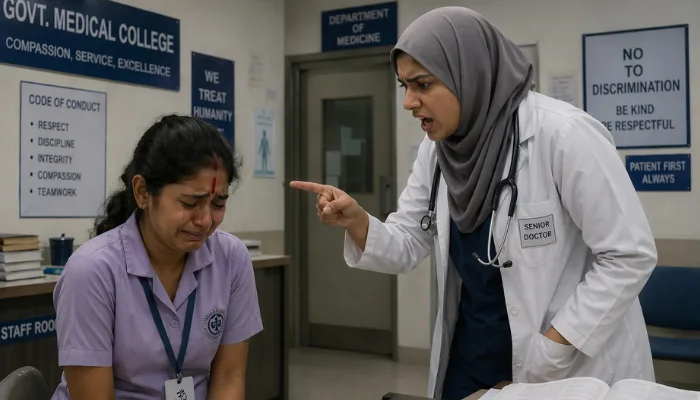
Case Summary
In Dehradun's Doon Medical College, a Hindu female employee was targeted by a Muslim doctor named Dr Ghazala Rizvi. The victim was restricted from wearing Hindu religious symbols and was also harassed for praying at a temple inside the college campus. According to media reports, this incident came to light as video testimony of the Hindu female victim went viral on social media on 22 April 2026. In the video, she was being interviewed by a Hindu activist, Lalit Sharma, from the Hindu Raksha Dal, a Hindu organisation. As per the video, the victim was constantly harassed by the accused Rizvi for wearing Hindu symbols like a tilak, a kalava and a bindi. The woman victim was working in the hospital during which a Ram temple was consecrated on the hospital campus on the same day that the Ram Janmabhoomi temple was inaugurated in Ayodhya (22 January 2024). From then on, she began visiting the temple on campus every day and praying. Soon after, the Muslim doctor started working in the hospital. During this time, she began targeting the woman for her Hindu faith, religious symbols, and praying at the temple. The victim was constantly harassed and was threatened by Dr Ghazala that she would get her fired from her job. Distressed by all this, the victim reached out to police with her complaints, but her complaints were not taken seriously, and police took no action. After this, she reached out to the Hindu Raksha Dal group for help. The Hindu activist who interviewed the victim stated that if the college authorities and police do not take action against the perpetrator, then the entire Hindu Raksha Dal would carry out protests outside the Doon Medical College on 22 April 2026. He also stated that the accused not only targeted the Hindu victim alone, but also harassed other students and employees working at the college. On the other hand, the college principal, Dr Geeta Jain, denied all the allegations and said that the complaints were being investigated and further action would be taken after considering all the aspects.
Why it is Hate Crime ?
The first primary category selected for this case is- Restriction/ban on Hindu practices. The subcategory selected is- Restriction on expression of Hindu identity. An example of the state-affected prejudicial and targeted orders against the Hindu community would be a government denying the right of a Hindu or a group of Hindus to hold a religious procession owing to the animosity of non-Hindu groups. Denial of the religious right of the Hindus to assuage the non-Hindu group which harbours animosity to a point where it could lead to violence against Hindus is not only a failure of law and order but is a prejudicial order against Hindus, denying them their fundamental rights to express their religious identity. An example of a hate crime against Hindus by a non-Hindu would be a non-Hindu institution forcing its Hindu employees to abandon religious symbols that a Hindu would wear as an expression of faith owing to inherent prejudice against the faith professed by the victim or a non-Hindu group of people restricting a Hindu group from constructing a place of worship simply because the demography of the area in which the temple is being built is dominated by non-Hindus. Such actions are driven by religious animosity and/or prejudice against Hindus and their faith and would therefore be categorized as a hate crime. The second primary category selected is- Attack not resulting in death. The subcategory selected is- Attacked for Hindu identity. In several cases, Hindus are attacked merely for their Hindu identity without any perceived provocation. A classic example of this category of religiously motivated hate crime is a murder in 2016. 7 ISIS terrorists were convicted for shooting a school principal in Kanpur because they got ‘triggered’ seeing the Kalava on his wrist and tilak that he had put. In this, the Hindu victim had offered no provocation except for his Hindu religious identity. The motivation for the murder was purely religious, driven by religious supremacy. Such cases where Hindus are targeted merely for their religious identity would be documented as a hate crime under this category. This case is a clear example of a religiously driven hate crime as the accused, Dr Ghazala Rizvi, a Muslim doctor, targeted a Hindu woman employee at Doon Medical College in Dehradun by restricting her from wearing sacred Hindu religious symbols, such as a tilak, a kalava, and a bindi. This act constitutes clear religious discrimination because it singles out the victim's Hindu identity for suppression in a professional setting, using authority and threats to enforce conformity to the perpetrator's preferences. By prohibiting these symbols, which are integral expressions of Hindu devotion and cultural heritage, the doctor violated the victim's right to express her faith visibly, creating a hostile work environment rooted in religious bias. Such targeted interference demonstrates animosity towards Hinduism, transforming a workplace into a space of coerced religious erasure and amounting to a religiously motivated hate crime. In Hinduism, the tilak represents the third eye of Lord Shiva, symbolising spiritual insight, protection, and divine consciousness; it is applied on the forehead during prayers to invoke blessings and mark one's devotion to deities. The kalava, or sacred thread tied on the wrist, embodies protection from evil forces and commitment to righteousness, worn during rituals to remind the wearer of dharma and divine safeguarding in daily life. The bindi, a coloured dot on the forehead, signifies marital status, prosperity, and the awakening of inner energy, serving as a visible emblem of feminine auspiciousness and spiritual focus in Hindu tradition. Restricting these sacred religious symbols in a workplace thus harasses the Hindu victim over her religious identity, curtailing her religious autonomy and expression, which violates fundamental rights and establishes this as a religiously motivated hate crime driven by animosity towards Hindu practices. When Hindu symbols are forcibly restricted in a workplace through threats, as here, where the victim was warned of job loss, it reveals deep-seated religious animosity towards the Hindu community. This coercion implies Hindus must conceal their religious identity to retain employment, fostering an environment of intimidation and second-class treatment based solely on faith. Such actions erode professional equity and signal a deliberate intent to marginalise Hindus, marking this as a clear case of religiously motivated hate crime that prioritises the perpetrator's bias over legal protections for religious freedom. The victim faced additional threats and harassment from Dr Rizvi for worshipping at the Ram temple on the college campus, further evidencing the perpetrator's aim to suppress all expressions of Hindu faith. This restriction on praying in a consecrated space dedicated to Lord Ram, a central figure in Hinduism, directly attacks devotional practices, amplifying the religious targeting. By policing private worship alongside religious symbols, the Muslim doctor imposed her will on the victim's spiritual life, constituting multifaceted harassment that underscores religiously motivated hate crime through systematic curtailment of Hindu religious observance. Overall, the victim endured constant harassment and job loss threats solely for wearing her religious symbols and praying at the campus temple, spotlighting her Hindu identity as the trigger. Hindus targeted in this manner for benign faith expressions reveal the perpetrator's profound animosity towards the Hindu community, equating visible devotion with professional peril. This pattern of attacks on core religious markers cements the incident as a religiously motivated hate crime, where bias manifests as sustained aggression against Hindu identity. The Hindu activist noted that the perpetrator would not limit harassment to this single woman victim but extend it to other Hindu students and employees, indicating a broader pattern of suppressing Hindu expression across the medical college. This intent to systematically restrict Hindu symbols, worship, and presence demonstrates organised animosity aimed at dominating the institutional space. Such escalation against the entire Hindu community qualifies as a religiously motivated hate crime, evidencing a calculated effort to intimidate and erase Hindu religious life in a shared professional environment. The police inaction in this case, where the Hindu victim's complaints of harassment, threats, and religious symbol restrictions were dismissed without any probe or action against Dr Ghazala Rizvi, exemplifies institutionalised discrimination against Hindus when they are the victims of hate crimes. This systemic failure signals that the state apparatus condones targeting of Hindus, refuses to punish perpetrators of religious animosity, and leaves victims feeling profoundly vulnerable. Consequently, aggressors like Dr Ghazala operate with impunity, emboldening further attacks on Hindu identity and perpetuating a culture where faith-based hate crimes against Hindus encounter no accountability, thereby entrenching bias within law enforcement itself. Given that this case meets multiple parameters of a hate crime, it has been added to the hate crime database of the Hinduphobia Tracker. Disclaimer: The Hinduphobia tracker records the dates of incidents based on when the crime occurs or when the victim's ordeal begins, rather than when it is reported by the media. In this current case, media reports have not stated the exact date from when the victim's ordeal began. It only states that after 22 January 2024, when the Ram temple was inaugurated inside Doon Medical College, the Muslim doctor soon started working there and began harassing the victim, marking the onset of her ordeal. Therefore, for documentation purposes, 22 January 2024 has been selected as the indicative incident date.
Victim Details
Total Victim
1
Deceased
0
Gender
- Male 0
- Female 1
- Third Gender 0
- Unknown 0
Caste
- SC/ST 0
- OBC 0
- General 0
- Unknown 1
Age Group
- Minor 0
- Adult 1
- Senior Citizen 0
- Unknown 0


Case Status
Complaint not filed


Perpetrators Details
Perpetrators
Muslim Extremists
Perpetrators Range
One Person
Perpetrators Gender
female
 Sources




