Hindu doctor intimidated and abused after religious identity revealed, targeted with 'mini Pakistan' threats at Aligarh Muslim University
 Aligarh, Uttar Pradesh, India
  13 April, 2026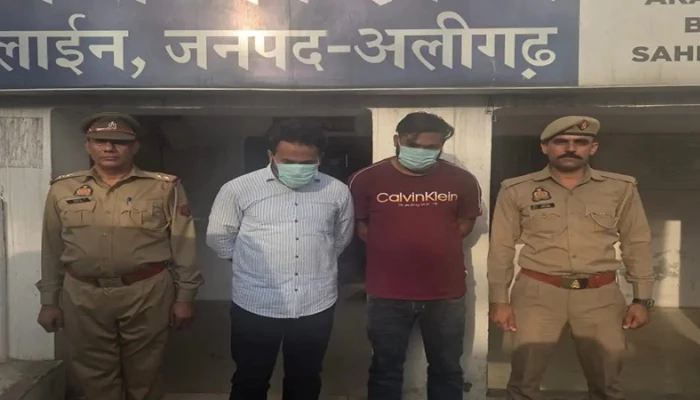
Case Summary
In Aligarh, Uttar Pradesh, a Hindu doctor, Dr Kulwant Singh, was abused, intimidated and violently threatened after the revelation of his religious identity by Muslim students in Aligarh Muslim University. Dr Kulwant Singh, a resident of Nagalia Mev in Gajraula, Amroha, visited the campus of Aligarh Muslim University (AMU) on 14 April 2026, to meet a female friend studying there. After the meeting, he left the campus in an e-rickshaw. While returning, he was stopped by a group of Muslim youths near the campus. Soon, more Muslim students were called, and a crowd of around 30 people surrounded him. The group engaged in verbal abuse and intimidation, and the doctor was encircled for nearly half an hour. During the confrontation, two accused namely, Shahbaz Izharul Haq, a resident of Ghazipur, and Najeeb Haseeb, a resident of Bareilly, threatened the doctor and said: “यहाँ सिर्फ मुस्लिमों की चलती है। AMU छोटा पाकिस्तान है, यहाँ तुझे काटकर हलाल कर देंगे और दफना देंगे, तेरे घर वालों को भी पता नहीं चलेगा।” (“Only Muslims have a say here. AMU is mini Pakistan. We will cut you, slaughter you, and bury you here; your family will not even come to know.”) Feeling unsafe, Dr Kulwant Singh called Dial 112 and sought police assistance. The police and the university proctorial team reached the spot, intervened, and escorted him to safety before ensuring his exit from the area. Based on the complaint, police registered a case and initiated an investigation. CCTV footage was examined, leading to the identification of Shahbaz and Najeeb. Both were arrested on 20 April 2026 with the assistance of the university authorities and were sent to jail. Further investigation into other individuals involved in the incident remained ongoing.
Why it is Hate Crime ?
This case is being added to the tracker under the primary category "Attack not resulting in death". The subcategory selected is- “Attacked for Hindu identity.” In several cases, Hindus are attacked merely for their Hindu identity without any perceived provocation. A classic example of this category of religiously motivated hate crime is a murder in 2016. 7 ISIS terrorists were convicted for shooting a school principal in Kanpur because they got ‘triggered’ seeing the Kalava on his wrist and the tilak that he had put. In this, the Hindu victim had offered no provocation except for his Hindu religious identity. The motivation for the murder was purely religious, driven by religious supremacy. Such cases where Hindus are targeted merely for their religious identity would be documented as a hate crime under this category. The other category selected is- Hate speech against Hindus, and within this, the subcategory selected is- Violent threats. Violent threats, explicit, implicit or implied, is the most dangerous form of hate speech since it goes beyond discriminatory and prejudicial language to express the intent of causing harm to an individual or a group of people based on their religious identity and faith. There could be several different kinds of threats that are issued to Hindus based on religious animosity. An explicit threat would mean the direct threat of violence towards an individual Hindu, a group of Hindus or Hindus at large. Physical violence, death threats, threats of destruction of property belonging to Hindus and threats of genocide would mean explicit threats against Hindus for their religious identity. Implicit threats may not be a direct threat but implied through the use of symbols of actions – for example – in the Nupur Sharma case, other than explicit threats, there were also implicit threats when Islamists took to the streets to burn and beat her effigies. It implies that they want to do the same to Nupur Sharma – thereby is considered an implicit threat. Violent threats can be delivered in person, through letters, phone calls, graffiti, or increasingly through social media and other online platforms. It would be important to understand that a threat – explicit or implicit, online or offline – to an individual who happens to be a Hindu does not qualify as a religiously motivated threat. Such a threat, while vile and dangerous, could be owing to non-religious reasons and/or personal animosity. To qualify as a religiously motivated threat, it would need to exhibit an indication that the individual is being targeted for religious reasons and/or owing to his/her religious identity as a Hindu. The incident was treated as a hate crime because it was triggered not by any personal dispute but by the visible identity of the victim as a Hindu entering a space the perpetrators claimed as exclusively theirs. The incident began with a simple obstruction but quickly escalated into collective intimidation, as a group gathered, surrounded the victim, and asserted control. This shift from an individual confrontation to mob behaviour shows that the hostility was not situational but rooted in the victim’s identity. The language used makes this even clearer. Statements like “only Muslims have a say here” and calling the campus “mini Pakistan” were not casual remarks but deliberate attempts to exclude. They projected the space as one where Hindus do not belong, reflecting a mindset of religious superiority and control over who can enter or move freely. The victim was not just stopped, but made to feel like an outsider in a public space purely because of his identity. The threats further reinforced this. Saying he would be “cut, slaughtered and buried” invoked violent, religiously loaded imagery, intensifying the intimidation. This was not random abuse but targeted hostility that tied violence directly to who he was. The “mini Pakistan” remark carries deeper meaning in this context. It is not just a political or pro Pakistan statement. When used during an act of intimidation against a Hindu individual, it signals that the space is being seen as belonging to a separate Muslim collective, where Hindus are outsiders. This idea draws from a broader belief of religious separation, where identity is defined in opposition to a Hindu presence. In such moments, it becomes a way to assert dominance and exclusion, not just express opinion. The way the incident unfolded also shows coercion and public humiliation. The victim was surrounded for a prolonged period, threatened in a group setting, and not allowed to leave freely. This creates fear not just for him but sends a wider message to others of the same identity about their safety in such spaces. Taken together, the targeting, the explicitly exclusionary language, the religiously charged threats, and the mob intimidation make it clear that this was not an isolated confrontation. It reflects a pattern where dominance is asserted through fear, reinforcing boundaries along religious lines and discouraging the presence of Hindus in spaces claimed as exclusively Muslim. Disclaimer: The perpetrator count has been recorded as 2, although reports indicate that around 30 Muslim men had surrounded the victim. CCTV footage led to the identification of two primary accused, Shahbaz and Najeeb, who were subsequently arrested. Since the police investigation established the involvement of these two individuals, the recorded count reflects that finding.
Victim Details
Total Victim
1
Deceased
0
Gender
- Male 0
- Female 0
- Third Gender 0
- Unknown 1
Caste
- SC/ST 0
- OBC 0
- General 0
- Unknown 1
Age Group
- Minor 0
- Adult 0
- Senior Citizen 0
- Unknown 1


Case Status
Arrested


Perpetrators Details
Perpetrators
Muslim Extremists
Perpetrators Range
From 2 To 5
Perpetrators Gender
male
 Sources




