Ancient Hindu temple desecrated; religious sanctity and customs violated through deliberate act of throwing meat by Muslim woman
 Mahrajganj, Uttar Pradesh, India
  18 April, 2026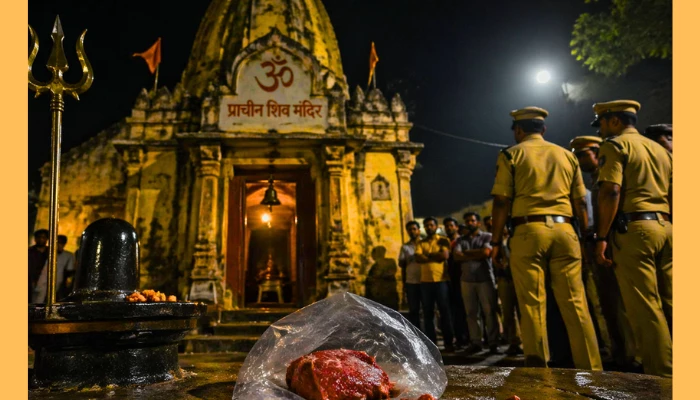
Case Summary
In the Maharajganj district of Uttar Pradesh, an ancient Shiva temple was targeted, an idol vandalised, and Hindu customs were defiled by a Muslim woman, who deliberately threw meat in the temple premises. The incident was reported from Khoria Bazaar village under the Nautanwa police station area. According to reports, the village has an ancient Shiva temple where residents regularly perform worship. On Sunday night, 19 April 2026, at around 8:30 PM, a Muslim woman, who was a resident of the same village, threw a piece of meat into the temple after placing it in a polythene bag. The meat was scattered inside the temple premises after being thrown. It was further reported that the act was witnessed by a local person at the time, following which an alarm was raised. Hearing the commotion, nearby villagers gathered at the spot, and the situation quickly escalated into a protest and disturbance within the area. Upon receiving the information, the Khoria Bazaar outpost police reached the location and cleaned the temple premises. The incident created tension in the village, and police personnel initially struggled in manage the situation. Following this, Station House Officer Purushottam Rao also arrived at the scene along with the police force and assessed the situation. Police took the woman accused of throwing the meat, along with some other individuals, to the police station for questioning.
Why it is Hate Crime ?
This case has been added to the tracker under the primary category- Attack on Hindu religious representations. The subcategory selected is- Attack on Temples. In Hinduism, a temple is the abode of the Deity. The Deity in the Temple is consecrated, thereby making it a real, breathing entity. Hindus believe that not just the Deity but the temple premises itself are sacred to Hindus since Hindus hold the faith that the entire Temple space is an amalgamation of the divine energy of the deity. Given the central significance of Temples in Hindu Dharma, any attack against a Hindu Temple or its peripheral premises is an attack on the faith itself and is born out of animosity towards the faith, of which the Temple is a central tenet. Any manner of attack against a Temple and/or its premises would therefore be considered a religiously motivated hate crime. The other sub-category selected is- Defiling religious customs. Sanatan Dharma is not a religion of one book, which is to say that while it has religious scriptures that form the central tenets of the faith, there are several traditions followed through thousands of years, mostly passed from generation to generation orally. Several such customs and traditions are followed by various Hindus and Hindu sects. Defiling of these traditions and customs is a breach of an individual or group’s religious practices. Such practices can range from dietary restrictions like not eating non-vegetarian food for a certain period of the year, not eating non-vegetarian food at all, not eating beef since the cow is considered holy in Hinduism, the sanctity of religious customs followed in the house (like many ISCKON devotees), etc. Any malicious action leading to the breach of such traditions or defilement of these traditions owing to animosity towards the faith or for the sake of activism stems not only from the lack of faith in the religion itself but also from disregard for the faith of the devotees who follow the customs/traditions and implicit bias against the faith, the tradition itself. Since these specific traditions are central to the faith of the devotees of that specific sect of Hindus, any non-compliance with these traditional rules would be considered a religiously motivated hate crime. The other sub-category selected is - Desecration of Hindu religious symbols. Icons and symbols, or a religious representation of a spiritual ideal, are widely revered in Hinduism. Iconography is of vital significance in the Hindu milieu. It helps connect people’s spiritual beliefs with the real world. Iconography within the Hindu faith takes several shapes and forms. Murtis are of most significance to Hindus, to which daily rituals, prayers and offerings are done. Besides the murtis, there are several other symbols which have deep significance in the Hindu faith – the Om and Swastika, for example. Since these Hindu religious symbols hold paramount importance in Hinduism, any desecration of symbols, icons, murtis, religious representations and manifestations, is driven by animosity towards the faith itself, which manifests itself through these murtis, icons and symbols. Therefore, any desecration of these Hindu religious symbols and representations is considered a religiously motivated hate crime under this category. This case was added to the Hinduphobia Tracker because the accused, the Muslim woman, had deliberately thrown meat into the ancient Shiva temple. She targeted its consecrated premises with clear intent to desecrate a sacred Hindu space, making this a religiously motivated hate crime. At the outset, the trigger lay in the deliberate decision to introduce a substance strictly prohibited within a sacred Hindu site that holds central importance for devotees’ faith, reflecting hostility towards the sanctity of Hindu worship. The act was not compelled by circumstance, as any non-religious or alternative location could have been chosen, yet the Hindu temple was specifically targeted. This choice of venue establishes intent and demonstrates a targeted disregard for Hindu religious beliefs and sacred spaces. In Sanatana Dharma, temples serve as ritually sanctified abodes of the divine. Their architecture aligns precisely with human energy centres, such as chakras, to channel spiritual harmony and elevate consciousness during worship. Cleanliness underpins this sanctity. In essence, it transcends physical hygiene to embody a profound spiritual principle that sustains the pure vibrational atmosphere vital for rituals, prayers, and darshan. Devotees uphold this through meticulous daily cleansing rites, ensuring the entire temple space remains a pious extension of divine presence, revered even in its grounds and surroundings. The Muslim woman intentionally shattered this sacred order. Specifically, she introduced meat, a substance categorically barred within temple premises under longstanding Hindu customs of dietary purity and ritual discipline. Temples enforce rigorous norms on conduct and offerings. For example, many, including Shiva temples, prohibit non-vegetarian items based on local traditions to preserve untainted sanctity. Consequently, her intrusion polluted both the physical surroundings and the spiritual equilibrium that devotees strive to maintain. This deliberate defilement directly assaulted the temple's pious value to the community, violating the core religious sentiments of Hindus. Furthermore, the choice of location exposed her hostility. She selected an active Shiva temple, a living hub of daily worship and cultural identity, not a church, not a mosque or any neutral area. She executed the act precisely to contaminate this pious space, breaching established practices that link dietary restraint to spiritual purity. This planned disruption was to worsen the disciplined religious life of Hindus, inflicting deep emotional and spiritual harm. This incident constituted a hate crime because the actions of the accused stemmed from prejudice against Hindu beliefs. Her intent shone through in the premeditated selection of a temple, the prohibited substance, and the manner of intrusion, all aimed at undermining the faith's sacred symbols, customs, and institutions. By desecrating a space of immense pious value to devotees, she expressed overt animosity towards Hinduism, transforming a personal act into a communal religious violation.


Case Status
Unknown


Perpetrators Details
Perpetrators
Muslim Extremists
Perpetrators Range
One Person
Perpetrators Gender
female
 Sources




