Hindu religious symbol desecrated at place of worship, devotees find Hanuman idol broken in temple
 Janjgir-Champa, Chhattisgarh, India
  19 April, 2026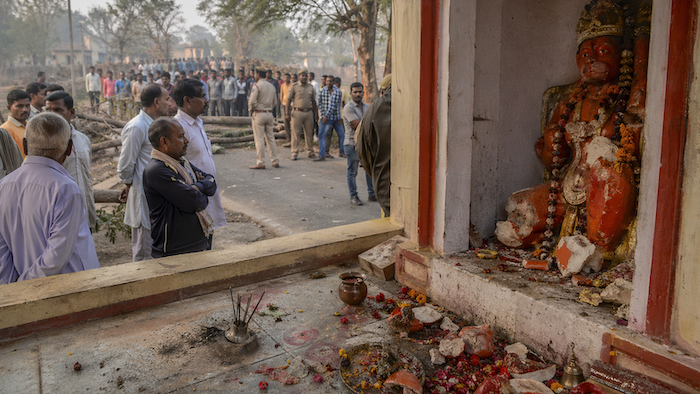
Case Summary
Hindu devotees discovered that a Hanuman idol had been broken inside a temple in Janjgir Champa, Chhattisgarh. The damage was found following a night of disruption in the village. The act triggered immediate anger among Hindu residents. The incident quickly escalated into a larger community response. On the night of 20th April 2026, a Hanuman idol located in a small temple in Mudpar village, under Shivrinarayan police station area in Janjgir Champa district, was targeted. The temple was a site where Hindu devotees regularly gathered for worship and prayer. During the night, unidentified perpetrators entered the temple premises and damaged the idol of Lord Hanuman. The idol was broken inside the temple structure, resulting in visible desecration of the place of worship. The act directly affected a site of religious significance for the Hindu residents of the village. On the morning of 21st April 2026, Hindu villagers became aware of the damage. The sight of the broken idol led to anger and distress among the devotees. The temple, which served as a regular place of worship, had been disturbed through the destruction of the idol. In response, a large number of Hindu residents gathered and organised a protest. They moved towards the Shivrinarayan main road and blocked it, demanding action against those responsible for the desecration. The road blockade continued for several hours as villagers remained gathered at the site. Police officials from Shivrinarayan police station reached the location after receiving information about the incident. Senior officers, including Additional Superintendent of Police Umesh Kashyap, arrived at the protest site and engaged with the Hindu villagers. The blockade continued for approximately four hours before being lifted following assurances of action. A formal case was registered against unidentified perpetrators. Police initiated an investigation, including examination of nearby closed-circuit television cameras. The situation was brought under control, and monitoring of the area continued.
Why it is Hate Crime ?
This case has been added to the tracker under the primary category - Attack on Hindu religious representations. Within this, the subcategory selected is - Attack on temples. In Hinduism, a temple is the abode of the Deity. The Deity in the Temple is consecrated, thereby, making it a real, breathing entity. Hindus believe that not just the Deity but the temple premises itself are sacred to Hindus since Hindus hold the faith that the entire Temple space is an amalgamation of the divine energy of the deity. Given the central significance of Temples in Hindu Dharma, any attack against a Hindu Temple or its peripheral premises is an attack on the faith itself and is born out of animosity towards the faith, of which, the Temple is a central tenet. Any manner of attack against a Temple and/or its premises would therefore be considered a religiously motivated hate crime. The other sub-category selected for this case is - Desecration of Hindu religious symbol. Icons and symbols or a religious representation of a spiritual ideal are widely revered in Hinduism. Iconography is of vital significance in the Hindu milieu. It helps connect people’s spiritual beliefs with the real world. Iconography within the Hindu faith takes several shapes and forms. Murtis are of most significance to Hindus, to which daily rituals, prayers and offerings are done. Besides the murtis, there are several other symbols which have deep significance in the Hindu faith – the Om and Swastika for example. Since these Hindu religious symbols hold paramount importance in Hinduism, any desecration of symbols, icons, murtis, religious representations and manifestations, is driven by animosity towards the faith itself which manifests itself through these murtis, icons and symbols. Therefore, any desecration of these Hindu religious symbols and representations is considered religiously motivated hate crimes under this category. This case qualified as a religiously motivated hate crime because a Hindu place of worship was targeted and a sacred idol was deliberately broken, directly impacting Hindu devotees and their ability to practise their faith. The act was not limited to property damage but was directed at a religious symbol central to Hindu worship. Even though the perpetrators remained unidentified at the time of the last update, the nature of the act itself, the selection of the target, and the form of damage clearly established that the incident stemmed from hostility towards Hinduism. The destruction of a consecrated idol within a temple demonstrated that religion was the central motivating factor behind the act. In the primary religious marker, the incident involved a direct attack on Hindu religious representations in the form of a consecrated idol of Lord Hanuman. The idol was not an ordinary object but a sacred representation of a deity, central to the devotional practices of Hindu worshippers. For Hindu devotees, such idols are treated as embodiments of the divine and form the focal point of daily prayers and rituals. The perpetrators deliberately chose to damage this specific representation, ensuring that the harm was inflicted not just on physical property but on a core element of Hindu religious identity. By targeting the idol inside an active place of worship, the perpetrators exploited its religious significance to maximise emotional and spiritual harm to Hindu devotees. This choice revealed a clear intent to attack what Hindus revere, demonstrating that the act was designed to insult and undermine their faith in a way that a non religious act of vandalism would not achieve. In the second religious marker, the attack extended to a Hindu temple, which functioned as a communal religious space for Hindu residents of the village. Temples are not merely structures but are central to collective worship, cultural continuity, and religious expression. The perpetrators entered this sacred space and carried out the act within its premises, violating the sanctity of a location dedicated exclusively to Hindu religious practice. This was significant because the temple served as a shared spiritual centre where devotees gathered regularly. By choosing this location, the perpetrators ensured that the impact of the act would extend beyond individual worshippers to the entire Hindu community connected to the temple. This deliberate intrusion into a sacred space demonstrated intent to disrupt Hindu religious life at a collective level, indicating that the perpetrators sought to instil fear and insecurity among devotees within their own place of worship because of their religious identity. In the third religious marker, the act constituted the desecration of a Hindu religious symbol through the breaking of the Hanuman idol. Desecration carries a distinct religious meaning, as it involves the intentional defilement of an object regarded as sacred. For Hindu devotees, damaging an idol is not only physical destruction but a direct violation of religious sanctity and belief. The perpetrators chose to break the idol rather than engage in random damage, indicating a conscious decision to target a sacred object. This act amplified the harm by transforming the temple from a place of reverence into a site of violation. Even though the perpetrators were unidentified, the specific nature of the act, breaking a consecrated idol within a temple, demonstrated that the action stemmed from hostility towards Hinduism. This revealed deliberate intent to offend, provoke, and emotionally injure Hindu devotees by attacking a symbol that holds deep religious significance. Given that this case met the parameters of a religiously motivated hate crime, it was added to the hate crime database of the tracker.


Case Status
Complaint filed


Perpetrators Details
Perpetrators
Unknown
Perpetrators Range
Unknown
Perpetrators Gender
unknown
 Sources




