Hindu Brahmin Hindu community subjected to vile social media attacks targeting sacred religious symbols in Gujarat
 Ahmedabad, Gujarat, India
  19 April, 2026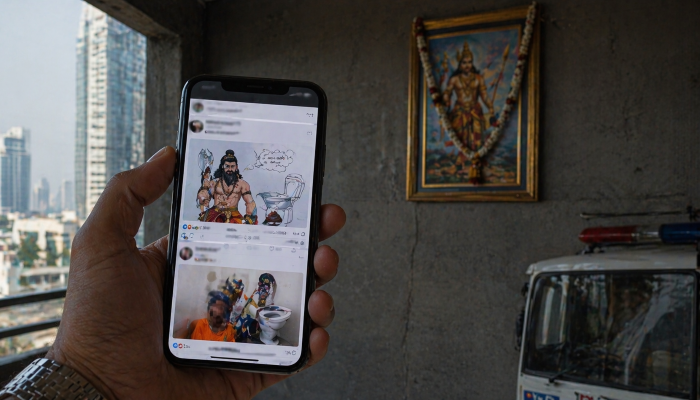
Case Summary
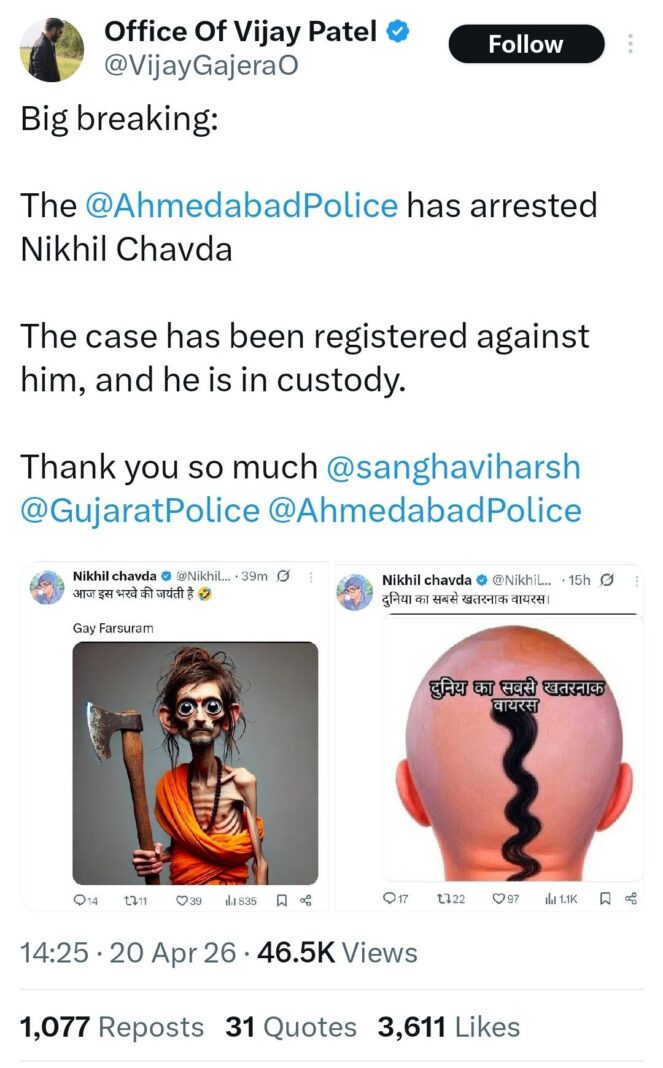
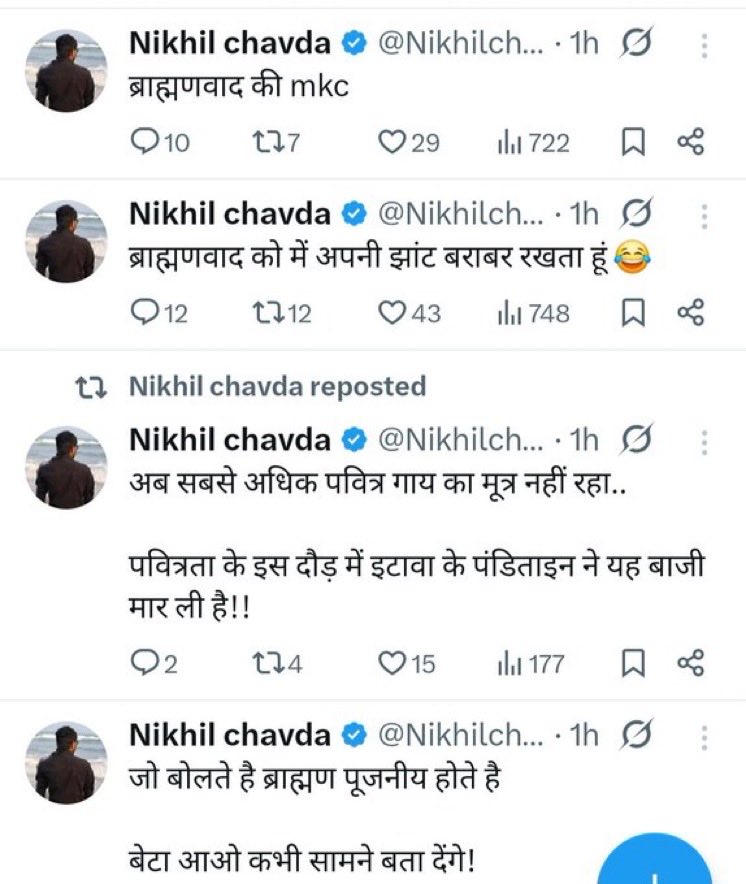
A young man named Nikhil Chavda was arrested by the Ahmedabad Crime Branch, Gujarat, after posting deeply offensive and provocative content against Hindu gods and goddesses and the Brahmin community on social media. The posts, which included abusive language targeting Lord Parshuram and a controversial image mocking the shikha [the sacred tuft of hair worn by Hindu Brahmin men as a mark of religious identity], had gone viral and triggered widespread outrage. Gujarat Minister of State for Home Harsh Sanghvi and the police department received widespread praise on social media for their swift action. Nikhil Chavda had posted content on social media using indecent language against Lord Parshuram [a revered Hindu deity and one of the ten avatars of Lord Vishnu] and shared a provocative image targeting the shikha of Brahmin men. The posts spread rapidly on social media and caused deep offence to the Hindu community. Investigation revealed that Nikhil Chavda had been engaged in such activities for an extended period. His older posts on social media were found to contain extremely abusive and obscene language directed against Brahminism. He had not only inflamed religious sentiments but had also made vile comments about women and Hindu sacred symbols. Following the prominent circulation of the case on social media, Ahmedabad police acted swiftly and arrested Nikhil Chavda. Police were investigating the motive behind the provocative campaign and whether he had been acting at the behest of a specific group to spread communal animosity in society. The accused was in police custody, and legal proceedings against him were ongoing as of the source date.
Case Images
Why it is Hate Crime ?
The primary category for this case is "Hate speech against Hindus". The sub-category here for this case is "Anti-Hindu slurs, mocking faith". Anti-Hindu slurs and the deliberate mocking of the Hindu faith owing to religious animosity involve the usage of derogatory terms, stereotypes, or offensive references to religious practices, symbols, or figures. One of the common anti-Hindu slurs used against Hindus is “cow-worshipper” and “cow piss drinker”. The intention of using this term is to demean and mock Hindus as a group and their religious beliefs since Hindus consider the cow holy. Additionally, some symbols and the slurs attached to them have a historical context that exacerbates the insult, hate, stereotyping, dehumanisation and oppression against Hindus. Cow worship has been used for centuries to denigrate Hindus, insult their faith and oppress Hindus specifically as a religious group. There has been overwhelming documentation about how cow slaughter has been used to persecute Hindus with cow meat being thrown in temples and places of worship. There has also been overwhelming documentation where cow meat (beef) has been force-fed to Hindus to either forcefully convert them to Islam or denigrate their faith. Apart from cow worship, the Swastika – which holds deep religious significance for the Hindus – has also been misinterpreted and distorted to use as a slur against Hindus. Similarly, the worship of the Shivling has been used by supremacist ideologies and religions to denigrate Hindus owing to religious animosity. Such slurs and denigration stem out of inherent animosity and hate towards Hindus and their faith, therefore, it is categorised as hate speech targeted at Hindus specifically owing to their religious identity. The other category selected here is- Attack on Hindu religious representation, and within this, the subcategory selected is- Iconoclastic representation of Hindu Gods/Goddesses. An icon is a symbol of someone or something that is revered, or a religious representation of a spiritual ideal. Iconography is of vital significance in the Hindu milieu. It helps connect people’s spiritual beliefs with the real world. Iconography within the Hindu faith takes several shapes and forms. Murtis are of most significance to Hindus, to which daily rituals, prayers and offerings are done. Besides the murtis, there are several other symbols which have deep significance in the Hindu faith – the Om and Swastika for example. Any iconoclastic representation of these symbols, images and murtis is an affront to the religious beliefs and faith of the Hindu community itself since the symbols and icons are deeply religious in nature. In this sub-category of crime, we would record hate crimes and iconoclastic representations, in words, art, or any other form of representations of symbols that hold religious significance for the Hindu community. Since these symbols, icons and murtis are central to the Hindu faith, any iconoclastic representation of these symbols is born out of animosity towards the faith itself, manifesting itself through these symbols and therefore, these representations would be considered religiously motivated hated crimes. This case qualifies as a religiously motivated hate speech incident in which a young man deliberately published offensive and abusive content targeting Hindu gods and goddesses, the Brahmin community, and Hindu sacred symbols on social media over an extended period. The content was not a single impulsive post. It was a sustained and deliberate campaign of anti-Hindu mockery and denigration that had been ongoing for a significant period before it was brought to public attention and acted upon by the police. The deliberate use of abusive language directed at Lord Parshuram is the primary religious marker in this case. Lord Parshuram is not a peripheral figure in the Hindu tradition. He is one of the ten avatars of Lord Vishnu, among the most important deities in the Hindu theological framework, and he holds a position of particular and deep reverence within the Brahmin community as their presiding divine ancestor and protector. The deliberate use of indecent and abusive language directed at Lord Parshuram was not a casual act of political commentary or irreverent humour. It was a targeted assault on one of the most sacred figures in the Hindu tradition, chosen specifically because of his central importance to the Brahmin community. The perpetrator chose Lord Parshuram deliberately because attacking him would cause maximum religious injury to the community that reveres him most deeply. The mocking of the shikha, a sacred Brahmin religious symbol, is the second religious marker. The shikha is not merely a hairstyle or a cultural practice. It is a sacred religious marker worn by Hindu Brahmin men as an expression of their devotion, their community identity, and their commitment to the religious tradition they uphold. The deliberate sharing of a provocative image targeting the shikha was an act of religious desecration directed specifically at one of the most visible and intimate expressions of Brahmin Hindu identity. The perpetrator chose the shikha as his target deliberately because it is a uniquely Hindu Brahmin symbol with no parallel in other traditions, ensuring that the mockery would fall exclusively and most painfully on the Brahmin Hindu community. The iconoclastic nature of the content is an additional religious marker in this case. Iconoclasm, in this context, refers to the deliberate degradation or symbolic destruction of sacred religious figures and symbols through distortion, mockery, or abusive representation. By targeting both Lord Parshuram and the shikha, one representing divine reverence and the other a living marker of religious identity, the perpetrator did not merely criticise or comment but actively sought to strip these symbols of their sanctity. This transformation of sacred elements into objects of ridicule is a classic form of symbolic desecration, where the intent is to erode the reverence attached to them and normalise disrespect toward the faith they represent. The sustained pattern of anti-Hindu content across multiple posts over an extended period is the third religious marker. The investigation revealed that Nikhil Chavda had not posted offensive content even once, not even in moments of anger. He had been engaged in sustained anti-Hindu posting over an extended period, with older posts containing extremely abusive and obscene language directed against Brahminism. This pattern confirms that the anti-Hindu content was not opportunistic or reactive but deliberate and sustained, reflecting a deep and consistent hostility toward Hindu religious identity and the Brahmin community that had been expressed repeatedly and systematically over time. The perpetrator chose to maintain this campaign over an extended period because his objective was not to make a single point but to sustain a consistent assault on Hindu religious identity through repeated public denigration. It may be argued that the accused primarily targeted a specific caste group, and that the insults were directed at the micro-identity of Brahmins rather than Hindus as a whole. However, in this case, such a distinction does not dilute the religious nature of the offence. The Brahmin identity is not separate from Hinduism but is deeply embedded within its religious structure, traditions, and symbols. The targeting of Lord Parshuram, a deity closely associated with the Brahmin community, along with the mocking of the shikha, demonstrates that the attack was rooted in hostility towards Hindu religious identity expressed through one of its most visible and recognisable forms. The abuse of a caste-linked identity, therefore, functioned as a pathway to target Hinduism itself. The deliberate selection of symbols and figures that hold religious significance within the Brahmin community indicates that the intent was not limited to social or caste-based insult but extended to denigrating the broader Hindu faith. In this context, the distinction between caste identity and religious identity collapses, as the elements targeted are integral to Hindu belief and practice. The vile comments about women and Hindu sacred symbols are the fourth religious marker. In addition to the direct attacks on Lord Parshuram and the shikha, Nikhil Chavda made offensive comments about women and Hindu sacred symbols more broadly. This extension of the anti-Hindu content beyond specific deities and community symbols to encompass Hindu sacred symbols generally and women within the Hindu community reflects a comprehensive hostility toward Hindu religious identity that was not limited to one aspect of the faith but directed at its entirety. The perpetrator chose to broaden the scope of his attacks deliberately, ensuring that the harm extended across the full width of Hindu religious and community identity rather than being confined to a single target. Given that this case met the parameters of a religiously motivated hate speech incident, the conduct of the perpetrator reflected more than a series of offensive social media posts. By deliberately and repeatedly targeting Lord Parshuram, the shikha, Hindu sacred symbols, and the Brahmin community through sustained abusive and obscene content over an extended period, his actions demonstrated a clear and deliberate hostility toward Hindu religious identity and the Brahmin community specifically. The Hindu community was the deliberate and exclusive target of his campaign, and each element of the content he chose to publish was selected because it would cause maximum religious injury to the community he was targeting. This reflects an underlying hostility toward Hindu religious identity that cannot be characterised as anything other than religiously motivated hate speech. Given that this case met the criteria for a religiously motivated hate speech incident, it was added to the tracker's hate speech database.


Case Status
Arrested


Perpetrators Details
Perpetrators
Others
Perpetrators Range
One Person
Perpetrators Gender
male
 Sources




