Hindu transgender woman kidnapped, beaten and coerced into filing false complaint by Muslim men running forced conversion campaign
 Damoh, Madhya Pradesh, India
  17 April, 2026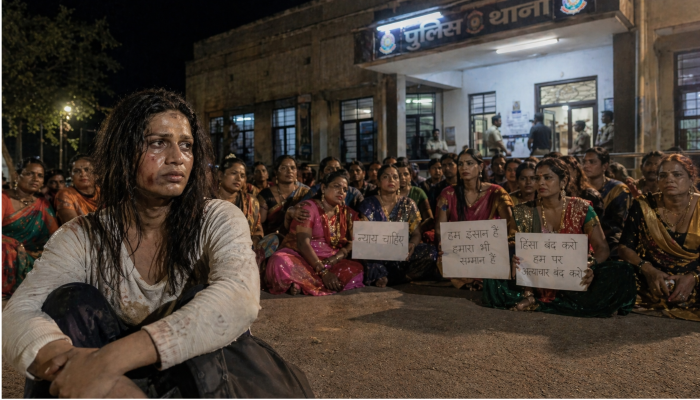
Case Summary
In Madhya Pradesh's Damoh district, Hindu transgender individuals are being forced to adopt Islam, physically assaulted, and even kidnapped. What initially appeared to be an isolated dispute has now revealed serious allegations of forced religious conversion, physical violence, and intimidation targeting members of the Hindu transgender community. The incident came to light when Khushi, a transgender individual from Damoh, approached the police on the night of April 18, 2026 (Saturday), alleging assault. However, as events unfolded, a far more serious account emerged. Khushi later revealed that she had been forcibly abducted by Gudiya Nayak, the leader of the local transgender community, along with several Muslim youths. She was held captive, brutally beaten, and threatened with death to compel her to file a false complaint. Even after doing so, she continued to face sustained physical and mental torture before managing to escape. Members of the transgender community stated that this was not an isolated incident but part of a broader pattern where Hindu transgender individuals are being targeted, intimidated, and pressured to convert. According to their testimonies, similar instances had already surfaced in Sagar, and the same pattern had now extended to Damoh. The situation escalated dramatically on April 19, 2026 (Sunday), when a large number of transgender people arrived in Damoh and declared the complaint against Gudiya Nayak to be false and part of a conspiracy. They proceeded directly to the residence of the Superintendent of Police [SP], prompting senior police officials to rush to the scene. Discussions were ongoing at the SP's office when the most alarming development of the case emerged. Khushi herself came forward and disclosed the truth of what had been done to her. She told her fellow transgender community members that she had been forcibly kidnapped by a transgender individual and a group of Muslim men. She was held captive, beaten severely, threatened with death, and coerced under extreme duress into filing a false complaint against Gudiya Nayak. After the false complaint was filed, the perpetrators continued to torture her through the night and throughout Sunday. She managed to escape their grip and reach the police. The visible injuries on Khushi's body confirmed her account and triggered immediate outrage among the assembled transgender community members. Under the leadership of Jagat Maa, the head of transgender people across the state, all those present proceeded to the Damoh Kotawali police station. They demanded the immediate withdrawal of the false case against Gudiya Nayak and strict action against the real perpetrators. Police explained that the registered case could only be quashed by a court, but the community refused to disperse and staged a dharna [sit-in protest] through the entire night. The protest ended on April 20 (Monday) morning, following extended negotiations with the Circle Superintendent of Police [CSP]. The seriously injured Khushi was admitted to the district hospital for treatment. The transgender community handed police the names of the Muslim men responsible for orchestrating an organised campaign of forced conversion targeting Hindu transgender people. They stated that the campaign had begun in Sagar and had reached Damoh, where Hindu transgender people were being intimidated and coerced into abandoning their Hindu faith. The community submitted the names of the accused Muslim men to the police and demanded strict action against them.
Why it is Hate Crime ?
The primary category for this case is "Predatory Proselytisation". The secondary category is "Harassment, threats, coercion for conversion". Harassment covers a wide range of behaviours of an offensive nature. It is commonly understood as behaviour that demeans, humiliates, and intimidates a person, including threats and coercion. Harassment and threats, in this case, find their root on discriminatory grounds which has the effect of nullifying a person’s rights or infringing upon his freedom to exercise his right specifically owing to the victim’s religious identity. Verbal and physical threats and psychological or physical harassment are often used against Hindu victims because they choose to practice their professed religion. Religious harassment also includes forced and involuntary conversions by harassment, threats or coercion. Coercion includes intimidatory tactics like force-feeding a Hindu victim beef to convert to another religion, forceful circumcision etc. In several cases documented, non-Hindu perpetrators or those who harbour specific animosity towards Hinduism, harass victims simply based on their religious identity. Such cases often also include harassment to ensure the Hindu victim abandons his/her professed religion and adopts the religion of the perpetrator. Such cases where Hindu victims are harassed to convert to the perpetrator’s religion are rooted in animosity towards the victim’s religious identity and are therefore documented as religiously motivated hate crimes. Another sub-category for this case is "Proselytisation by grooming, brainwashing, manipulation and subtle indoctrination". The tertiary category for this case is "Pattern of targeting Hindus". Religious brainwashing essentially means the often subtle and forcible indoctrination to induce someone to give up their religious beliefs to accept contrasting regimented ideas. Religious grooming or brainwashing also involves propaganda and manipulation. It involves the systematic effort, driven by religious malice and indoctrination, to persuade “non-believers’ to accept allegiance, command, or doctrine to and of a contrasting faith. Cases of such grooming or brainwashing are far more nuanced than direct threats, coercion, inducement and violence. In such cases, it is often seen that there is repeated, subtle and continual manipulation of the victim to induce disaffection towards their own faith and acceptance of the contrasting faith of the perpetrator. While subtle indoctrination is widely acknowledged as predatory, an element which is often understated in such conversions or the attempts of such conversion is the role of loyalty and trust which might develop between the perpetrator and the victim. Fiduciary relationships are often abused to affect such religious conversion. For example, an educator transmitting religious doctrine of a competing faith to a Hindu student. The Hindu student is likely to accept what the teacher is transmitting owing to existence of the fiduciary relationship. The exploitation of the fiduciary relationship to religiously indoctrinate victims would also be included in this category. Since the underlying animosity towards the victim’s faith forms the basis of predatory proselytization, such cases are considered religiously motivated hate crimes. This case qualifies as a religiously motivated hate crime in which a Hindu transgender woman named Khushi in Damoh district, Madhya Pradesh was kidnapped, held captive, and beaten severely. She was threatened with death and subjected to sustained torture. The violence was not a personal dispute or a random criminal act. It was a deliberate instrument of religious coercion. It was deployed as part of a structured and multi-district operation designed to intimidate Hindu transgender people into abandoning their Hindu faith. The kidnapping and physical torture of Khushi as an instrument of religious coercion is the primary religious marker of this case. The perpetrators did not approach Khushi with persuasion, inducement, or even open demands for conversion. They kidnapped her, held her captive, beat her severely, and threatened to kill her. The extreme violence they deployed was not disproportionate frustration or personal anger. It was a deliberate and calculated instrument of religious coercion, chosen specifically because it would most effectively break the resistance of a Hindu transgender woman and compel her compliance with their demands. The perpetrators chose violence because they understood that Khushi, as a transgender woman without conventional family protection, was in a position of particular vulnerability that made extreme physical coercion an effective tool of religious transformation. The coercion of Khushi into filing a false complaint as a mechanism of community destabilisation is the second religious marker. The perpetrators did not merely beat Khushi and demand she convert. They used her under duress to file a false complaint against Gudiya Nayak, the leader of the local Hindu transgender community. This act was calculated to serve multiple purposes simultaneously. It discredited the leader of the Hindu transgender community, creating internal division and conflict within a community that was already vulnerable. It occupied the attention of police with a fabricated dispute, diverting institutional resources away from the real crime being committed. And it demonstrated to the Hindu transgender community that their own members could be weaponised against their leaders through sufficient violence and intimidation. The false complaint was not an impulsive act of misdirection. It was a strategically designed instrument of community destabilisation directed specifically at the Hindu transgender community's internal solidarity and leadership. The organised and multi-district character of the conversion campaign is the third religious marker. The transgender community confirmed to police that the forced conversion campaign targeting Hindu transgender people had begun in Sagar before being extended to Damoh. This geographic expansion confirms that the targeting of Hindu transgender people was not a local or spontaneous phenomenon but a structured and organised campaign operating across multiple districts of Madhya Pradesh simultaneously. The existence of an organised network capable of planning and executing forced conversion operations in multiple locations reflects a level of institutional infrastructure and deliberate strategic planning that places this case within a framework of organised religious persecution rather than individual criminal conduct. Given that this case met the parameters of a religiously motivated hate crime, the conduct of the perpetrators reflected more than a localised act of criminal violence. By kidnapping a Hindu transgender woman, subjecting her to sustained torture, using her under duress to destabilise the leadership of the Hindu transgender community, and doing so as part of an organised multi-district campaign of forced conversion targeting Hindu transgender people specifically because of their Hindu identity, their actions demonstrated a clear and deliberate disregard for the religious identity, dignity, and safety of the Hindu transgender community. This reflects an underlying hostility toward Hindu religious identity that cannot be characterised as anything other than religiously motivated. Given that this case met the parameters of a religiously motivated hate crime, it was added to the hate crime database of the tracker.
Victim Details
Total Victim
1
Deceased
0
Gender
- Male 0
- Female 0
- Third Gender 1
- Unknown 0
Caste
- SC/ST 0
- OBC 0
- General 0
- Unknown 1
Age Group
- Minor 0
- Adult 1
- Senior Citizen 0
- Unknown 0


Case Status
Complaint filed


Perpetrators Details
Perpetrators
Muslim Extremists
Perpetrators Range
Unknown
Perpetrators Gender
unknown
 Sources




