Vulnerable Hindus targeted to convert to Christianity through false promises of financial aid; stone pelted upon protest in Nainital, Uttarakhand
 Naini Tal, Uttarakhand, India
  19 April, 2026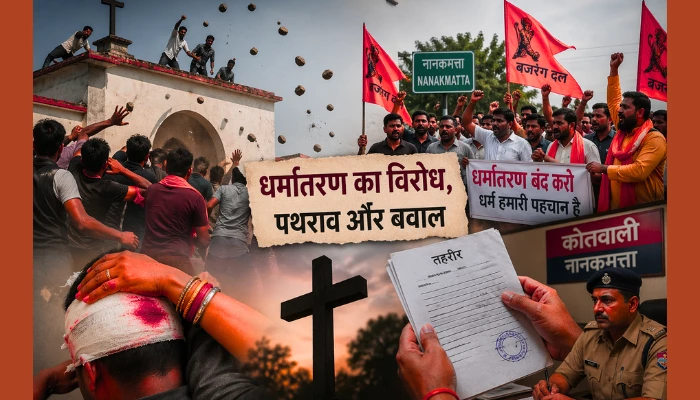
Case Summary
In Nanakmatta, located in the Nainital district, Uttarakhand, innocent Hindus were lured and brainwashed to convert to Christianity under the guise of a prayer meeting and false promises of financial aid. The incident took place in village Naveen Nagar, where the event triggered strong opposition from local Hindu residents and organisations. On 20th April 2026, during the prayer meeting, members of the Vishwa Hindu Parishad and Bajrang Dal, along with villagers, reached the spot to protest against the conversion activities. This led to a direct confrontation between two groups. The situation quickly escalated into a clash, during which stone pelting took place from the roof of the site, accompanied by physical assault. During the violence, several villagers sustained injuries, including Priyanshu Rana, Renuvati Devi, Sunita Devi, Sarju Vati, and Kishan Singh. The injured were sent for medical examination by the police. Members of Bajrang Dal and villagers who had gathered to oppose the conversion activities were among those targeted in the stone pelting. Following the incident, angry villagers staged a protest at the Nanakmatta police station and submitted a written complaint demanding strict action against those involved. The protest was led by VHP president Ajay Bhagat and Bajrang Dal state coordinator Puran Joshi. A memorandum was also sent to the Sub-Divisional Magistrate through Rajiv Dubey, highlighting that simple and vulnerable villagers were being influenced through money and inducements for conversion, and calling for a high-level investigation. The police received the complaint submitted by the VHP. At the time of reporting, no First Information Report had been registered. Authorities stated that the matter was under investigation and that instructions had been issued to maintain peace in the area.
Why it is Hate Crime ?
This case has been added to the tracker under the primary category- Predatory Proselytisation. Within it, the sub-category selected is Conversion/attempts to convert by inducement. Predatory Proselytisation is not just limited to threat, harassment, force and violence, but it also has contours of stealth. In several cases, the Hindu victim is exploited to convert, with non-Hindus taking advantage of their poverty. In such cases, the Hindu victim who is suffering financially is offered monetary benefits, including lucrative offers for jobs, health treatment, education, etc, to induce the victim into changing his/her religion. In such cases, the religious identity of the victim and the aim to disenfranchise him from his faith form the heart of the crime. Also, taking advantage of and exploiting an individual’s economic vulnerabilities is widely acknowledged as exploitation, forms of which are often penalised by law. Such cases, therefore, are considered religiously motivated hate crimes since the victim’s religious identity forms the very heart of the crime itself. The other sub-category selected is - Proselytisation by grooming, brainwashing, manipulation or subtle indoctrination. The tertiary category is- Pattern of targeting Hindus. Religious brainwashing essentially means the often subtle and forcible indoctrination to induce someone to give up their religious beliefs to accept contrasting, regimented ideas. Religious grooming or brainwashing also involves propaganda and manipulation. It involves the systematic effort, driven by religious malice and indoctrination, to persuade “non-believers’ to accept allegiance, command, or doctrine to and of a contrasting faith. Cases of such grooming or brainwashing are far more nuanced than direct threats, coercion, inducement and violence. In such cases, it is often seen that there is repeated, subtle and continual manipulation of the victim to induce disaffection towards their own faith and acceptance of the contrasting faith of the perpetrator. While subtle indoctrination is widely acknowledged as predatory, an element which is often understated in such conversions or the attempts of such conversion is the role of loyalty and trust which might develop between the perpetrator and the victim. Fiduciary relationships are often abused to affect such religious conversion. For example, an educator transmitting religious doctrine of a competing faith to a Hindu student. The Hindu student is likely to accept what the teacher is transmitting owing to the existence of the fiduciary relationship. The exploitation of the fiduciary relationship to religiously indoctrinate victims would also be included in this category. Since the underlying animosity towards the victim’s faith forms the basis of predatory proselytisation, such cases are considered religiously motivated hate crimes. This other primary category added in this case is - Attack not resulting in death. Within it, the sub-category selected is - Attacked for opposing radicals or trying to save a victim. In several cases, Hindus are attacked for opposing religiously motivated crimes being committed against a fellow Hindu or simply for voicing an opinion opposing radical elements, who either have in the past or continue to persecute Hindus. In such cases, the initial attack against the victim, against which the Hindu was trying to defend the victim, would also need to be classified as a religiously motivated hate crime. Since the initial crime itself was religiously motivated and the subsequent crime of attempting to save the victim or speaking against the radical elements ends up inviting a violent attack, it would also be classified as a religiously motivated hate crime under this category. This case qualified as a religiously motivated hate crime because the activities in village Naveen Nagar in Nanakmatta were directed at influencing and converting Hindus by targeting their economic vulnerability. The individuals approached were not random. They were poor, simple and vulnerable Hindus who were identified precisely because their financial condition made them susceptible to inducement. Monetary assistance, benefits and support were used to lure them, gradually weakening their attachment to their own faith. This demonstrated that the actions were rooted in exploiting Hindu identity and circumstances, rather than any neutral or incidental engagement. The primary religious marker was the use of inducement and manipulation to facilitate conversion. Vulnerable Hindus were lured with financial help and subjected to sustained persuasion and brainwashing. This was not a single interaction but a process where trust and dependency were built over time, making it easier to influence their beliefs. Such conduct showed a calculated effort to reshape religious identity by taking advantage of hardship. The fact that economically weaker Hindus were specifically chosen reflected a deliberate strategy to target those least able to resist such pressure. The second religious marker was the use of prayer meetings as a cover to carry out these activities. The gathering, described as a “changaai sabha”, was used as a platform where religious messaging and influence were exercised in a structured manner. These meetings created an environment where repeated exposure to contrasting beliefs could gradually condition attendees. This demonstrated elements of grooming and subtle indoctrination, where vulnerable individuals were drawn in under the guise of religious healing or support, only to be influenced towards conversion over time. The third religious marker was the clear pattern of targeting Hindus as a community. The focus remained on poor and vulnerable Hindu villagers, showing that the intent was not general outreach but a directed effort at a specific religious group. The repeated engagement with such individuals indicated a pattern where Hindus, particularly those in need, were seen as easy targets for conversion. This reinforced that the acts were driven by religious considerations and aimed at altering the faith composition of the community. The incident took a violent turn when members of Hindu organisations, including the Vishwa Hindu Parishad and Bajrang Dal, were attacked merely because they opposed the ongoing conversion activities. When they reached the site to protest, they were met with stone pelting and physical assault. Several villagers sustained injuries in the attack. This demonstrated that any attempt to resist or question the activities was met with immediate violence, reinforcing a climate where opposing such acts invited direct physical harm. The sequence of targeting vulnerable Hindus through inducement and brainwashing, conducting such activities under the guise of prayer meetings, and then attacking those who resisted, established a clear and continuous chain of religiously motivated actions. The impact was not limited to individuals but extended to the wider Hindu community, creating fear, insecurity and a sense of being systematically targeted. Such actions stem from inherent hostility towards the victim's professed faith since Abrahamic faiths believe that any non-adherent to the faith is subject to being dehumanised till they convert. Since such predatory actions stem from doctrinal animosity towards the Hindu faith and its adherents, this case is being documented as a religiously motivated hate crime. Disclaimer: Media reports stated that the Hindu victims were targeted by the Christian evangelists; however, the total number of victims was not specified. Only five victims who were hurt in the stone pelting were specified. Therefore, the victim count was recorded as five (5). This is a conservative estimate, as the total number of perpetrators could be higher.
Victim Details
Total Victim
5
Deceased
0
Gender
- Male 3
- Female 2
- Third Gender 0
- Unknown 0
Caste
- SC/ST 0
- OBC 0
- General 0
- Unknown 5
Age Group
- Minor 0
- Adult 0
- Senior Citizen 0
- Unknown 5


Case Status
Complaint filed


Perpetrators Details
Perpetrators
Christian Extremists
Perpetrators Range
Unknown
Perpetrators Gender
unknown
 Sources




