Hindu residents targeted, homes destroyed and set ablaze in Nadia district during festival related violence
 Nadia district, West Bengal, India
  16 April, 2026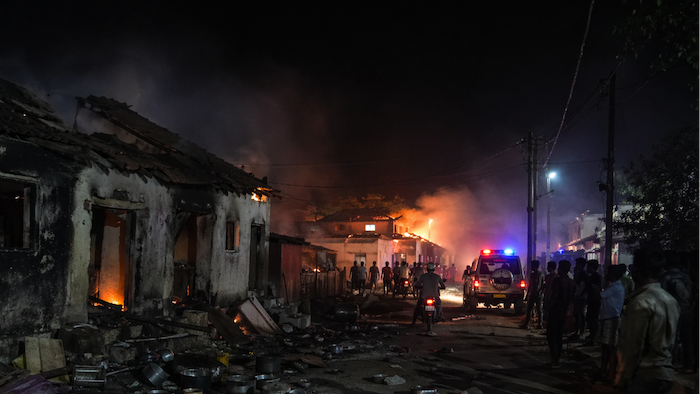
Case Summary
Hindu residents were attacked and their homes vandalised and set on fire in Nadia, West Bengal by unidentified individuals. The violence broke out during the period of Charak Puja festivities. Several Hindu individuals were assaulted and injured. The incident escalated rapidly during the night, leaving multiple Hindu families affected. On the night of 17th April 2026, Hindu residents in the Adarsha Gram area of Madhabpur, under Haringhata Police Station in Nadia district, were present during ongoing Charak Puja and Neel Shiv Puja-related activities. The area was witnessing religious festivities associated with Hindu traditions. During this time, a dispute began following loud revving of motorcycle engines near the locality where Hindu residents were present. The situation escalated into a confrontation between groups. The altercation intensified and turned into a physical attack directed at Hindu residents in the area. As the violence escalated, Hindu homes became the focus of the attack. Three to four houses belonging to Hindu families were vandalised. Property within these homes was damaged during the course of the assault. Following the vandalism, three of the Hindu houses were set on fire during the same sequence of events. Hindu residents who attempted to respond to the disturbance and protect their homes were physically assaulted. One Hindu man was struck during the altercation and fell into a construction pit located near the house. Another Hindu individual who attempted to assist him was also attacked from behind and injured. The violence spread across the locality during the night, affecting multiple Hindu households. The attacks caused fear and disruption among Hindu residents during an ongoing period of religious observance. The situation remained unstable until external intervention occurred. On 18th April 2026, police and Central Forces reached the area following the incident. Several individuals from the village were detained in connection with the violence, with at least eight persons taken into custody. Hindu victims stated that representatives of the Trinamool Congress attributed the incident to members of the Bharatiya Janata Party. Authorities stated that an investigation was underway and maintained that no political angle had been identified. Police presence was increased in the locality, and patrols were conducted to maintain order. The area remained tense following the incident.
Why it is Hate Crime ?
This case has been added to the tracker under the primary category - Attack not resulting in death. Within this, the subcategory selected is - Communal clash/attack. Communal clash is a form of collective violence that involves clashes between groups belonging to different religious identities. For a communal clash between Hindus and non-Hindus to qualify as a religiously motivated hate crime, the trigger of the violence itself would have to be anti-Hindu in essence. For example, if there is a Hindu religious procession that comes under attack from a non-Hindu mob and after the initial attack, Hindus retaliate in self-defence, leading to a communal clash between the two religious communities. While at a later stage, both communities are involved in the clash/violence, the initial trigger of the violence was by the non-Hindu mob against the Hindus and therefore, it could safely be termed as an anti-Hindu violence. Further, the trigger would also have to be religiously motivated. In the cited example, the attack by the non-Hindu mob was against religious processions and therefore, can be concluded to be religiously motivated. In some cases, the trigger may be non-religious, however, it develops into religious violence against Hindus at a later stage. In such cases too, the foundational animosity towards Hindus becomes the motivating factor of the crime and therefore, it would be classified as a religiously motivated hate crime against Hindus under this category. This case qualified as a religiously motivated hate crime because Hindu residents were attacked, their homes vandalised, and set on fire during the period of Charak Puja and Neel Shiv Puja observances. The violence took place in the context of an ongoing Hindu religious festival and was directed at Hindu individuals within their own locality. The escalation from a minor trigger to the targeted destruction of Hindu homes established that the victims were identified and harmed because they were Hindus. Religion was central to both the timing of the attack and the nature of the harm inflicted. It is important to mention here that the violence unfolded while Hindu families were engaged in festival-related observances tied to Charak Puja and Neel Shiv Puja, which hold deep religious and cultural significance. The Hindu residents were observing their festival peacefully in their locality without disturbing others. Despite this, the perpetrators chose to escalate a minor situation into physical assault and arson at that exact moment. This timing was deliberate. By initiating violence during an active religious observance, the perpetrators ensured maximum disruption to a sacred period of worship. This choice demonstrated that the harm was designed not only to injure individuals but to interfere with Hindu religious life at a moment of spiritual importance. The perpetrators chose this moment because it would inflict deeper psychological and cultural harm on Hindu residents. In the second religious marker, the incident developed into a communal attack directed at Hindu residents as a group. The initial trigger, loud revving of motorcycle engines near the locality during an ongoing Hindu festival, escalated into widespread violence that went far beyond a personal disagreement. For Hindu residents, such provocation during a religious period directly affects an environment centred on ritual observance and collective participation. The perpetrators did not limit their actions to the immediate confrontation. They expanded the violence to target Hindu households specifically. Homes belonging to Hindu families were vandalised and set on fire, and individuals who attempted to intervene were physically assaulted. This progression showed that the perpetrators deliberately moved from a minor trigger to the collective punishment of Hindu residents. The decision to burn homes indicated an intention to cause maximum damage, targeting both physical safety and the security of Hindu living spaces. This demonstrated that the perpetrators acted against Hindus as a community, using violence to intimidate, displace, and destabilise them within their own locality because of their religious identity. Obviously, it was not the objection to the loud revving of motorcycle engines by the Hindu devotees that actually triggered the Islamists, in fact, that was only an excuse used by the perpetrators to target the Hindus because of their religious identity. Such attacks are a form of symbolic aggression against the Hindu community that stems from an innate hatred for Hinduism. Given that the fundamental motivation behind these actions was contempt for Hindus and their religion, this instance has been added to the tracker under the following category. The victim count in this case has currently been recorded as two, based on confirmed reports of individuals who sustained physical injuries during the attack. While multiple Hindu homes were vandalised and set on fire, and several families were directly affected by the violence, specific details regarding individual victims beyond the two injured persons have not been clearly documented at this stage. Given the scale and nature of the attack, which involved targeted violence against multiple households, there remains a strong possibility that additional Hindu residents were impacted. However, in the absence of verified, individual-level confirmation, the count has been conservatively limited to two.
Victim Details
Total Victim
2
Deceased
0
Gender
- Male 2
- Female 0
- Third Gender 0
- Unknown 0
Caste
- SC/ST 0
- OBC 0
- General 0
- Unknown 2
Age Group
- Minor 0
- Adult 0
- Senior Citizen 0
- Unknown 2


Case Status
Complaint filed


Perpetrators Details
Perpetrators
Unknown
Perpetrators Range
Unknown
Perpetrators Gender
unknown
 Sources




