Hindu devotees attacked during charak puja with stones, multiple injured and hospitalised by Muslim group
 Medinipur, West Bengal, India
  16 April, 2026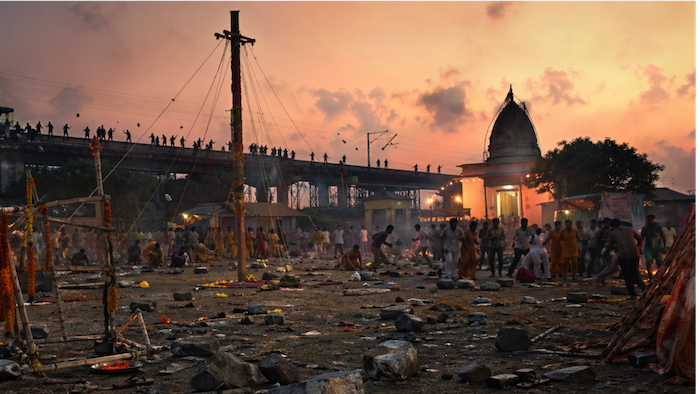
Case Summary
Hindu devotees were attacked and injured during Charak Puja celebrations in Medinipur, West Bengal by Muslim group. The gathering was disrupted at the moment of religious observance. Violence broke out as rituals were about to begin. Several Hindu individuals were left injured and hospitalised. On the night of 17th April 2026, Hindu devotees had gathered in Medinipur town for Charak Puja rituals, a long standing religious tradition associated with Lord Mahadev. The event was being conducted at a location historically used for these rituals. As preparations for the ceremony progressed, a group of Muslim individuals objected to the performance of the rituals at that site and stated that the event would not be allowed to proceed. Hindu devotees approached the local police station to seek clarification and intervention. Police authorities stated that the rituals could proceed as they were part of a long standing tradition. Following this, preparations continued for the ceremony under the expectation that the event would take place. On 18th April 2026, as the Charak Puja rituals began and Hindu devotees gathered in large numbers, a coordinated attack was carried out. From elevated positions near the railway tracks and surrounding structures, Muslim perpetrators hurled large stones at the Hindu crowd. The stones used were of the type typically found along railway lines and were thrown with force towards the gathering. Several Hindu devotees were struck during the attack. At least four Hindu individuals sustained injuries to the head, neck, and other parts of the body. The injured were taken to hospital for treatment. The attack caused panic among the devotees and disrupted the religious proceedings. During the same sequence of events, reports emerged that stones had been stockpiled in advance on rooftops and nearby locations. The positioning of the perpetrators at elevated points enabled sustained stone pelting on the Hindu gathering. The attack continued for a period of time, affecting multiple individuals present at the site. Following the incident, Hindu devotees gathered at the police station to demand action. They raised concerns regarding the attack, the injuries sustained, and the continuation of the violence during the religious event. A road blockade was organised as part of the protest. Hindu protesters also raised concerns regarding the detention of a Hindu man who had been present at the event as a participant. He was taken into custody during the aftermath of the incident. The gathering demanded his release and action against those responsible for the attack. Police and Central Forces were deployed in the area following the incident. Several individuals were detained in connection with the violence. Authorities stated that an investigation was underway and that no political angle had been identified at that stage. The area remained tense with continued police presence and monitoring.
Why it is Hate Crime ?
This case has been added to the tracker under the primary category - Attack not resulting in death. Within this, the subcategory selected is - Attack on religious procession. The outward celebration and display of religious symbols in an intrinsic part of Hinduism. Religious processions on various festivals are age-old traditions and a way to manifest faith and form a part of the religious practices of Hindus. On several occasions, such religious processions come under attack by non-Hindu mobs, in a manifestation of their animosity towards Hinduism and their practices. The reasons cited for such violent attacks are many and range from crossing a non-Hindu resident-dominated area to playing loud music, crossing from an area where there is a religious structure of another faith etc. The violent attacks are triggered by the outward display of religiosity by Hindus. The attacks are mainly a manifestation of religious supremacist doctrine which believes that idolatry, essentially the Hindu faith, is one that deserves to be annihilated since the very tenets of Hinduism, its practices and traditions are considered a sin in those doctrines. Since these attacks emanate from intrinsic and doctrinal animosity towards Hindus and Hinduism, it is considered a religiously motivated hate crime under this category. Another subcategory selected for this case is - Attack against Hindu devotees. Hindu devotees are a few of the easiest targets of religiously motivated hate crimes because during the festival/procession/puja etc, for non-Hindus it is easy to profile their victims on the basis of religion. Hindu devotees come under attack on several occasions by individual non-Hindus or mobs of non-Hindus owing to their animosity against Hinduism, its symbols and tradition/practices. There are several instances of Hindu devotees being attacked while they worship in temples or temporary religious structures, during religious processions, doing bhajan/kirtan/puja in their own homes, in the residential society etc. These attacks are perpetrated by non-Hindus primarily because of their animosity towards Hindus and their faith. In some cases, the trigger for the violence may be non-religious, however, there are two elements that make these hate crimes. First, the Hindus who come under attack are attacked violently while indulging in religious activity. Whether they are in a place of worship or not is immaterial to the crime. When individuals are attacked while indulging in religious practices, the attack in itself is a hindrance to their freedom to practice religion and therefore constitutes a hate crime. Secondly, religious supremacist doctrines and ideologies deem religious practices of Hindus to be offensive ab initio since they are considered “sinful” by these ideologies, worthy to be annihilated by force or coercion. Driven by these religious supremacist ideologies and doctrines, the attacks against Hindu devotees stem from intrinsic animosity towards Hinduism. In some cases, the trigger for the violence may be non-religious, however, it develops into a religiously motivated crime during the course of the violence. Since these attacks stem from animosity towards Hindus and Hinduism, they are considered religiously motivated hate crimes under this category. The other primary category selected for this case is - Attack on religious representations. Within this, the subcategory selected is - Desecration of Hindu religious symbol. Icons and symbols or a religious representation of a spiritual ideal are widely revered in Hinduism. Iconography is of vital significance in the Hindu milieu. It helps connect people’s spiritual beliefs with the real world. Iconography within the Hindu faith takes several shapes and forms. Murtis are of most significance to Hindus, to which daily rituals, prayers and offerings are done. Besides the murtis, there are several other symbols which have deep significance in the Hindu faith – the Om and Swastika for example. Since these Hindu religious symbols hold paramount importance in Hinduism, any desecration of symbols, icons, murtis, religious representations and manifestations, is driven by animosity towards the faith itself which manifests itself through these murtis, icons and symbols. Therefore, any desecration of these Hindu religious symbols and representations is considered religiously motivated hate crimes under this category. This case qualifies as a religiously motivated hate crime because Hindu devotees were deliberately attacked while participating in Charak Puja, a significant and long-standing religious tradition. The gathering was neither spontaneous nor unlawful; it was part of an established practice observed in the area over time. Despite this, the organisers had sought prior permission before proceeding with the celebration, indicating that the event was intended to be conducted in a lawful, peaceful, and organised manner. There is no indication that the devotees engaged in any behaviour that could be construed as provocation. The participants were engaged in ritual worship connected to their faith when the violence was initiated. The attack was carried out at the peak of the religious activity, when devotees were visibly engaged in worship. This timing is significant because it ensured maximum disruption of a sacred ritual and heightened the impact of the violence. The targeting of a religious gathering in such a moment demonstrates that the intent extended beyond causing physical harm. It interfered directly with the devotees’ ability to practise their faith and transformed a sacred occasion into one of fear and insecurity. The victims were clearly identifiable as Hindus engaged in a religious procession and ritual. The attack was not directed at random individuals or property but at a congregation assembled for worship. This establishes that the selection of targets was linked to their religious identity and the visible expression of that identity in a public space. The fact that the attack occurred during a religious procession further reinforces that the perpetrators chose a moment when the Hindu identity of the participants was most visible. Another critical aspect is that the violence followed prior objections to continuing the Charak Puja rituals. This indicates that the attack was not spontaneous but was preceded by resistance to the religious activity itself. The escalation from objection to violence shows a clear intent to prevent or suppress the continuation of the ritual. The disruption of a long-standing tradition under these circumstances reflects hostility towards the religious practice and its public expression. The attack also carried a broader impact beyond the immediate victims. By targeting devotees during a recognised religious event, the perpetrators created an atmosphere of fear that extends to the wider Hindu community. Such acts send a message that participation in religious gatherings can invite violence, thereby discouraging open and collective expression of faith. This chilling effect is a key indicator of targeted hostility, as it seeks not only to harm individuals but also to restrict the community’s religious freedom. Basically, the attack on the Hindu religious event had multiple threads of religious animosity leading to the violence against Hindus. First, the Muslim mob pelted stones at the devotees peacefully carrying out their own religious activity. The attack was unprovoked in nature, and the Hindu devotees had done nothing which could be branded as provocation leading to the violence by the Muslim mob. The unprovoked attack was driven by intrinsic and doctrinal religious animosity, which also stemmed from the fact that the attack was launched even after due permission was granted by the authorities to carry out the Hindu festival. This was not an isolated incident; in fact, there is a precedent. Hinduphobia Tracker has documented several such incidents where Hindu religious procession or events have come under attack by Muslims on some pretext or other, as ridiculous as playing of DJ music or passing across a mosque. Hindus often face hostility since the tenets of Islam harbour antagonism towards the Hindu faith and the adherents of Hinduism. Such religious and doctrinal animosity manifests in violence against Hindu devotees when religious processions pass areas with a Muslim majority. Since the violence was a product of religious animosity, this case is being categorised as a religiously motivated hate crime.


Case Status
Complaint filed


Perpetrators Details
Perpetrators
Muslim Extremists
Perpetrators Range
Unknown
Perpetrators Gender
unknown
 Sources




