Hindu student lured, blackmailed and coerced into removing 'Bindi', 'Kalava'; compelled to convert and take oath of Gazwa-e-Hind by Muslim student in Nashik, Maharashtra
 Nashik, Maharashtra, India
  16 April, 2026
Case Summary
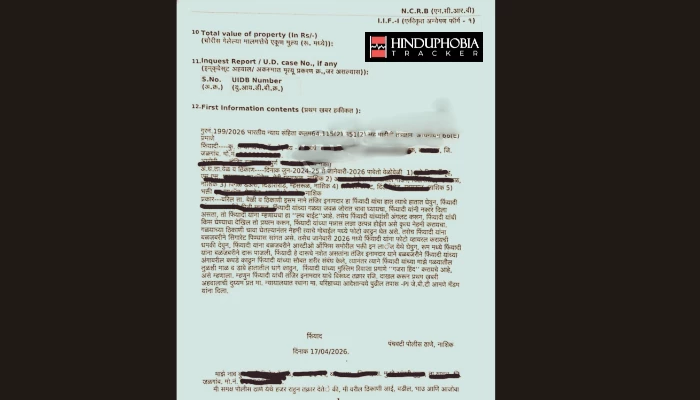
In Nashik, Maharashtra, a young Hindu woman, an engineering student aged 20 years, was lured, brainwashed, deceived, blackmailed and forced to convert by a Muslim student named Tanzeer Inamdar. The case came to light on 17th April 2026, after a young Hindu woman approached the Panchavati Police Station and lodged a complaint against the accused. Acting on her complaint, the police registered an FIR and arrested the accused. The team at Hinduphobia Tracker secured a copy of the FIR and annexed it to the report, for reference. As per the complaint, the accused had initially befriended the Hindu victim and developed a relationship with her by promising marriage. This interaction began around June 2024. Over time, he started taking her to different locations, including private spaces and lodges. During these meetings, he forced her to consume alcohol and smoke cigarettes. The victim stated that on several occasions, she was not fully conscious when sexual acts were committed against her. The victim further stated that during the course of the relationship, the accused deliberately removed her Hindu religious identifiers, including her Tulsi mala from her neck, her bindi and ‘Kalava’, a sacred thread from her wrist. After doing so, he pressured her to adopt Islamic practices and attempted to compel her to take an oath associated with “Ghazwa-e-Hind.” During the course of the relationship, the accused captured private and objectionable photographs of the victim without her consent. In January 2026, he began using these images to threaten her with defamation and to circulate them virally on social media. Under this threat, he repeatedly took her to lodges and forced physical relations. The victim also stated that the accused inflicted physical marks on her body, including biting her neck and referring to it as a “love bite.” These acts were followed by continued coercion and exploitation. The incidents of sexual exploitation took place over an extended period from June 2024 to January 2026, across multiple locations, including lodges, college premises, gardens, and other private establishments. As the harassment escalated in January 2026, the victim approached the police and filed a formal complaint. Following this, the accused was arrested and produced before the court. Police further indicated that there was suspicion that the accused may have targeted other women similarly, though only one formal complaint had been registered at the time. The investigation remained ongoing.
Case Images
Why it is Hate Crime ?
This case is being added to the tracker under the primary category- Crimes against women in relationships or other sexual crimes. The subcategory selected is- Brainwashed and/or Groomed. The tertiary categories selected are - Victim says was groomed, Rape and sexual assault/harassment. In our database, we have not added incidents where women have converted to another religion of their free will, and no allegations of forced/involuntary conversion have been made. However, there are certain cases of conversion where the consent itself is a result of the brainwashing or grooming of a minor by the non-Hindu perpetrator trying to victimise a woman for her Hindu religious identity. The phenomenon of grooming points to non-Hindu perpetrators identifying their Hindu victims’ vulnerabilities and exploiting them over months and sometimes years, to extract the supposed ‘consent’ to convert their religion. In most cases of grooming, the victims are minors, or the grooming started when the victim was a minor. In other cases of grooming, the non-Hindu perpetrator brainwashes and grooms a minor victim to extract their trust and then proceeds to rape them repeatedly with the intent of converting them to their faith. It is pertinent to understand here that when the victim is a minor, the ‘consent’ to convert or enter into a romantic relationship with an adult itself is redundant – addressed by POCSO. While every case of conversion of a minor and incidents of establishing a physical relationship with a minor by an adult are crimes, for this database, a case would be considered a hate crime only if there is a distinct religious angle to the grooming. For example, in the UK, if a Hindu minor is targeted by Pakistani grooming gangs, it would be considered a hate crime because the victims are specifically targeted owing to their non-Muslim religious identity, with the perpetrators being Muslim. In other cases, if a Hindu minor is brainwashed into entering a physical relationship with the non-Hindu adult perpetrator and the family alleges grooming/brainwashing of the minor to convert her religion, it would form a part of this database. If the victim is a Hindu adult, the case would form a part of this database only if the victim herself says that she was brainwashed/groomed to convert her religion. However, if the victim is deceased (murdered or otherwise), the case would form a part of this database if her family/friends provided testimony that the victim was brainwashed/groomed to convert her religion. Since these crimes have a distinct religious angle where the victim is being targeted owing to her Hindu religious identity, these cases are considered hate crimes. The other secondary category selected here is - Blackmailed to convert. When Hindu women are in a relationship with non-Hindu men, there are cases where the woman is blackmailed to convert to another religion, owing to her religious identity as a Hindu. Such relationships may be consensual with the religious identity of the non-Hindu man known to the victim; however, there could be cases where the relationship is not consensual, and the non-Hindu man starts blackmailing a Hindu woman to convert her religion. In these cases, it is often seen that the Hindu woman is blackmailed with intimate photos and/or videos, threats of harm to her or her family, threats of violence, etc. Such cases are driven by specific religious motivations and against the religious identity of the victim and are therefore qualified as hate crimes. The other secondary category selected here is- Desecration of Hindu religious symbols in relation. When Hindu women are in a relationship with non-Hindu men, there are cases where the woman faces insult and desecration of her faith (Hinduism) and its symbol because of the inherent disregard for polytheism of the non-Hindu partner. Such relationships may be consensual with the religious identity of the non-Hindu man known to the victim. Somewhere along the relationship, the non-Hindu man starts desecrating the religious symbols of the Hindu partner out of spite for her faith. Such cases are driven by specific religious motivations and against the religious identity of the victim and are therefore qualified as hate crimes. This third primary category selected in this case is -"Attack not resulting in death". The subcategory selected is- “Attacked for Hindu identity.” In several cases, Hindus are attacked merely for their Hindu identity without any perceived provocation. A classic example of this category of religiously motivated hate crime is a murder in 2016. 7 ISIS terrorists were convicted for shooting a school principal in Kanpur because they got ‘triggered’ seeing the Kalava on his wrist and the tilak that he had put. In this, the Hindu victim had offered no provocation except for his Hindu religious identity. The motivation for the murder was purely religious, driven by religious supremacy. Such cases where Hindus are targeted merely for their religious identity would be documented as a hate crime under this category. In this case, a Hindu woman was systematically groomed, sexually exploited, blackmailed, and pressured to convert to Islam by the Muslim accused, Tanzeer Inamdar. What began as a relationship on the promise of marriage quickly unfolded into a calculated pattern of control where her Hindu identity was not incidental but central to the abuse. The trigger in this case did not arise from a mere personal dispute but from a sustained and deliberate targeting of a Hindu woman’s religious identity, executed through a repeated and patterned course of conduct that revealed clear intent. The moment her Tulsi Mala and sacred thread were removed, and she was persistently pressured to abandon her faith, the nature of the acts crossed into religiously motivated wrongdoing. This was not an isolated instance of disrespect but a conscious and repeated effort to strip her of visible markers of Hindu identity and replace them with another belief system. The continuity of such acts showed preparation, awareness, and a fixed objective rather than impulse. Even though the accused did not conceal his Muslim identity, the relationship was shaped in a way that led the Hindu victim to believe that religion would not matter. At first, this created trust and comfort. However, as time passed, that trust became the basis for control, and what had appeared ordinary gradually shifted into a situation in which expectations were imposed. In this way, the interaction shifted from mutuality to dominance, showing that the initial acceptance was not genuine but rather a means to draw her in and limit her ability to act freely. Subsequently, the use of threats ensured that this control remained intact. The pressure created through fear of consequences removed any real scope for resistance. As a result, the situation was no longer one of choice but of compliance under intimidation, where the victim was left with limited options and continued under compulsion. In parallel, a clear and direct focus emerged on the victim’s Hindu identity. She was repeatedly pressurised to convert and was made to take an oath linked to “Ghazwa-e-Hind.” The term Ghazwa-e-Hind is often used by radical Muslims to describe a supposed religious battle against the Indian subcontinent, and by extension against Hindu as such Muslims view India as a Hindu collectivity. The very basis of the partition of India was that the Muslims believed that Islam was a nation unto itself, which could not survive with a Hindu collectivity like India. Its use here was therefore not incidental. By forcing the victim to take an oath invoking this term, the accused was not only pressuring her to convert but was also attempting to impose a belief system that positioned her existing faith as something to be rejected. When seen alongside the removal of her Hindu religious symbols and the insistence on adopting Islamic practices, this reflects an effort to replace her Hindu identity and align her with a worldview that stands in conflict with it. This act went beyond mere criminal behaviour; it was a calculated and malicious attack on the victim's religious identity. The Muslim perpetrator first built trust, then manipulated her into a situation where he could coerce her into abandoning her faith. The use of blackmail to force conversion is a clear demonstration of religious hate, as it targets the victim's religious beliefs and seeks to erase her identity. This case is a glaring example of how deep-seated intolerance can manifest in violent and coercive actions, with the ultimate goal of religious subjugation and domination. The deliberate nature of the deception and the subsequent attempt to force conversion highlight the extent of disdain the accused harboured for the victim's faith, making this a clear case of religiously motivated hate. Disclaimer: The Hinduphobia Tracker records incident dates based on when the victim's ordeal began, rather than when the media reported it. In this case, the report does not mention the exact date when the victim's ordeal began; therefore, the date when the FIR was filed, 17 April, 2026, has been recorded as the indicative incident date for documentation purposes.
Victim Details
Total Victim
1
Deceased
0
Gender
- Male 0
- Female 1
- Third Gender 0
- Unknown 0
Caste
- SC/ST 0
- OBC 0
- General 0
- Unknown 1
Age Group
- Minor 0
- Adult 1
- Senior Citizen 0
- Unknown 0


Case Status
Arrested


Perpetrators Details
Perpetrators
Muslim Extremists
Perpetrators Range
One Person
Perpetrators Gender
male
 Sources




