Hindu man forced to convert to Islam, offer namaz, do wudu and eat beef by Muslims in Muzaffarnagar, Uttar Pradesh
 Muzaffarnagar, Uttar Pradesh, India
  15 April, 2026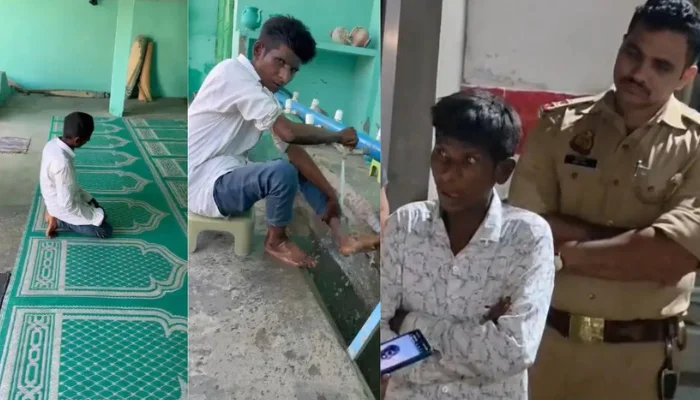
Case Summary
In Muzaffarnagar, Uttar Pradesh, a Hindu man named Rakesh Sharma was forcibly converted to Islam, was made to offer namaz (Islamic ritual prayer), do wudu (Islamic ablution ritual for purification before prayer) and eat beef (cow meat) by Muslims. The young Hindu man was originally a resident of Haridwar district, Uttarakhand, who had been living and working for approximately 15 years in the Bhopa police station area village of Sikri in Muzaffarnagar. He was employed at the home of Afsar Qureshi, the main Muslim accused. This incident came to light when, on 16 April 2026, a Muslim man, Salman, took Rakesh to a mosque in Bhokarhedi town within the Morna area, offered him one hundred rupees, and forced him to perform namaz. The act was filmed on video throughout. The video was circulated on social media and spread rapidly, causing immediate alarm and anger among Hindu organisations across the area. Hindu Sangharsh Samiti convenor Narendra Panwar, also known as Sadhu Gurjar, arrived at the police station with the Hindu victim, recorded his statement, and demanded strict and impartial action against the accused. Hindu organisations surrounded the police station and demanded the immediate arrest of the perpetrators. Anjesh Gurjar and Vaibhav Yadav were present during the demonstration. According to information, Rakesh Sharma stated that he had been working as a domestic help at Afsar's house in the village for the past 15 years. It was stated that in recent days, Afsar, along with his aunt and a maulana (Islamic religious cleric), assaulted him and also forced him to convert, perform wudu, offer namaz, and even force-fed him beef. The Hindu young man provided a full statement to the police. Police took cognisance of the viral video. Hindu organisations expressed outrage and demanded strict action against the accused. Police stated that, given the sensitivity of the matter, a fair investigation had been launched. They stated that the accused had acted in a planned and conspiratorial manner, specifically to film the video and circulate it. Following this, the police registered a case and arrested the main accused, Afsar Qureshi. Meanwhile, Afsar Ali (Rakesh's employer) also filed a police complaint against three unidentified youths. The complaint alleges that these youths lured Rakesh into making a video of him offering namaz in another village's mosque and then made it viral, thus hatching a false conspiracy against him. Afsar Ali has also demanded police action. Senior Superintendent of Police (SSP) Muzaffarnagar Sanjay Kumar Verma said that action was being taken to arrest the accused and send him to jail as per the law. Circle Officer (CO) Bhopa and Station House Officer (SHO) Bhopa formed a team. Evidence and facts were being collected.
Why it is Hate Crime ?
The primary category for this case is "Predatory Proselytisation". The sub-category for this case is "Conversion/attempts to convert by inducement". Predatory Proselytisation is not just limited to threat, harassment, force and violence, but it also has contours of stealth. In several cases, the Hindu victim is exploited to convert, with non-Hindus taking advantage of their poverty. In such cases, the Hindu victim who is suffering financially is offered monetary benefits, including lucrative offers for jobs, health treatment, education, etc, to induce the victim into changing his/her religion. In such cases, the religious identity of the victim and the aim to disenfranchise him from his faith form the heart of the crime. Also, taking advantage of and exploiting an individual’s economic vulnerabilities is widely acknowledged as exploitation, forms of which are often penalised by law. Such cases therefore are considered religiously motivated hate crimes since the victim’s religious identity forms the very heart of the crime itself. The other subcategory selected is "Harassment, threats, coercion for conversion." Harassment covers a wide range of behaviours of an offensive nature. It is commonly understood as behaviour that demeans, humiliates, and intimidates a person, including threats and coercion. Harassment and threats, in this case, find their root on discriminatory grounds which has the effect of nullifying a person’s rights or infringing upon his freedom to exercise his right specifically owing to the victim’s religious identity. Verbal and physical threats and psychological or physical harassment are often used against Hindu victims because they choose to practice their professed religion. Religious harassment also includes forced and involuntary conversions by harassment, threats or coercion. Coercion includes intimidatory tactics like force-feeding a Hindu victim beef to convert to another religion, forceful circumcision etc. In several cases documented, non-Hindu perpetrators or those who harbour specific animosity towards Hinduism, harass victims simply based on their religious identity. Such cases often also include harassment to ensure the Hindu victim abandons his/her professed religion and adopts the religion of the perpetrator. Such cases where Hindu victims are harassed to convert to the perpetrator’s religion are rooted in animosity towards the victim’s religious identity and are therefore documented as religiously motivated hate crimes. This case stood as a clear example of a religiously motivated hate crime as the Muslim perpetrators forced the Hindu victim to convert to Islam, offer namaz (Islamic ritual prayer), perform wudu (Islamic ablution ritual for purification before prayer), and eat beef. They also paid him inducements, like money, to perform Islamic prayers. The victim was assaulted throughout this process. All these elements combined to demonstrate deliberate targeting of his Hindu faith, making it a clear case of a religiously motivated hate crime. In this case, the Hindu victim worked at the Muslim perpetrator's home, which showcased that the perpetrator already had established control over him through the employer-employee dynamic. This professional relationship was exploited by the perpetrator to assert religious dominance, assault the Hindu victim, and later force him to convert to Islam. Overall, this revealed the predatory nature of the crime, driven by religious animosity, making it a clear case of a hate crime. The act of forcing the Hindu victim to convert to Islam violated his religious autonomy and fundamental rights to freely practice his faith. It went beyond a mere change of faith; the perpetrators specifically sought to overwrite and destroy his Hindu faith and identity completely by erasing his religious beliefs through direct coercion and harassment. Forced conversions directly showcased the perpetrators' deep animosity towards Hinduism, as they targeted the victim's core religious identity to humiliate and subjugate him, making it a clear case of a religiously motivated hate crime. The act of forcing the Hindu victim to perform wudu (Islamic ablution ritual) and offer namaz (Islamic ritual prayer) showcased how the imposition of Islamic practices severed him from his Hindu identity. By imposing Islamic faith and its rituals upon him against his will, the perpetrators methodically stripped away his Hindu beliefs, customs, and practices step by step, replacing them with alien religious practices, making this case a clear example of a hate crime. The perpetrators also force-fed the victim beef despite his resistance. In Hinduism, the cow holds a sacred status as a symbol of life, non-violence, and maternal nurturing, central to daily rituals and ethics, and consuming beef is strictly taboo and seen as a grave sin. The act of force-feeding beef to the Hindu victim was done particularly to sever the victim's ties to his Hindu faith completely and irreversibly. Eating beef cuts a Hindu off from his faith and community permanently, as it violates core dietary and spiritual prohibitions in Hinduism. The perpetrators did this forcibly to strip the victim of his Hindu faith entirely, sever all ties to it, and force him into a deeply sinful act. This demonstrated the zeal of the perpetrators who would cross any limit, including violence and desecration, to destroy the victim's Hindu faith and identity. In the past, Muslim extremists repeatedly used force-feeding beef and throwing beef into temples as deliberate tactics to desecrate Hindu sacred spaces, provoke outrage, and forcibly convert Hindus to Islam, establishing these as clear cases of religiously motivated crimes. The perpetrators in this case followed this exact historical pattern of Islamic imperialism and anti-Hindu hatred, employing the same proven tactic of forcible conversion through beef consumption even today to assert dominance, making it a clear case of a religiously motivated hate crime. The perpetrators gave the Hindu victim one hundred rupees specifically to offer namaz in a mosque as a direct financial inducement. The use of such monetary inducements exploited the victim's economic vulnerabilities as a long-term domestic worker in the perpetrator's home, aiming to strip him of his Hindu faith systematically through dependency. When financial inducements are offered to forcibly convert someone, it is never an act of kindness or charity but a calculated method of coercion deeply rooted in religious animosity against Hinduism. The perpetrators arm-twist vulnerable Hindus by exploiting their economic dependence, luring them with cash payments, and forcibly imposing alien faith's practices on them. Similarly, in this case, offering money to a poor Hindu victim working for 15 years at the Muslim perpetrator's house directly exploited his financial vulnerability, tempted him with immediate cash, and pressured him to publicly convert to Islam and perform namaz on camera. This showcased clear predatory tactics engineered for religious conversion and domination, making it a hate crime. The fact that the perpetrators recorded a video of the victim offering namaz in a mosque and circulated it widely on social media platforms showcased their deliberate intent to hurt Hindu sentiments and spark outrage across the Hindu community nationwide. This was done to religiously dominate Hindus through public symbolic humiliation, forcing Hindus to witness one of their own bowing to Islamic rituals under duress. Videos of a Hindu person forced to convert to Islam or offer namaz, shared publicly on the internet for maximum visibility, instilled deep humiliation and demoralisation in the hearts of the Hindu community by openly displaying their core members being stripped of their faith in a visible, mocking manner designed to provoke shame. This calculated tactic directly generated widespread outrage, fear, communal tension, and division, marking it as a clear case of a hate crime. Given that this case met several parameters of a religiously motivated hate crime, it was added to the Hinduphobia Tracker's Hate Crime database. Disclaimer: The Hinduphobia Tracker records the dates of incidents based on when the victim's ordeal begins, rather than when it is reported by the media. In this case, media reports did not specify the exact start date of the ordeal, only noting that the victim had worked for the perpetrator for 15 years and faced recent pressure to convert to Islam, eat beef, perform wudu, and offer namaz. As the precise beginning remained unknown, the date of the video, when Salman took the victim to the mosque and made him offer namaz on 16 April 2026, was selected as the indicative incident date for documentation purposes only. In this case, although the main perpetrator was the Muslim man, Afsar Qureshi, he received help in the entire forced conversion from his aunt and another Muslim youth named Salman. Therefore, the total perpetrator count was recorded as "3", referring to all these individuals.
Victim Details
Total Victim
1
Deceased
0
Gender
- Male 1
- Female 0
- Third Gender 0
- Unknown 0
Caste
- SC/ST 0
- OBC 0
- General 1
- Unknown 0
Age Group
- Minor 0
- Adult 1
- Senior Citizen 0
- Unknown 0


Case Status
Case sub-judice


Perpetrators Details
Perpetrators
Muslim Extremists
Perpetrators Range
From 2 To 5
Perpetrators Gender
both
 Sources




