Hindu wedding guests abused with casteist slurs, assaulted, and stabbed, violence erupts during procession by Muslim perpetrators
 Shajapur, Madhya Pradesh, India
  17 April, 2026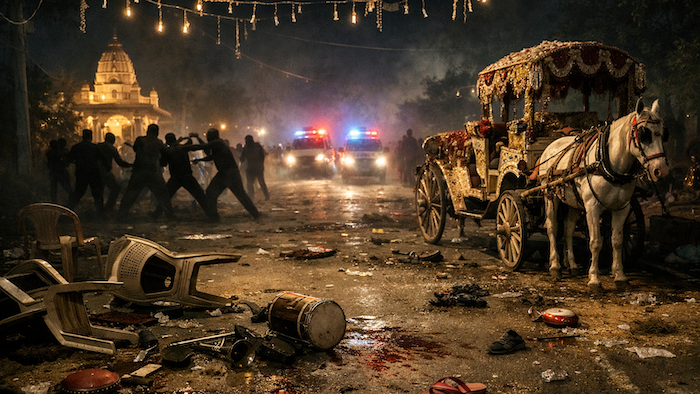
Case Summary
Hindu wedding guests were abused with casteist slurs, attacked and injured during a procession in Shajapur, Madhya Pradesh. The procession was moving through a public road when it was stopped and disrupted by Muslim truck driver. The situation escalated quickly into violence. Several Hindu individuals were left injured as the incident unfolded. On the night of 18th April 2026, between 9 pm and 10 pm, a Hindu wedding procession was passing through the Berchha area in Shajapur district. As the procession moved near Saraswati Shishu Mandir on the Berchha bypass, it encountered a vehicle obstructing the route. The vehicle was being driven by a Muslim man, Shahrukh Sheikh. A dispute began when members of the Hindu wedding procession asked for the vehicle to be moved to allow passage. The Muslim driver refused and began verbally abusing members of the Hindu group. During this exchange, he used caste based slurs directed at the Hindu participants. The verbal confrontation intensified the situation and created tension at the site. Shortly after the initial altercation, the Muslim man left the scene and returned with a group of other Muslim men. The group approached the Hindu wedding procession and began a physical attack. The assault targeted members of the Hindu gathering, leading to multiple injuries. During the attack, the Muslim man, Shahrukh Sheikh, used a knife to stab a Hindu man identified as Suraj Bhilala. Another Hindu man, Arihant Jain, was also attacked by a member of the group identified as Raju. The violence spread across the procession, and a total of six Hindu individuals sustained injuries. The attack disrupted the wedding procession and caused panic among those present. The Hindu participants were forced to stop the procession as the violence continued. The situation remained chaotic for a prolonged period as the group of Muslim men continued the assault. Following the incident, a large number of Hindus gathered and expressed anger over the attack. The gathering escalated into a protest outside the police station, where participants raised slogans and demanded action. The protest created further tension in the area and drew attention to the incident. A written complaint was filed by a Hindu victim, Ravi Samora, aged 32 years. A formal First Information Report was registered. Multiple Muslim men, including Shahrukh Sheikh, Wasim, Pappu, Raju, Iqrar, Anish, Saddam Mansoori, and Tajuddin, were named in the case. Four of the perpetrators were detained. Police forces from multiple stations were deployed to control the situation. Officials engaged with protesters and took measures to maintain order. The investigation remained ongoing.
Why it is Hate Crime ?
This case has been added to the tracker under the primary category - Hate speech against Hindus, and within this, the subcategory selected is- Anti-Hindu slurs, mocking faith. Anti-Hindu slurs and the deliberate mocking of the Hindu faith owing to religious animosity involve the usage of derogatory terms, stereotypes, or offensive references to religious practices, symbols, or figures. One of the common anti-Hindu slurs used against Hindus is “cow-worshipper” and “cow piss drinker”. The intention of using this term is to demean and mock Hindus as a group and their religious beliefs since Hindus consider the cow holy. Additionally, some symbols and the slurs attached to them have a historical context that exacerbates the insult, hate, stereotyping, dehumanisation and oppression against Hindus. Cow worship has been used for centuries to denigrate Hindus, insult their faith and oppress Hindus specifically as a religious group. There has been overwhelming documentation about how cow slaughter has been used to persecute Hindus with cow meat being thrown in temples and places of worship. There has also been overwhelming documentation where cow meat (beef) has been force-fed to Hindus to either forcefully convert them to Islam or denigrate their faith. Apart from cow worship, the Swastika – which holds deep religious significance for the Hindus – has also been misinterpreted and distorted to use as a slur against Hindus. Similarly, the worship of the Shivling has been used by supremacist ideologies and religions to denigrate Hindus owing to religious animosity. Such slurs and denigration stem out of inherent animosity and hate towards Hindus and their faith, therefore, it is categorised as hate speech targeted at Hindus specifically owing to their religious identity. The other category is- Attack not resulting in death. Within this, the subcategory selected is - Attacked for Hindu identity. In several cases, Hindus are attacked merely for their Hindu identity without any perceived provocation. A classic example of this category of religiously motivated hate crime is a murder in 2016. 7 ISIS terrorists were convicted for shooting a school principal in Kanpur because they got ‘triggered’ seeing the Kalava on his wrist and tilak that he had put. In this, the Hindu victim had offered no provocation except for his Hindu religious identity. The motivation for the murder was purely religious, driven by religious supremacy. Such cases where Hindus are targeted merely for their religious identity would be documented as a hate crime under this category. This case qualified as a religiously motivated hate crime because Hindu wedding participants were deliberately targeted and attacked by Muslim perpetrators during a religious and cultural procession. The violence was directed at a Hindu gathering engaged in a significant life event tied to their identity. The perpetrators escalated a minor dispute into a coordinated assault against Hindu individuals. Religion was central to the selection of the target and the nature of the violence inflicted. In the primary religious marker, Hindu individuals were subjected to a violent physical attack that did not result in death but caused serious injuries. The attack occurred during a Hindu wedding procession, a moment of religious and cultural significance. For Hindus, such processions are not merely social events but public expressions of identity and tradition. The perpetrators chose to escalate the situation at this exact moment, ensuring that the harm would disrupt a sacred and communal occasion. This was not an isolated act of violence. The decision to attack during a Hindu procession showed deliberate timing intended to maximise fear and disruption within a Hindu gathering. This revealed that the perpetrators chose a moment of collective Hindu visibility because it would have a greater psychological and social impact on the community. In the second religious marker, the Muslim perpetrators targeted the Hindu procession specifically because of the identity of those present. The initial confrontation involved verbal abuse and caste-based slurs directed at Hindu individuals. These slurs were not generic insults. They were rooted in caste identity, which holds deep social, cultural, and historical significance within Hindu society. For Hindu victims, such language is designed to degrade dignity, humiliate identity, and reinforce social vulnerability. The perpetrators deliberately chose caste-based abuse because it strikes at an internal and sensitive aspect of Hindu identity. This was not spontaneous anger. It was a calculated choice of words intended to provoke, demean, and psychologically weaken the Hindu group before escalating to physical violence. By using caste slurs, the perpetrators ensured that the attack was not limited to physical harm but extended into symbolic humiliation of the Hindu identity itself. This verbal targeting was immediately followed by a coordinated physical assault, showing a clear progression from identity-based humiliation to bodily harm. The perpetrators did not disengage after the exchange. They returned with reinforcements and attacked the same Hindu group. This demonstrated that the caste-based abuse was an intentional precursor to violence, used to establish dominance and justify escalation. The deliberate use of such language revealed that the perpetrators consciously targeted Hindus not only as individuals but as members of a socially and religiously identifiable group, with the intent to maximise both psychological and physical harm. In the third religious marker, the incident developed into a broader communal attack involving multiple perpetrators acting together against Hindu individuals. When the Muslim perpetrators regrouped and returned with a larger group, transforming a dispute into a targeted assault. For Hindu victims, being attacked by a coordinated group from another community creates a sense of collective targeting rather than a personal conflict. The use of weapons, including a knife, and the targeting of multiple individuals within the procession showed organised intent to inflict harm. The perpetrators did not limit their actions to a single individual. They expanded the violence across the group, ensuring that multiple Hindu individuals were injured. This revealed that the attack was designed to send a broader message of intimidation to the Hindu community. The choice to escalate collectively and target a group demonstrated that the perpetrators intended to harm Hindus as a community rather than engage in just a personal dispute. Given that this case met the parameters of a religiously motivated hate crime, it was added to the hate crime database of the tracker.
Victim Details
Total Victim
6
Deceased
0
Gender
- Male 6
- Female 0
- Third Gender 0
- Unknown 0
Caste
- SC/ST 0
- OBC 0
- General 0
- Unknown 6
Age Group
- Minor 0
- Adult 6
- Senior Citizen 0
- Unknown 0


Case Status
Complaint filed


Perpetrators Details
Perpetrators
Muslim Extremists
Perpetrators Range
From 5 to 10
Perpetrators Gender
male
 Sources




