Hindu sentiments hurt as sacred temple wall defiled; inscripted with defamatory words against dieties in Chatra, Jharkhand
 Chatra, Jharkhand, India
  15 April, 2026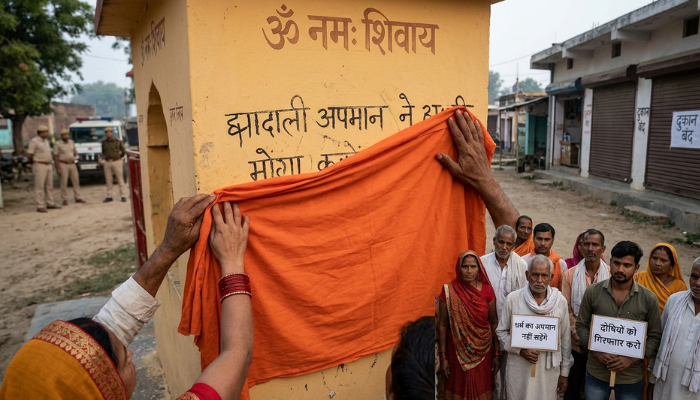
Case Summary
In Chatra district, Jharkhand, Hindu deities were disrespected and derogatory words against deities were written on the wall of a temple by unknown perpetrators. The incident came to light in the morning when villagers arrived at the temple to perform prayers. Upon reaching the premises, they discovered that the temple wall had been defaced with insulting words directed at Lord Ram and Goddess Sita. The content was considered deeply offensive and disrespectful towards the deities. As the news spread quickly through the village, it sparked strong reactions among members of the Hindu community. The act was seen as a deliberate attempt to insult their religious beliefs and hurt their sentiments. The defacement of the temple caused widespread anger among the villagers, who viewed it as an attack on their faith. A local villager, Rahul Kumar, stated that this was not the first such incident in the area. He said that the temple had been targeted in a similar manner earlier as well, but no concrete action had been taken by the police at that time. Following the incident, members of the Hindu community staged protests in the area. As part of their protest, local market shops were shut, and it was clearly stated that the shutdown would continue until strict action was taken against those responsible. After the incident, police deployed heavy security in the area and effectively turned the locality into a secure zone to prevent any escalation.
Why it is Hate Crime ?
This case is being added to the tracker under the primary category- Attack on Hindu religious representations. The subcategory selected is- Desecration of a Hindu religious symbol. Icons and symbols, or a religious representation of a spiritual ideal, are widely revered in Hinduism. Iconography is of vital significance in the Hindu milieu. It helps connect people’s spiritual beliefs with the real world. Iconography within the Hindu faith takes several shapes and forms. Murtis are of most significance to Hindus, to which daily rituals, prayers and offerings are done. Besides the murtis, there are several other symbols which have deep significance in the Hindu faith – the Om and Swastika, for example. Since these Hindu religious symbols hold paramount importance in Hinduism, any desecration of symbols, icons, murtis, religious representations and manifestations, is driven by animosity towards the faith itself, which manifests itself through these murtis, icons and symbols. Therefore, any desecration of these Hindu religious symbols and representations is considered a religiously motivated hate crime under this category. The other subcategory selected is- Attack on Temples. In Hinduism, a temple is the abode of the Deity. The Deity in the Temple is consecrated, thereby making it a real, breathing entity. Hindus believe that not just the Deity but the temple premises itself are sacred to Hindus since Hindus hold the faith that the entire Temple space is an amalgamation of the divine energy of the deity. Given the central significance of Temples in Hindu Dharma, any attack against a Hindu Temple or its peripheral premises is an attack on the faith itself and is born out of animosity towards the faith, of which the Temple is a central tenet. Any manner of attack against a Temple and/or its premises would therefore be considered a religiously motivated hate crime. This case reflected a clear and targeted act of hostility towards the Hindu faith, as the wall of a temple was deliberately defaced with derogatory and insulting words against revered deities like Lord Ram and Goddess Sita. Such an act was not random vandalism. It directly struck at sacred representations that Hindus worship and revere with deep devotion. By choosing a temple wall as the site of the act, the perpetrators ensured that the insult was not private but public, visible to every devotee who came to offer prayers, thereby maximising hurt and humiliation. Temples in Hindu Dharma are not merely physical structures; they are considered sacred spaces where the divine resides. The entire temple premises are treated with reverence, and every part of it is associated with spiritual significance. Defacing such a space with abusive and objectionable content amounted to a direct violation of that sanctity. It was an act designed to pollute a place of worship and disrupt the sense of peace and devotion that the temple provides to the community. The use of written abuse targeting deities further showed that the attack was aimed not just at property, but at the core beliefs of Hindus. An important factor that deepened the gravity of this incident was that such acts had occurred in the area before. A local villager explicitly stated that the temple had been targeted in a similar manner earlier as well, but no effective action had been taken at that time. This repetition showed that the perpetrators acted with a sense of impunity and confidence that they would not face consequences. It also indicated a pattern, where the same sacred space was repeatedly chosen to provoke and insult, pointing towards deliberate and sustained intent to hurt the religious sentiments of Hindus rather than a one-off incident. The impact of such incidents goes beyond immediate outrage and creates deep anger and resentment within the Hindu community. Devotees who visit temples for peace and devotion are instead confronted with deliberate insults to their faith, which leaves a lasting sense of hurt and humiliation. When such acts are repeated, and no strict action is taken against those responsible, it fosters a feeling among Hindus that their beliefs are not being respected or protected. Over time, this inaction leads to a sense of helplessness, where individuals begin to feel that both their religion and their identity are being undermined without consequence. Taken together, the facts showed a deliberate attempt to insult Hindu deities, defile a sacred temple space, and provoke the community. The repeated nature of such incidents in the same area strengthened the inference that the act was driven by intent to hurt religious sentiments and undermine the sanctity of Hindu religious symbols and spaces. Such conduct clearly went beyond ordinary mischief and carried the imprint of targeted religious hostility. It is important to mention here that though the last update was that the miscreants were unknown, regardless, the action stemmed out of hatred against Hinduism and resulted in the desecration of the sacred temple and would therefore be considered a religiously motivated hate crime. Disclaimer: The Hinduphobia Tracker records incident dates based on when the crime occurs, rather than when it is reported in the media. In this case, the exact date of the defacement was not specified in the source material. Therefore, the date on which the incident came to light and was reported has been recorded as the indicative incident date for documentation purposes.


Case Status
Unknown


Perpetrators Details
Perpetrators
Unknown
Perpetrators Range
Unknown
Perpetrators Gender
unknown
 Sources




