Revered Hindu diety Lord Hanuman disrespected, ridiculed and mocked in a play performed at Budaun's Madarsa
 Budaun, Uttar Pradesh, India
  14 April, 2026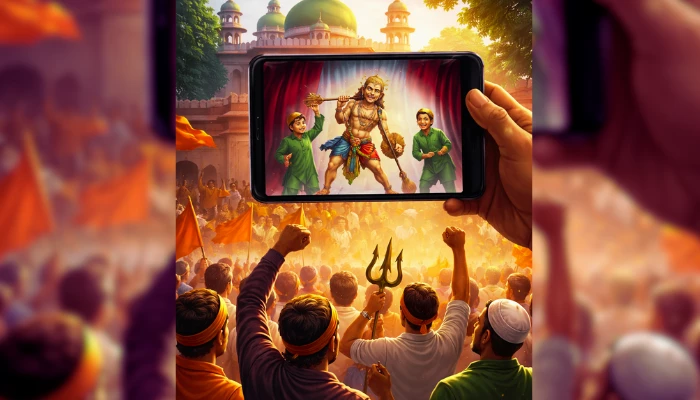
Case Summary
In Budaun, Uttar Pradesh, Lord Hanuman, a revered Hindu deity, was mocked and degraded during a staged performance at a madrasa. Enacted by minor children of the madrasa, the play, presented under the guise of satire on the gas cylinder issue, distortedly portrayed Lord Hanuman to demean and ridicule the Hindu faith. This demeaning portrayal of the Hindu deity triggered outrage after the video of the act surfaced on social media. In the skit, one student was dressed as Lord Hanuman, while another student, in a saffron dress, represented a common Hindu man. During the act, dialogues were delivered in which the common man asked Lord Hanuman for a gas cylinder. He offered incense sticks and prasad to the god, and then demanded that the god return the offering to him. One of the central lines spoken during the act was: “If you can't get a gas cylinder, what's the use of Hanuman?” This line was addressed by the Hindu man to Lord Hanuman. He further questioned his worth when his demands to secure a cylinder were not “fulfilled.” In another part of the performance, the character portraying Hanuman was addressed as“DM office ka babu”, comparing Lord Hanuman to a clerk in the District Magistrate’s office. Lord Hanuman, on several occasions, was shown using abusive and derogatory words. The portrayal reduced the revered deity to a subject of ridicule, with gestures and presentation that offended religious sentiments. The video of the act was recorded and later went viral on social media platforms. Following the circulation of the video, local Hindu organisations and residents expressed strong objections, stating that the act was an insult to their religious beliefs and an affront to a deeply revered figure in Hinduism. They demanded strict action against those responsible for organising and allowing such a performance. The outrage was not limited to local circles, as the video gained wider traction online, amplifying calls for accountability. Upon receiving information about the incident, local police took cognisance of the matter and initiated an inquiry. Authorities stated that appropriate legal action would be taken based on the investigation's findings. Reports indicated that some members of the protesting groups also raised additional concerns about the madrasa, claiming that students are being taught general knowledge related to Pakistan and questioning the intent behind it. They further claimed that the madrasa building stands on occupied land and called for a detailed investigation into these aspects as well. The incident added to a growing pattern of controversies involving perceived insults to Hindu religious symbols and deities, with community members emphasising the emotional and religious harm caused by such representations.
Why it is Hate Crime ?
This case is added to the tracker under the primary category- Hate Speech against Hindus. The subcategory selected is- Anti-Hindu slurs, mocking faith. Anti-Hindu slurs and the deliberate mocking of the Hindu faith owing to religious animosity involve the usage of derogatory terms, stereotypes, or offensive references to religious practices, symbols, or figures. One of the common anti-Hindu slurs used against Hindus is “cow-worshipper” and “cow piss drinker”. The intention of using this term is to demean and mock Hindus as a group and their religious beliefs since Hindus consider the cow holy. Additionally, some symbols and the slurs attached to them have a historical context that exacerbates the insult, hate, stereotyping, dehumanisation and oppression against Hindus. Cow worship has been used for centuries to denigrate Hindus, insult their faith and oppress Hindus specifically as a religious group. There has been overwhelming documentation about how cow slaughter has been used to persecute Hindus, with cow meat being thrown in temples and places of worship. There has also been overwhelming documentation where cow meat (beef) has been force-fed to Hindus to either forcefully convert them to Islam or denigrate their faith. Apart from cow worship, the Swastika – which holds deep religious significance for the Hindus – has also been misinterpreted and distorted to use as a slur against Hindus. Similarly, the worship of the Shivling has been used by supremacist ideologies and religions to denigrate Hindus owing to religious animosity. Such slurs and denigration stem from inherent animosity and hate towards Hindus and their faith; therefore, it is categorised as hate speech targeted at Hindus specifically owing to their religious identity. This case showed a clear and direct insult to the Hindu faith through the staged portrayal of Lord Hanuman in a madrasa. Lord Hanuman was not merely a character for Hindus; he was deeply worshipped and revered. Presenting such a deity in a mocking and degrading manner turned a sacred figure into an object of ridicule. This was not a casual act. It directly hurt the religious feelings of Hindus by disrespecting someone they held in the highest regard. Primarily, the setting itself was not incidental. Within Islamic belief, the concept of divinity was exclusive, with the assertion that there was no god but Allah. In such a framework, the inclusion of a Hindu deity in a staged act within a madrasa served neither devotional nor educational purposes. It raised a fundamental question of intent. The only plausible outcome of such a portrayal was ridicule, as the framework itself did not permit reverence towards non-Islamic deities. This transformed the act into a conscious exercise in belittling a faith held sacred by another community. Further, the manner in which Lord Hanuman was depicted aggravated the insult. He was depicted as a divine power, yet his divine stature was reduced to that of a powerless government clerk, portrayed as someone burdened by the system and unable to fulfil devotees' wishes. This representation stripped the deity of divinity and reduced a symbol of strength and devotion into a figure of helplessness and satire. Such a portrayal was not neutral; it was crafted to mock the very idea of Hindu belief in divine protection. Moreover, the act went beyond mere depiction and entered into direct ridicule of religious practices. Lord Hanuman was shown abusing devotees, using derogatory language, and engaging in behaviour that was completely contrary to how he was revered in Hindu tradition. The process of offering agarbatti and prasad, acts of devotion and reverence, was mocked and trivialised. These were not symbolic gestures alone but integral parts of daily worship for millions. By ridiculing these practices, the act targeted not just a deity but the lived faith of the community. It is important to understand that Hindu gods and symbols are sacred and form an essential part of daily life and belief. When they were shown mockingly, it sent a message that the Hindu faith could be ridiculed without consequence. This was not just about one performance. It reflected a mindset where Hindu beliefs were treated as expendable and open to insult. Such acts contributed to the normalisation of disrespect towards the community. Further, the damage increased when the video spread widely on social media. It signalled to the Hindu community that their most revered figures could be mocked openly, without restraint. It created an atmosphere where such ridicule could be repeated and even encouraged, deepening mistrust and tensions. Overall, this was neither a harmless act nor a simple performance. It was a direct and layered insult to a respected Hindu deity and to Hindu religious practices. The portrayal, the language used, and the mocking of rituals together reflected a deliberate attempt to demean the faith. Given that the underlying motivation was contempt for Hindu beliefs, this instance was added to the tracker under the relevant category. An additional and deeply concerning aspect of this incident is the involvement of minor children in enacting the derogatory portrayal. The performance was not carried out by adults alone but by students at an impressionable age, who were made to participate in and internalise a narrative that mocked a central Hindu deity. This is significant because children at this stage are highly receptive to the values and ideas they encounter, especially in structured educational or institutional settings. When they are guided to perform acts that ridicule a revered religious figure, it risks normalising disrespect towards that faith and embedding such attitudes at an early age. Disclaimer: The Hinduphobia Tracker recorded incident dates based on when the victim’s ordeal began or when the incident began, rather than when the media reported it. In this case, the report did not specify when the act was performed; therefore, the publication date was recorded as the indicative incident date for documentation purposes.


Case Status
Complaint filed


Perpetrators Details
Perpetrators
Muslim Extremists
Perpetrators Range
Unknown
Perpetrators Gender
unknown
 Sources




