Hindu family brutally attacked by a mob of Ambedkarites over minor dispute in Sidhi, Madhya Pradesh
 Sidhi, Madhya Pradesh, India
  13 April, 2026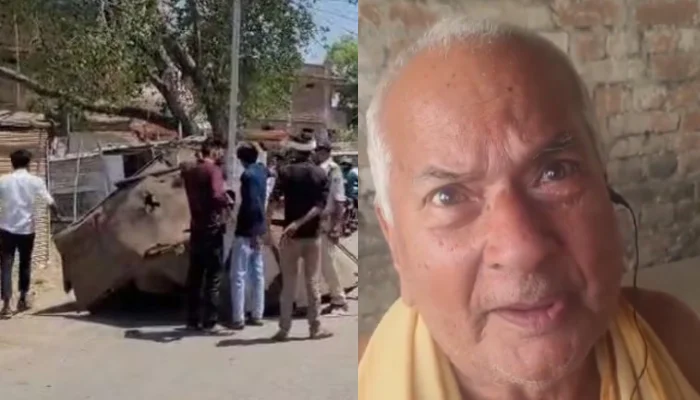
Case Summary
In Sidhi, Madhya Pradesh, a Hindu family of a man named Mani Shukla was attacked by a mob of Bhim Army members, an Ambedkarite anti-Hindu group. The attackers assaulted the entire family over a minor dispute on the day of Ambedkar Jayanti on 14 April 2026. According to media reports, the incident began when Mani Shukla parked his Bolero on the road during a Bhim Army rally dedicated to Dr BR Ambedkar on Ambedkar Jayanti. Enraged by this, a mob of 50 Bhim Army men entered his home and brutally assaulted him and his family members, while also damaging his vehicle. This incident sparked outrage in the area. Angry people surrounded and beat up some members of the Bhim Army. The dispute between the two sides escalated into a violent altercation between Hindus and Bhim Army members. Following this, the Bhim Army members began stone pelting at the Hindus. The Bhim Army then went to the police station and created a ruckus. They vandalised the police station premises and damaged vehicles parked outside. Furthermore, several policemen were also assaulted. A total of 14 people were injured in this incident, including an elderly man and two women. A seriously injured young man was referred to Rewa for treatment. Upon receiving information about the incident, the District Magistrate and senior police officers arrived at the scene to assess the situation. A heavy police force was deployed in the area to control the situation. At the time of writing this report, the police had registered a First Information Report and were searching for the accused.
Why it is Hate Crime ?
The primary category selected in this case is- Attack not resulting in death. The subcategory selected is- Communal Clash/Attack. Communal clash is a form of collective violence that involves clashes between groups belonging to different religious identities. For a communal clash between Hindus and non-Hindus to qualify as a religiously motivated hate crime, the trigger of the violence itself would have to be anti-Hindu in essence. For example, if there is a Hindu religious procession that comes under attack from a non-Hindu mob and after the initial attack, Hindus retaliate in self-defence, leading to a communal clash between the two religious communities. While at a later stage, both communities are involved in the clash/violence, the initial trigger of the violence was by the non-Hindu mob against the Hindus and therefore, it could safely be termed as an anti-Hindu violence. Further, the trigger would also have to be religiously motivated. In the cited example, the attack by the non-Hindu mob was against religious processions and therefore, can be concluded to be religiously motivated. In some cases, the trigger may be non-religious, however, it develops into religious violence against Hindus at a later stage. In such cases too, the foundational animosity towards Hindus becomes the motivating factor of the crime and therefore, it would be classified as a religiously motivated hate crime against Hindus under this category. This case stood as a clear example of a religiously motivated hate crime because a Hindu family faced a brutal attack by a mob of 50 men associated with the Bhim Army, an anti-Hindu Ambedkarite group. Even though the trigger appeared as a non-religious dispute over Mani Shukla parking his Bolero on the road during a Bhim Army rally on Ambedkar Jayanti, the disproportionate violence unleashed against his entire family showcased an assertion of anti-Hindu animosity that drove the assault. The Bhim Army sought to impose its ideological supremacy and anti-Hindu hatred through this mob attack, transforming a minor parking issue into a vicious home invasion. This disproportionate violent assault on Hindus by an anti-Hindu group showcased that the victims were targeted for their religious identity. This also revealed deep-seated religious animosity towards the Hindu community, making it a clear case of a religiously motivated hate crime. The Bhim Army members' actions led to a community clash between Hindus and Bhim Army activists, which escalated into stone pelting and vandalism at the police station. This did not change the fact that the clash resulted from the initial attack motivated by their antagonism towards the Hindu community, making it a clear case of a religiously motivated hate crime. When such communal attacks on Hindus occur, they often result in retaliatory clashes between Hindus and anti-Hindu groups, as seen in this case of mob violence. These attacks aimed to spoil communal harmony, intimidate, and threaten the Hindu community, marking them unequivocally as religiously motivated hate crimes. The perpetrators' association with Ambedkarism as a political ideology itself showcased its anti-Hindu nature. Ambedkarism, under the pretext of fighting the caste system or caste discrimination, often targets the entire Hindu community and faith, abuses their gods and goddesses, desecrates their temples, burns their scriptures, and, in many cases, attacks Hindus and threatens them. Overall, it uses the excuse of fighting casteism while demonstrating anti-Hindu vitriol and hatred. Hence, Ambedkarism functions as a political ideology, and the perpetrators' association with Ambedkarism showcases their deep-seated religious animosity towards the Hindu community. The accused, being active members of the Bhim Army, demonstrate their anti-Hindu hatred even more clearly. While the Bhim Army presents itself as a champion of Dalit rights, its actions and affiliations often contradict this claim. Dalits are very much Hindus, yet the Bhim Army frequently targets Hindu symbols, festivals, and practices, including those held sacred by Dalits themselves. This pattern suggests that the organisation’s agenda is less about genuine Dalit upliftment and more aligned with broader anti-Hindu narratives that seek to divide and weaken Hindu society from within. This becomes particularly apparent when the Bhim Army aligns with leftist and Islamist platforms, where identity politics is weaponised against Hindus. In such spaces, the micro identities of caste, region, and language are secondary; what matters most is religious identity. It is the Hindu identity, regardless of caste, that often becomes the target of animosity. As seen in cases where Dalit families were attacked for displaying Hindu symbols or worshipping deities, the hostility stems not from caste differences, but from a disdain for Hindu religiosity. For example, on May 19, 2020, reports emerged in which a Dalit family in Bihar’s Kishanganj district accused the local Bhim Army unit of attacking them for their beliefs, desecrating a temple as they objected to their reverence for Hindu deities and saffron flags. Similarly, on June 29, 2021, in Saharanpur, Uttar Pradesh, a Hindu named Saurabh Sharma was attacked by Bhim Army members over political differences. The assailants used swords and rods, causing severe injuries, and threatened to eliminate the Brahmin community from the area. Moreover, Bhim Army chief Chandrashekhar Azad has repeatedly made statements and taken positions that reflect his anti-Hindu stance. For instance, he has publicly endorsed conversion as a political weapon, invoking B.R. Ambedkar’s decision to leave Hinduism, and has actively supported movements that call for a rejection of Hindu festivals and practices. In fact, Chandrashekhar Azad's political trajectory has strongly focused on building a Dalit-Muslim alliance, a strategy that became particularly visible during his active participation in the anti-CAA (Citizenship Amendment Act) protests that culminated in the Delhi anti-Hindu Riots 2020. His brand of politics, under the banner of Dalit-Muslim unity, has contributed to narratives that vilify Hindu traditions and exacerbate targeted attacks against Hindus. Thus, by attacking Hindu symbols and aligning with forces hostile to Hinduism at large, the Bhim Army effectively turns against the cultural and spiritual traditions of the Dalit community itself. In doing so, it reinforces the very forces of division and religious antagonism that marginalise Dalits, not as a caste, but as Hindus. This contradiction reveals that, despite its stated mission, the Bhim Army’s trajectory increasingly serves an anti-Hindu, rather than a pro-Dalit, agenda. Given that this case meets the parameters of an anti-Hindu hate crime, it is added to the hate crime database of the tracker. Disclaimer: In this case, a total of fourteen victims were injured by the attack launched by the Bhim Army. Hence, the victim count has been selected as fourteen.
Victim Details
Total Victim
14
Deceased
0
Gender
- Male 2
- Female 2
- Third Gender 0
- Unknown 10
Caste
- SC/ST 0
- OBC 0
- General 2
- Unknown 12
Age Group
- Minor 0
- Adult 1
- Senior Citizen 1
- Unknown 12


Case Status
Complaint registered


Perpetrators Details
Perpetrators
Others
Perpetrators Range
From 10 to 100
Perpetrators Gender
male
 Sources




