Hindu temple land illegally occupied; encroachers remove temple trust's signboard in Maharashtra
 Raigarh, Maharashtra, India
  12 April, 2026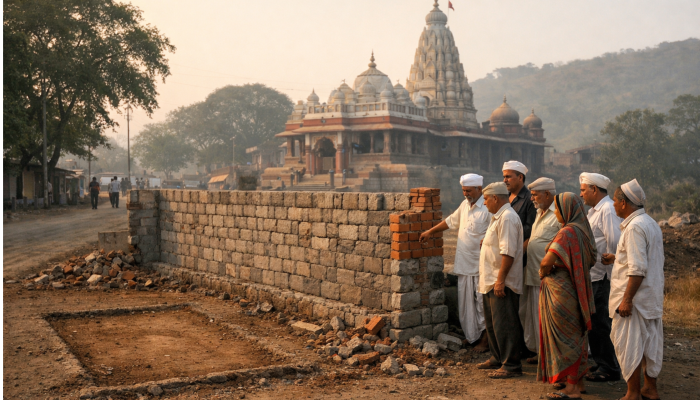
Case Summary
The sacred land belonging to the Shri Ganpati Sansthan, the administrative trust of the Mahad Ganpati temple, one of Maharashtra's most revered Ashtavinayak (eight sacred Ganesh shrines) pilgrimage sites, was encroached upon overnight by unidentified individuals. This Sansthan is located near the Mumbai-Pune National Highway in Maharashtra. The accused constructed an unauthorised wall on its property and removed its official signboard. The Hindu devotees and pilgrims who visit in their thousands daily stood to lose access to the land the temple required for future activities. The trust filed complaints with multiple authorities, and the Tehsildar ordered the encroachment to be removed. Reports confirmed that the Sansthan owned hundreds of acres of land in the Mahad temple complex area, located approximately one and a half kilometres from the Mumbai-Pune National Highway. Unidentified individuals targeted a strategically located plot on the primary approach route from the highway to the temple, a site of maximum visibility and value given the daily flow of thousands of Hindu pilgrims. Village residents discovered the construction and stopped it on one occasion. The perpetrators returned under the cover of darkness, resumed the work, and completed the unauthorised wall overnight. They also removed the Sansthan's official signboard from the site, erasing the visible marker of its ownership of the land. Sansthan working president Mohini Vaidya stated that all land ownership documents had been submitted to the Tehsildar, who ordered the encroachment to be removed. She confirmed that the Sansthan actively followed up with the Nagar Panchayat (local municipal body) to ensure enforcement. Administrator Pranit Bhosale confirmed that if the encroacher did not voluntarily remove the construction, the Nagar Panchayat would undertake the removal and recover all costs from them. Hindu village residents responded with firm solidarity, making clear that the temple land was irreplaceable for the future needs of the pilgrimage site and that they stood fully behind the Sansthan in resisting what they described as an attempt to seize Hindu religious property. For the hundreds of thousands of Hindu devotees who travelled to Mahad each year to seek the blessings of Lord Ganesha, the protection of its land was inseparable from the protection of their right to worship.
Why it is Hate Crime ?
The primary category selected for this case is: Attack on Hindu religious representations. The sub-category here for this case is: Encroachment or illicit takeover of temple land/land near temple. In Hinduism, a temple is the abode of the Deity. The Deity in the Temple is consecrated, thereby, making it a real, breathing entity. Hindus believe that not just the Deity but the temple premises itself are sacred to Hindus since Hindus hold the faith that the entire Temple space is an amalgamation of the divine energy of the deity. Not only the Temple but the Temple premises in its entirety are considered sacred by Hindus. In several cases, the premises of the Temple and/or religious centre are illicitly taken over by institutions belonging to other faiths – like the Waqf board or the Church. Other times, the temple property, land or the property of religious centres are illicitly encroached by non-Hindu groups. Any illicit take over or encroachment is a crime an initio, however, when non-Hindu groups illicitly take over or encroach the sacred land of Hindus, it is an affront to the Hindu community and is therefore classified as a religiously motivated hate crime under this category. This case qualified as a religiously motivated hate crime in which unidentified perpetrators encroached upon the land belonging to the Shri Ganpati Sansthan at the Mahad Ganpati temple, one of the eight Ashtavinayak pilgrimage sites in Maharashtra, by constructing an unauthorised wall on temple property under cover of darkness and removing the Sansthan's official signboard. The encroachment was not a spontaneous or opportunistic act. It was deliberate, premeditated, and directed specifically at land belonging to one of the most sacred Hindu pilgrimage institutions in Maharashtra. The encroachment upon sacred temple land served as the primary religious marker of this case. The Mahad Ganpati temple was not an ordinary piece of real estate. It was one of the eight Ashtavinayak shrines, each occupying a position of profound and irreplaceable significance in the Hindu religious tradition of Maharashtra. The Ashtavinayak pilgrimage ranked among the most sacred journeys a Hindu devotee could undertake, and the temple land proved inseparable from the temple's overall ecosystem and the devotional life of the Hindu community that venerates it. The encroachment upon Sansthan land at Mahad was therefore not merely a property dispute. It was a direct assault on the physical and spiritual integrity of a Hindu sacred site. The perpetrators did not target a remote or peripheral piece of Sansthan land. They targeted a strategically located plot on the primary approach route from the Mumbai-Pune National Highway to the temple, the most visible and valuable land in the Sansthan's holdings, given the daily flow of thousands of Hindu pilgrims. This choice reflected a calculated understanding of the land's significance and a deliberate decision to seize the most important piece of Hindu religious property. The encroachment is positioned to maximise disruption of the pilgrimage site and cause inconvenience to devotees. The perpetrators began their construction in daylight but were stopped by village residents on their first attempt. Rather than abandoning the encroachment, they returned at night, exploiting the darkness to complete the unauthorised wall without detection. This return under cover of darkness confirmed premeditation and a deliberate effort to circumvent the community's resistance. The perpetrators were not deterred by being stopped once. They remained committed to seizing the temple land and used the cover of night to consolidate their encroachment before it could be stopped again. The Sansthan's official signboard was also removed by the perpetrators. The signboard served as the visible institutional marker of the Sansthan's ownership and authority over the land. Its deliberate removal carried symbolic as well as practical significance. By erasing the signboard, the perpetrators attempted to remove the public evidence of the Hindu trust's ownership of the plot, making it easier to assert a competing claim to the land. The removal of a Hindu religious institution's official signboard from its own property constituted an act of direct hostility towards the institution and the Hindu community it served. This encroachment heavily impacted Hindu devotees negatively. The Mahad Ganpati temple received thousands of Hindu devotees daily and hundreds of thousands annually. The Sansthan's land proved essential for the current and future provision of facilities and amenities for these pilgrims. The encroachment directly threatened the capacity of one of Maharashtra's most sacred Hindu pilgrimage sites to serve its devotees, impacting the religious lives of the Hindu community that depended on the temple for its spiritual practice. The village residents who rallied in solidarity with the Sansthan recognised that the encroachment was not merely a dispute over land but an attack on the infrastructure of Hindu religious life at one of its most sacred sites. Given that this case met the parameters of a religiously motivated hate crime, it was added to the hate crime database of the tracke Disclaimer: The Hinduphobia Tracker records the dates of incidents based on when the crime occurs, rather than when it is reported by the media. In this case, media reports did not state the exact date when the crime occurred, so the date it was reported by the media, 13 April 2026, has been selected as the indicative incident date. This is recorded for documentation purposes only.


Case Status
Complaint filed


Perpetrators Details
Perpetrators
Unknown
Perpetrators Range
Unknown
Perpetrators Gender
unknown
 Sources




