Hindu religious event restricted, devotees harassed by police in Firozabad, Uttar Pradesh
 Firozabad, Uttar Pradesh, India
  11 April, 2026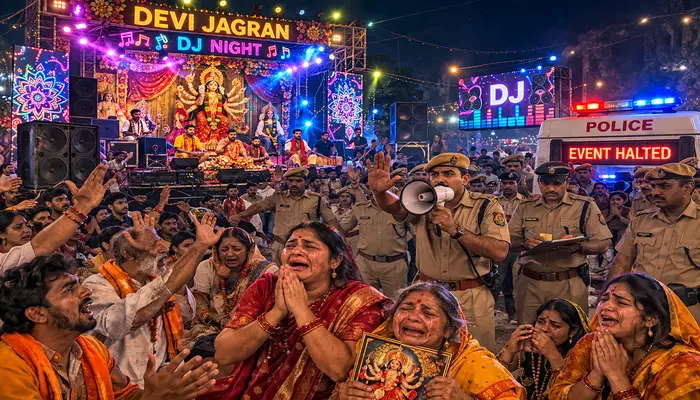
Case Summary
In Tundla, Firozabad, Uttar Pradesh, a Devi Jagran event, a religious event where night vigils are held, and the goddess is worshipped, was disrupted and restricted by the police. The police also harassed local Hindu community members who were attendees of the jagran. According to media reports, the event took place during a traditional fair (mela) at the Khere Wali Mata Temple on 12 April 2026. During this, the police halted the event and harassed members of the Nishad Hindu community, who were the devotees at the temple. This incident came to light during a meeting held at Garhi Thani at 2 p.m., where District Executive Member Captain Singh Nishad stated that the police were harassing members of the Hindu community by implicating them in false cases. During this, he also stated that the police even stopped the Jagran event at the fair. When the district president and MLA tried to intervene, they were not even heard. As per reports, Hindu roadside vendors were also fined. To this, Bharatiya Janata Party members tried to intervene, but the police did not listen to them. For these reasons, the district executive member of the BJP OBC Morcha, along with other party members, resigned from their posts on 13 April 2026. Kitab Singh, Nihal Singh, Netrapal, Saheb Singh and Devkumar, among others, were present at the meeting. District President Uday Pratap Singh stated that he was unaware of the incident.
Why it is Hate Crime ?
This case has been added to the tracker under the primary category- Restriction/ban on Hindu practices. The subcategory selected is- Administration restricting religious practices. In several cases, it is seen that the administration/state disallows a religious practice owing to prejudicial orders and concerns, targeted specifically against the Hindu community. Such restriction/prohibition would be considered documented as a hate crime because the orders are often a result of pressure by groups that harbour animosity towards Hinduism and Hindus. Often, the restriction by the authorities is driven by bias, hostility, or prejudice against the specific community being stopped from holding a religious practice, by pressure groups that harbour animosity towards Hindus, intrinsic to their faith. Since practices are intrinsic to the faith of the Hindus, such prejudicial restriction is considered a curtailing of the fundamental rights of the Hindu community. In several cases, for example, the authorities ban a Hindu religious practice due to pressure from groups opposed to the religion. In other instances the prohibition is selectively enforced against one religious group (Hindus) while others are allowed to proceed. There are still other cases where the authorities preemptively restrict a religious practice by Hindus because those who hold animosity towards Hindus may get “provoked” leading to them being violent, thereby assuaging the sentiments of those who hold animosity towards Hindus by curtailing the religious rights of Hindus. Such acts and orders are prejudiced, indicating discriminatory motives owing to the capitulation to groups that harbour animosity towards Hindus and therefore, would be categorized as a religiously motivated hate crime since the original pressure leading to the order itself is a result of hatred/bias/prejudice/religious hate against Hindus. The other subcategory selected is- Restriction/ban on expression of Hindu identity. An example of the state-affected prejudicial and targeted orders against the Hindu community would be a government denying the right of a Hindu or a group of Hindus to hold a religious procession owing to the animosity of non-Hindu groups. Denial of the religious right of the Hindus to assuage the non-Hindu group which harbours animosity to a point where it could lead to violence against Hindus is not only a failure of law and order but is a prejudicial order against Hindus, denying them their fundamental rights to express their religious identity. An example of a hate crime against Hindus by a non-Hindu would be a non-Hindu institution forcing its Hindu employees to abandon religious symbols that a Hindu would wear as an expression of faith owing to inherent prejudice against the faith professed by the victim or a non-Hindu group of people restricting a Hindu group from constructing a place of worship simply because the demography of the area in which the temple is being built is dominated by non-Hindus. Such actions are driven by religious animosity and/or prejudice against Hindus and their faith and would therefore be categorized as a hate crime. This incident is a clear case of a religiously motivated hate crime, as the police forcibly restricted the celebration of a Hindu religious event and halted the occurrence of a Devi Jagran event. The Devi Jagran is a sacred Hindu tradition involving night vigils dedicated to the divine mother goddess, where devotees gather to pray, sing devotional songs, and perform rituals throughout the night. These events hold profound spiritual significance, fostering community bonding, invoking divine protection, and commemorating the goddess's power against evil forces. The fact that the police forcibly stopped this event showcases their bias and deliberate targeting of Hindu practices. By intervening without justification, they aimed to restrict and suppress Hindu religious observance, causing deep institutionalised hurt to the Hindu community. Restricting such sacred Devi Jagran events wounds the core of the Hindu faith, eroding devotees' right to practise their religion freely and publicly, and signals a systemic prejudice that undermines Hindu religious identity. Here, the Hindus did not break any rules. Conducting a jagran is a rightful practice for the Hindu community. They created no noise or any other disturbance. Despite this, without any pretext, the police randomly arrived and stopped the Jagran event. This showcases institutional bias against Hindus and their public expression of faith. Even the conduction of a sacred Hindu religious practice was halted and restricted by the police, revealing animosity and prejudice against Hindus and their faith within the police administration. Such arbitrary interference not only violates religious freedoms but also perpetuates a pattern of discrimination, where Hindu rituals and practices are singled out for disruption and restrictions while similar practices of other faiths are allowed to be conducted freely. This incident occurred at the temple during a mela, a traditional fair, in Tundla. Hindu devotees were constantly harassed from the beginning of the event. They were even threatened with implication in false charges, and the harassment continued even after the Jagran ended, with police lingering to prevent any resumption. Such harassment of Hindu devotees while they participated in the sacred Hindu event represents a direct attempt to restrict the expression of their Hindu faith and identity in public spaces. The police launched false charges against them, further evidencing a deliberate intent to intimidate and suppress their faith identity and expression. By targeting devotees during the jagran, making it clear that this was a religiously motivated hate crime, the authorities sought to curtail Hindu religious practices and public displays of identity. This systematic targeting intimidates the community, discourages open celebration of festivals and rituals, and erodes the cultural and spiritual fabric of Hinduism, effectively policing Hindu expression as if it were a threat. Given that this case meets the parameters of a religiously driven offence, it is being added to the hate crime database of the Hinduphobia Tracker.


Case Status
Unknown


Perpetrators Details
Perpetrators
State and Establishment
Perpetrators Range
Unknown
Perpetrators Gender
unknown
 Sources




