Minor Hindu girl lured, abducted and killed for refusing to convert to Islam by Muslim man; victim's uncle also attacked with a knife
 Darbhanga, Bihar, India
  12 January, 2026
Case Summary
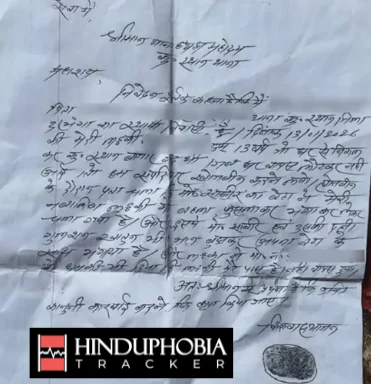
In Kusheshwarsthan, Darbhanga, Bihar, a minor Hindu girl from the Dalit community was lured into a relationship and marriage by a Muslim man named Mohammad Ujala. He abducted the girl, married her and then pressured her to convert to his religion. When she refused, he, along with his seven other Muslim accomplices, murdered the minor Hindu victim. After this, the accused Mohammad Ujala also attacked the victim's uncle with a knife, injuring him badly. This incident came to light when the father of the deceased Hindu girl filed a complaint at the police station in connection with the murder of his daughter. Five named Muslim individuals, including Ujala, and two or three other Muslims were named as accused. In his complaint, the victim's father stated that on 13 January 2026, Mohammad Ujala, son of Mohammad Sabir, a resident of Rampur Rauta, lured and abducted his daughter away and married her. After marriage, Ujala began pressuring the Hindu victim to convert to Islam and even threatened, assaulted and abused her for it. Even after all this, when she refused to convert, Ujala and his accomplices killed her by hanging her to death. The deceased's father said that when he learned of the incident, his brother-in-law, Arvind Paswan, went to the Muslim man's house and asked to see the girl. During this time, Mohammad Ujala attacked Arvind Paswan with a sharp knife, injuring him. He was rescued only after villagers gathered. The police registered an FIR, began an investigation, and sent the victim's body for a postmortem examination. After the post-mortem, the dead body of the Hindu victim was cremated according to Hindu rituals in the presence of the police. The police camped at the accused's house to prevent any untoward incident and to ensure security. The Station House Officer, Gaurav Prasad, stated that raids were conducted continuously to arrest the accused. Notably, while writing this report, the Hinduphobia Tracker team found the complaint registered by the Hindu victim's father and tried to contact the family, but failed at the moment.
Case Images
Why it is Hate Crime ?
The first primary category selected is- Crime against women in relationships and other sexual crimes. The subcategory selected is- Brainwashed and/or Groomed. The tertiary categories selected are- Conversion of Minor, Family/Friends of deceased victim says she was brainwashed/groomed. In our database, we have not added incidents where women have converted to another religion of their free will and no allegations of forced/involuntary conversion have been made. However, there are certain cases of conversion where the consent itself is a result of the brainwashing or grooming of a minor by the non-Hindu perpetrator trying to victimise a woman for her Hindu religious identity. The phenomenon of grooming points to non-Hindu perpetrators identifying their Hindu victims’ vulnerabilities and exploiting them over months and sometimes years, to extract the supposed ‘consent’ in order to convert their religion. In most cases of grooming, the victims are minors or the grooming started when the victim was a minor. In other cases of grooming, the non-Hindu perpetrator brainwashes and grooms a minor victim to extract their trust and then proceeds to rape them repeatedly with the intent of converting them to their faith. It is pertinent to understand here that when the victim is a minor, the ‘consent’ to convert or enter into a romantic relationship with an adult itself is redundant – addressed by POCSO. While every case of conversion of a minor and incidents of establishing a physical relationship with a minor by an adult is a crime, for the purpose of this database, a case would be considered a hate crime only if there is a distinct religious angle to the grooming. For example, in the UK, if a Hindu minor is targeted by Pakistani grooming gangs, it would be considered a hate crime because the victims are specifically targeted owing to their non-Muslim religious identity with the perpetrators being Muslim. In other cases, if a Hindu minor is brainwashed into entering a physical relationship with the non-Hindu adult perpetrator and the family alleges grooming/brainwashing of the minor to convert her religion, it would form a part of this database. If the victim is a Hindu adult, the case would form a part of this database only if the victim herself says that she was brainwashed/groomed to convert her religion. However, if the victim is deceased (murdered or otherwise), the case would form a part of this database if her family/friends provided testimony that the victim was brainwashed/groomed to convert her religion. Since these crimes have a distinct religious angle where the victim is being targeted owing to her Hindu religious identity, these cases are considered a hate crime. The other subcategory selected is- Forced conversion after marriage. In such cases, a non-Hindu man marries a Hindu woman, and the force/pressure to convert to any Abrahamic faith, like Islam, begins after marriage. In such cases, typically, two patterns emerge. First, when the relationship is consensual, and the religious identity of the perpetrator is known to the Hindu woman in the relationship. The marriage could be under the Special Marriages Act, where neither parties are required to convert their religion for the marriage to be considered legitimate. While the victim in such cases enters matrimony assuming that religious identity is not a barrier, the non-Hindu man starts to pressure the woman to convert her religion after marriage. The second is when the woman gets into a marriage with the man, pretending to share her faith. Later, when the truth is revealed, the man starts pressuring the woman to convert her religion and give up her religious identity. In both situations, there is application of force by the perpetrator, including the denial of the woman’s religious rights. Some of the means by which the woman is forced/pressured to convert include force-feeding beef, being forced to read the Kalma, being forced to wear a hijab, forced to undergo Halala, etc. There are several instances where, after marriage, the woman voluntarily converts to Islam. Such cases are often argued to be a result of religious brainwashing, however, for the purpose of documenting religiously motivated hate crimes, in the absence of the victim complaining of forced conversion, such cases do not form a part of the database. The other subcategory selected is- Assault or threat upon refusal to convert. When Hindu women are in a relationship with non-Hindu men, there are cases where the woman faces threats or assault after she refuses to convert and change her religious identity owing to pressure/force by the non-Hindu man. Such relationships may be consensual with the religious identity of the non-Hindu man known to the victim. Somewhere along the relationship, the non-Hindu man starts pressurizing the Hindu woman to convert to Islam and upon her refusal, assaults or threatens the victim. Such cases are driven by specific religious motivations and against the religious identity of the victim and are therefore qualified as hate crimes. Cases where the Hindu woman converts to Islam and does not file a complaint about the force or threat, are not considered a part of the hate tracker, even though, it may be argued that the woman was brainwashed or threatened to convert to Islam. The other subcategory selected is- Murder upon refusal to convert. When Hindu women are in a relationship with non-Hindu men, there are cases where the woman is forced to convert her religion and upon her refusal to do so, the non-Hindu partner murders the victim. Such relationships may be consensual with the religious identity of the non-Hindu man known to the victim. Somewhere along the relationship, the non-Hindu man starts pressuring the Hindu woman to convert. In some of these cases, the association could be non-consensual as well or, the religious identity of the non-Muslim man could be previously unknown to the Hindu victim. In such cases, the Hindu woman is first pressurized to change her religion by the non-Hindu man. The pressure could involve threats and/or violence. The trigger to murdering the woman in these cases is her refusal to comply and change her religion under threat and/or force. Such cases are driven by specific religious motivations and against the religious identity of the victim and are therefore qualified as hate crimes. The second primary category selected is- Predatory Proselytisation. The subcategory selected is- Proselytisation by grooming, brainwashing, manipulation or subtle indoctrination. The tertiary categories selected are- Conversion of Minor, Family/Friends of deceased victim says she was brainwashed/groomed. Religious brainwashing essentially means the often subtle and forcible indoctrination to induce someone to give up their religious beliefs to accept contrasting regimented ideas. Religious grooming or brainwashing also involves propaganda and manipulation. It involves the systematic effort, driven by religious malice and indoctrination, to persuade “non-believers’ to accept allegiance, command, or doctrine to and of a contrasting faith. Cases of such grooming or brainwashing are far more nuanced than direct threats, coercion, inducement and violence. In such cases, it is often seen that there is repeated, subtle and continual manipulation of the victim to induce disaffection towards their own faith and acceptance of the contrasting faith of the perpetrator. While subtle indoctrination is widely acknowledged as predatory, an element which is often understated in such conversions or the attempts of such conversion is the role of loyalty and trust which might develop between the perpetrator and the victim. Fiduciary relationships are often abused to affect such religious conversion. For example, an educator transmitting religious doctrine of a competing faith to a Hindu student. The Hindu student is likely to accept what the teacher is transmitting owing to existence of the fiduciary relationship. The exploitation of the fiduciary relationship to religiously indoctrinate victims would also be included in this category. Since the underlying animosity towards the victim’s faith forms the basis of predatory proselytization, such cases are considered religiously motivated hate crimes. The other subcategory selected is- Harassment, threats, coercion for conversion. Harassment covers a wide range of behaviours of an offensive nature. It is commonly understood as behaviour that demeans, humiliates, and intimidates a person, including threats and coercion. Harassment and threats, in this case, find their root on discriminatory grounds which has the effect of nullifying a person’s rights or infringing upon his freedom to exercise his right specifically owing to the victim’s religious identity. Verbal and physical threats and psychological or physical harassment are often used against Hindu victims because they choose to practice their professed religion. Religious harassment also includes forced and involuntary conversions by harassment, threats or coercion. Coercion includes intimidatory tactics like force-feeding a Hindu victim beef to convert to another religion, forceful circumcision etc. In several cases documented, non-Hindu perpetrators or those who harbour specific animosity towards Hinduism, harass victims simply based on their religious identity. Such cases often also include harassment to ensure the Hindu victim abandons his/her professed religion and adopts the religion of the perpetrator. Such cases where Hindu victims are harassed to convert to the perpetrator’s religion are rooted in animosity towards the victim’s religious identity and are therefore documented as religiously motivated hate crimes. The other subcategory selected is- Murdered upon refusal to convert. When there is pressure, threat or coercion employed upon the Hindu victim to convert to a different religion, in several cases, the victim refuses to succumb to the pressure/threats. Once the victim refuses, the perpetrator proceeds to murder the victim owing to his/her refusal to convert. In such cases, the pressure/threat/intimidation/coercion/violence itself is driven by animosity towards the victim’s Hindu faith. The murder then is another hate crime driven by the victim’s refusal to abandon his professed faith, Hinduism, and convert to the religion of the non-Hindu perpetrator. Since the victim’s faith is at the heart of the pressure to convert and the ensuing murder of the victim, such cases are considered religiously motivated hate crimes. The third primary category selected is- Attack resulting in death. The subcategory selected is- Attacked for refusal to convert. When pressure, threats, or coercion are employed upon a Hindu victim to convert to another religion, in several cases the victim refuses to succumb. Once the victim resists, the perpetrator proceeds to attack the victim due to this refusal to convert. In such instances, the pressure, intimidation, and violence are clearly driven by hostility toward the victim’s Hindu faith. The attack then becomes an expression of that same hate, motivated by the victim’s refusal to abandon Hinduism and embrace the religion of the non-Hindu perpetrator. Since the victim’s faith is central to both the coercion and the subsequent attack, such cases are categorised as religiously motivated hate crimes. The fourth primary category selected is- Attack not resulting in death. The subcategory selected is- Attacked for opposing radicals or trying to save victim. In several cases, Hindus are attacked for opposing religiously motivated crimes being committed against a fellow Hindu or simply for voicing an opinion opposing radical elements, who either have in the past or continue to persecute Hindus. In such cases, the initial attack against the victim, against which the Hindu was trying to defend the victim, would also need to be classified as a religiously motivated hate crime. Since the initial crime itself was religiously motivated and the subsequent crime of attempting to save the victim or speaking against the radical elements ends up inviting a violent attack, it would also be classified as a religiously motivated hate crime under this category. This case exemplifies a religiously motivated hate crime, as the Muslim perpetrator Mohammad Ujala and his seven Muslim accomplices demonstrated profound religious animosity by targeting a Hindu girl's faith from the outset. Ujala lured her, a minor from the Dalit Hindu community, into a deceptive relationship under false pretences of romance, only to marry her forcibly and subject her to relentless pressure to abandon Hinduism for Islam. This pattern of assault, threats, and abuse escalated when she refused conversion, culminating in her brutal murder by hanging and the stabbing of her uncle, who intervened, revealing a calculated hatred aimed at erasing her Hindu identity and punishing her loyalty to her faith. It's also important to note that the victim was a minor, stripping away any pretence of consent and genuine conviction from the outset, as minors lack the maturity and foresight to grasp the profound spiritual and communal severance of forced conversion to Islam. Due to their vulnerable age, they cannot understand the ramifications of converting to another faith. The Muslim perpetrator Mohammad Ujala and his accomplices deliberately exploited this vulnerability through luring, abduction, forcible marriage, relentless pressure, and ultimately her murder by hanging for defiance, exposing their predatory, supremacist animosity that deems Hinduism inferior and ripe for violent eradication, marking this Darbhanga case as a blatant, religiously motivated hate crime against Hindus. The act of luring the victim into a relationship with premeditated conversion as the endgame unveils the perpetrators' deep-seated religious animosity towards Hinduism and its adherents. This was no impulsive act but a deliberate strategy to exploit her faith, isolate her from her Hindu family and community, and compel her to renounce her religious roots entirely. The mobilisation of seven other Muslim accomplices further exposes a coordinated network driven by collective hostility, transforming personal deception into communal aggression against a Hindu girl's sacred religious ties, proving the crime's foundation in targeted religious hatred rather than mere romance turned sour. The fact that the perpetrator did not hide his identity showcases that the victim was made to believe that religious differences would not impede their romantic bond, masked a manipulative ploy steeped in religious animosity against Hindus. He fostered a false sense of equality to gain her trust, only to later weaponise her Hindu identity through conversion demands, assaults, and threats, exposing his view of her faith as an obstacle to be demolished. This duplicitous tactic, ending in her murder for non-compliance, underscores a profound contempt for Hinduism, treating Hindu girls as convertible trophies in a broader campaign of faith-based domination. Abducting the minor from her family's protective embrace constituted severe religious harassment, as it severed her from the Hindu safeguards essential for her spiritual and cultural security. By luring and kidnapping her to enforce isolation, then imposing Islamic marriage and conversion, the perpetrator aimed to dismantle her Hindu world piece by piece. This predatory isolation tactic, driven by animosity that views Hindu family structures as barriers to conversion, highlights the crime's religiously motivated design to aggress against the victim's faith through enforced vulnerability. Forcing the Hindu victim to convert starkly epitomises religious animosity, as it constitutes a direct, aggressive assault on her fundamental right to religious autonomy, reducing her lifelong devotion to Hinduism, its gods, rituals, festivals, and sacred traditions, to mere disposable refuse that must be discarded in favour of Islam. Genuine faith transitions stem solely from personal inner conviction and spiritual exploration, never from external coercion or threats; yet here, Mohammad Ujala and his Muslim accomplices unleashed relentless pressure through abuse, intimidation, and ultimatums, signalling a deep supremacist disdain that views Hindu practices as inherently inferior, the victim's Hindu identity as erasable, and her dignity as expendable unless she betrays her ancestral heritage. This calculated demand to renounce her faith by force and threats not only humiliates her personal beliefs but weaponises religion itself to dominate and subjugate, exposing the perpetrators' profound hostility towards Hinduism and its adherents, making it a religiously motivated offence. Upon her refusal to convert to Islam, the perpetrators unleashed repeated assaults, threats, and verbal abuse, wielding escalating violence as direct punishment for her steadfast Hindu devotion, beating her, intimidating her with promises of death, and isolating her further to shatter her resolve. This religiously charged brutality, meticulously aimed at breaking her spirit through unrelenting fear of further physical and psychological harm, lays bare the perpetrators' profound animosity towards Hindu faith and identity, showcasing their readiness to go to any extent, even threatening and assaulting the victim, to forcibly erase her Hindu beliefs. This extreme hostility confirms it as a religiously motivated hate crime. After all this, the Hindu victim was killed for refusing to convert. The act of killing the Hindu girl solely for refusing to convert constitutes a quintessential hate crime, as it represents the ultimate escalation of religiously motivated violence where her murder stemmed directly from her exercise of religious freedom and loyalty to her Hindu faith, transforming her personal spiritual choice into a capital offence punishable by death. This act unveils the Muslim perpetrators' profound religious animosity, revealing a supremacist worldview that deems a Hindu life forfeit if it resists assimilation into Islam, treating her refusal not as an individual right but as an intolerable affront to their faith that demanded lethal retribution. By hanging her to death purely for upholding her Hindu identity, rejecting the abandonment of her gods, rituals, and beliefs in favour of Islamic doctrine, the perpetrators exposed their deep-seated hostility towards Hinduism itself, positioning her unwavering devotion as a direct challenge to be eradicated through brutality rather than tolerated, thereby framing the killing as a deliberate assertion of religious dominance over a vulnerable adherent of the Hindu faith. Overall, this makes this incident a clear example of a hate crime. When the victim's uncle, Arvind Paswan, confronted the perpetrators at their house, they stabbed him viciously with a sharp knife, broadening their religious animosity to assault anyone who dared uphold solidarity with the deceased Hindu girl. This brutal attack on her family member, Arvind Paswan, symbolises unyielding aggression against the collective resilience of her Hindu kin, punishing his intervention with life-threatening ferocity simply for opposing their violence and demanding to see his niece. By attacking Arvind Paswan specifically for stepping in against their faith-based murder of the minor Hindu victim, the accused Mohammad Ujala and his accomplices affirmed that their seething hatred extends ruthlessly to anyone who supports the Hindu victim and her family, solidifying the crime's scope as purely religiously motivated hatred against Hindus who resist such predatory assaults. Given that this case fulfils every parameter of a religiously motivated hate crime, it has been added to the hate crime database of the tracker.
Victim Details
Total Victim
2
Deceased
1
Gender
- Male 1
- Female 1
- Third Gender 0
- Unknown 0
Caste
- SC/ST 2
- OBC 0
- General 0
- Unknown 0
Age Group
- Minor 1
- Adult 1
- Senior Citizen 0
- Unknown 0


Case Status
Complaint filed


Perpetrators Details
Perpetrators
Muslim Extremists
Perpetrators Range
From 5 to 10
Perpetrators Gender
male
 Sources




