Hindu sentiments hurt as temple pathway encroached in Meerut village, devotees report obstruction
 Meerut, Uttar Pradesh, India
  14 April, 2026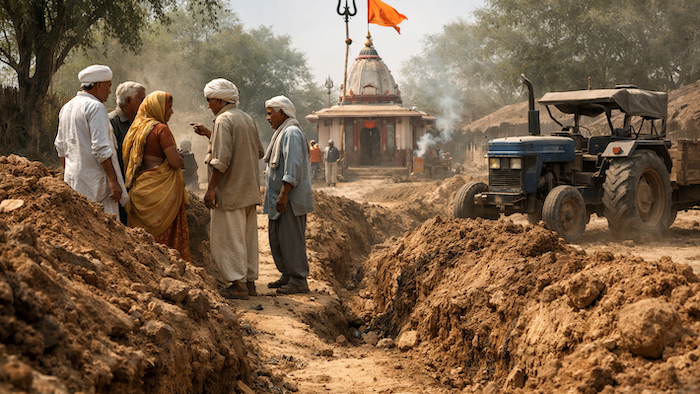
Case Summary
The Hindu devotees of Sindhawali village in Meerut district, Uttar Pradesh, faced obstruction to accessing their Shiva temple when the pathway leading to it was encroached upon. The incident took place in the Kankarkheda police station area. The narrowing of the temple path disrupted the movement of Hindu devotees visiting the temple. On 14th April 2026 at around 11 a.m., Hindu villagers from Sindhawali village arrived at the Kankarkheda police station using a tractor trolley. The group collectively approached the police to report the obstruction affecting access to their Shiva temple. The villagers stated that the pathway leading to the Shiva temple was originally approximately 52 feet wide. Over time, the width of the pathway was reduced significantly. The villagers reported that the path had been narrowed to approximately 14 feet due to encroachment. The complaint identified former village head Shrichand and his son Sheetal as responsible for the encroachment. The villagers stated that the encroachment occurred gradually and affected the entire stretch of the path leading to the temple. A large number of Hindu villagers, including Yogesh, Sunny, Sonu, Arvind, Sumit Jatav, Raju, Rohit, Vinay, Jabar Singh, Binder Singh, Krishna, Surajpal, Sushil, and Ganesh, jointly submitted the written complaint. They requested that the path be cleared and restored to its original width to ensure unhindered access to the temple. Sheetal stated that soil had been placed on the path to prevent water from entering his field. He stated that the soil was later removed. Inspector Gambhir Singh at Kankarkheda police station received the complaint and assured the villagers that the matter would be investigated. He stated that appropriate legal action would be taken after examining the facts. Following this assurance, the villagers returned from the police station. The matter remained under investigation at the time.
Why it is Hate Crime ?
This case has been added to the tracker under the primary category - Attack on Hindu religious representations. Within this, the subcategory selected is - Encroachment or illicit takeover of temple land/land near temple. In Hinduism, a temple is the abode of the Deity. The Deity in the Temple is consecrated, thereby, making it a real, breathing entity. Hindus believe that not just the Deity but the temple premises itself are sacred to Hindus since Hindus hold the faith that the entire Temple space is an amalgamation of the divine energy of the deity. Not only the Temple but the Temple premises in its entirety are considered sacred by Hindus. In several cases, the premises of the Temple and/or religious centre are illicitly taken over by institutions belonging to other faiths – like the Waqf board or the Church. Other times, the temple property, land or the property of religious centres are illicitly encroached by non-Hindu groups. Any illicit take over or encroachment is a crime an initio, however, when non-Hindu groups illicitly take over or encroach the sacred land of Hindus, it is an affront to the Hindu community and is therefore classified as a religiously motivated hate crime under this category. This case qualifies as a religiously motivated hate crime because access to a Hindu place of worship was obstructed through encroachment on the pathway leading to a Shiva temple. The obstruction did not merely alter land usage but directly interfered with the ability of Hindu devotees to reach and participate in religious worship. By restricting access to a temple, the act impacted a core aspect of religious practice, which is the physical ability to visit and offer prayers at a sacred site. The first element is the obstruction of access to the Shiva temple. The pathway was reduced from approximately 52 feet to 14 feet, significantly limiting movement. This is religiously significant because temples are meant to be accessible to all devotees, including during peak hours, festivals, and community gatherings. A drastic narrowing of the path does not just inconvenience movement; it creates practical barriers that can prevent large numbers of devotees from reaching the temple, especially the elderly, women, and groups visiting collectively. This transforms access from open and communal to restricted and difficult, directly affecting religious participation. The second element is the encroachment on land connected to a temple. The pathway was not ordinary land but a functional extension of the temple space, enabling devotees to approach, gather, and engage in rituals. Encroaching upon such land reduces the usable religious space and alters how the temple can be accessed and experienced. In many Hindu settings, the approach to a temple holds ritual importance, and any disruption to it affects the continuity of established practices. This shows that the impact extends beyond property to the erosion of a religious environment. The third element is the gradual nature of the encroachment. The villagers described a continuous reduction in the pathway’s width over time. This indicates a sustained and incremental restriction rather than a one-time act. Such gradual encroachment normalises the loss of religious space and makes resistance more difficult, ultimately leading to a situation where devotees are left with limited access without a single identifiable moment of disruption. The prolonged nature of the act compounds its impact on the community. Another key element is the direct effect on religious practice. The narrowing of the pathway made it difficult for devotees to visit the temple in groups, organise rituals, or participate in collective worship. Hindu religious practices are often community-oriented and require open access to temple spaces. By restricting this access, the act disrupted not just individual visits but the collective expression of faith, thereby weakening the community’s ability to practise its religion in the customary manner. In such cases, the obstruction is not merely physical but translates into a direct constraint on the exercise of religious freedom. Restricting access to a temple by encroaching on its approach route diminishes devotees' ability to practise their faith fully and collectively. When such interference occurs despite the known religious importance of the space, it reflects a clear disregard for the sanctity of Hindu places of worship and the rights of those who rely on them. It is this deliberate and sustained impact on religious access and practice that establishes the nature of the offence. Disclaimer: The tracker records incident dates based on when the crime occurred, not when it was reported. In this case, the exact date when the encroachment first began was not specified in the available sources. Therefore, 14th April 2026 has been used as the indicative incident date, as it corresponds to the article’s publication date. This date has been recorded for documentation purposes only.


Case Status
Complaint filed


Perpetrators Details
Perpetrators
Others
Perpetrators Range
From 2 To 5
Perpetrators Gender
male
 Sources




