Hindu temple attacked with stones, flags and banners damaged; locals allege vandalism during Shab-e-Barat
 Saran, Bihar, India
  3 February, 2026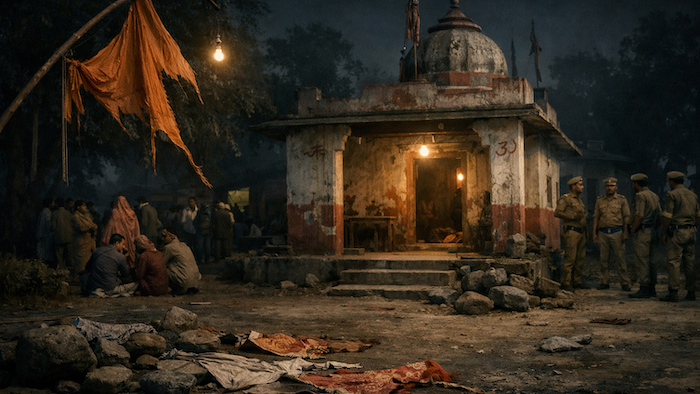
Case Summary
The Hindu devotees of a temple in Saran district, Bihar, faced desecration of their religious site when the temple’s flag and banners were vandalised during the night. The incident occurred in a village under the jurisdiction of Gadkha police station. The damage to the temple premises disrupted religious sanctity and created tension among Hindu residents in the area. On the night of February 3, 2026 (Tuesday), the temple premises were approached by unidentified individuals. The perpetrators damaged the temple flag and tore banners placed within the premises. Stones were also thrown towards the temple area, causing distress among Hindu devotees and disturbing the religious environment. As information about the incident spread, Hindu villagers and residents from nearby areas gathered near the temple premises. The gathering quickly grew in size, creating a tense atmosphere in the locality. During this time, members of another community also reached the site, leading to a confrontation between the two sides. The incident coincided with the movement of people in the area for Shab-e-Barat, a religious observance in Islam involving night prayers. Villagers stated that the vandalism took place during this period. The presence of people travelling for the religious event overlapped with the timing of the damage to the temple property. The growing crowd and confrontation led to a dispute at the site. Villagers informed the police as tensions escalated. The situation remained sensitive as both groups stayed gathered near the temple premises. Police from Gadkha police station arrived at the scene and intervened to disperse the crowd. Additional police forces were deployed in the village, and continuous patrols were carried out throughout the night. Senior officials, including Sub Divisional Police Officer Rampukar Singh and Sub Divisional Officer Nitesh Kumar, visited the site, assessed the situation, and held meetings with local representatives from both communities. An investigation was initiated to identify the perpetrators and determine the sequence of events. The administration stated that the situation was brought under control and emphasised the need to maintain peace, with strict action to be taken against those found responsible.
Why it is Hate Crime ?
This case has been added to the tracker under the primary category - Attack on Hindu religious representations. Within this, the subcategory selected is - Desecration of Hindu religious symbol. Icons and symbols or a religious representation of a spiritual ideal are widely revered in Hinduism. Iconography is of vital significance in the Hindu milieu. It helps connect people’s spiritual beliefs with the real world. Iconography within the Hindu faith takes several shapes and forms. Murtis are of most significance to Hindus, to which daily rituals, prayers and offerings are done. Besides the murtis, there are several other symbols which have deep significance in the Hindu faith – the Om and Swastika for example. Since these Hindu religious symbols hold paramount importance in Hinduism, any desecration of symbols, icons, murtis, religious representations and manifestations, is driven by animosity towards the faith itself which manifests itself through these murtis, icons and symbols. Therefore, any desecration of these Hindu religious symbols and representations is considered religiously motivated hate crimes under this category. The other sub-category selected for this case is - Attack on temples. In Hinduism, a temple is the abode of the Deity. The Deity in the Temple is consecrated, thereby, making it a real, breathing entity. Hindus believe that not just the Deity but the temple premises itself are sacred to Hindus since Hindus hold the faith that the entire Temple space is an amalgamation of the divine energy of the deity. Given the central significance of Temples in Hindu Dharma, any attack against a Hindu Temple or its peripheral premises is an attack on the faith itself and is born out of animosity towards the faith, of which, the Temple is a central tenet. Any manner of attack against a Temple and/or its premises would therefore be considered a religiously motivated hate crime. This case qualifies as a religiously motivated hate crime because Hindu religious symbols and a place of worship were deliberately targeted. The perpetrators damaged a temple flag and banners, which are central markers of Hindu religious identity. The act took place within the temple premises, a sacred space for Hindu devotees. The nature and location of the act show that the intent was directed at a specific religious community. The first key element is the damage to the temple flag and banners. These objects are not ordinary property; they represent religious identity and devotion. By tearing and destroying them, the perpetrators targeted symbols that hold spiritual meaning for Hindu devotees. This is significant because such acts are not random vandalism; they are directed at what the community holds sacred. This shows that the harm was aimed specifically at Hindus through their religious symbols. The second element is the act occurring on the temple premises. A temple is a consecrated space where worship and rituals are performed. Entering such a space and committing acts of damage violates its sanctity. This is religiously significant because places of worship are protected spaces meant for spiritual practice. By targeting the temple, the perpetrators disrupted a core site of Hindu religious life, directly impacting the community’s ability to practise their faith peacefully. The third element is the violation of the norms governing a place of worship. Religious spaces operate under expectations of respect, purity, and non-disturbance. The act of entering at night, damaging property, and pelting stones broke these norms. This is significant because it shows a disregard for the sanctity and rules associated with Hindu worship spaces. Such actions are not accidental but demonstrate intentional intrusion into a protected religious environment. The fourth element is the broader impact on the Hindu community. The incident led to immediate distress among devotees and triggered a large gathering near the temple. Religious sentiments were directly affected, and tensions escalated between communities. This shows that the act was not limited to physical damage but had a wider communal impact, targeting Hindus collectively by disturbing their sense of safety around their place of worship. The timing of the incident, coinciding with movement related to another religious observance, adds further context. The overlap heightened tensions and contributed to the perception that the act was linked to religious identity. This reinforces the idea that the targeting was not random but occurred within a sensitive religious context, increasing its impact on Hindu devotees. Given that this case met the parameters of a religiously motivated hate crime, it was added to the hate crime database of the tracker. Disclaimer: The tracker records incident dates based on when the crime occurred rather than when it was reported. In this case, the exact date of the incident was not specified in the available sources. Therefore, 4th February 2026 has been used as the indicative incident date, as it corresponds to the article’s publication date. This date has been recorded for documentation purposes only.


Case Status
Complaint filed


Perpetrators Details
Perpetrators
Unknown
Perpetrators Range
Unknown
Perpetrators Gender
unknown
 Sources




