Hindu trainees face religious discrimination and coercion for conversion by salon's Muslim director in Moradabad, Uttar Pradesh
 Muradabad, Uttar Pradesh, India
  23 July, 2024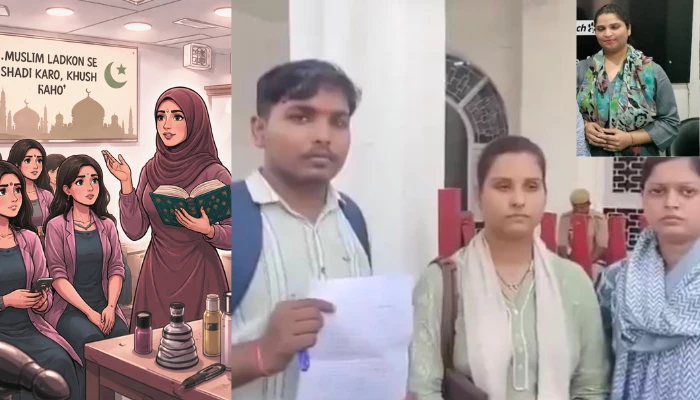
Case Summary
In Moradabad, Uttar Pradesh, Hindu trainees enrolled at a Lakmé salon-academy were brainwashed, discriminated against, and forced to convert to Islam by the Muslim director of the institute. Two Hindu women and one Hindu man complained that they were discriminated against based on their religious identity. The two women also stated that they were coerced into converting to Islam. Following a complaint by three trainees, two women and one man, the Moradabad police charged the beauty and make-up institute director, Rakshanda Khan, under Sections 299 (deliberate and malicious acts to outrage religious feelings), 351(2) (criminal intimidation), and 318(1) (dishonest concealment of facts) of the Bharatiya Nyaya Sanhita, 2023. The incident took place at a Lakmé salon-academy in Moradabad, where Rakshanda Khan was serving in a managerial and supervisory role over the trainees. Two trainees, Tanya Chaudhary and Swati Pal, who are undergoing beautician and salon training at the academy, confirmed that Khan often coerced them into entering relationships with Muslim men to facilitate conversion to Islam through marriage. According to the trainees, Rakshanda Khan advised Hindu girls to marry Muslim men, stating, “Muslim ladkon se shaadi karo, khush rahogi.” The trainee further stated that she narrated her own story of religious conversion and stated that she had earlier been a Hindu and had married a Muslim man. The Hindu trainees further stated that the academy's atmosphere reflected discriminatory treatment. It was stated that assistance and guidance were extended more readily to Muslim trainees, while Hindu students were either ignored or given incorrect responses when they approached management with their queries during their training. According to reports, Hindu activists, including Swati Pal, staged a protest in connection with the incident. A complaint was thereafter raised before the authorities in Moradabad. Subsequently, the Moradabad Police registered a case against Rakshanda Khan and initiated an inquiry into the matter. Further legal proceedings and investigation were undertaken based on the complaint submitted by the affected trainees and protesting activists.
Why it is Hate Crime ?
This case is added to the tracker under the primary category- Predatory Proselytisation. The subcategory selected is- Conversion/attempts to convert by inducements. Predatory Proselytisation is not just limited to threat, harassment, force and violence, but it also has contours of stealth. In several cases, the Hindu victim is exploited to convert, with non-Hindus taking advantage of their poverty. In such cases, the Hindu victim who is suffering financially is offered monetary benefits, including lucrative offers for jobs, health treatment, education, etc, to induce the victim into changing his/her religion. In such cases, the religious identity of the victim and the aim to disenfranchise him from his faith form the heart of the crime. Also, taking advantage of and exploiting an individual’s economic vulnerabilities is widely acknowledged as exploitation, forms of which are often penalised by law. Such cases, therefore, are considered religiously motivated hate crimes since the victim’s religious identity forms the very heart of the crime itself. The other subcategory selected is- Proselytisation by grooming, brainwashing, manipulation or subtle indoctrination. The tertiary category selected under it is - Victim says was brainwashed or groomed. A religiously motivated hate crime is one where a victim is targeted because of the offender's hostility towards the victim’s professed faith, whether the underlying act, in this case, constitutes a crime in the limited scope of the laws driven by a secular framework. Proselytisation itself is an act that stems from the proselytising faith’s inherent and theological hostility towards Hinduism (Sanatan Dharma). Christianity, for example, considers idolatry as a sin and likens it to immorality (https://www.openbible.info/topics/idolatry). Islam has a far more violent approach to idolatry, with over 500 mentions of Kufr (non-believer) and Shirk (anything that does not conform to Islamic tenets) found in the Quran. The Quran has several verses that ordain its followers to convert the polytheists (Hindus in this case) by sword. Therefore, it is safe to conclude that the hostility towards Hinduism in Islam and Christianity is theologically embedded. As such, any conversion by Muslims or Christians of Hindus is a result of hostility towards Hinduism. There are cases, in fact, where even faiths that don’t inherently harbour animosity towards Hinduism have been militarised to express hatred by a section of the adherents of the faith. Such faiths also indulge in predatory proselytisation. For this category, we would only focus on those conversions which have a component of coercion, force, threats, harassment, inducement, brainwashing and the like. For this category, though the argument that any conversion to Islam or Christianity stems from inherent hostility towards Hinduism, we would not take into account conversions where the convert has changed his religion without any coercion or inducement, but supposedly, a change of conscience. This case qualified for inclusion in the tracker because the conduct described was not limited to a workplace or training-related dispute, but specifically centred upon influencing Hindu trainees to distance themselves from their professed faith and move towards another religious identity through sustained psychological persuasion. A particularly significant feature of this incident was the use of a position of authority and trust. The accused was not a stranger but the manager of the academy where the Hindu trainees had enrolled for professional training. By virtue of that role, she occupied a position of influence over young women who depended upon the institution for skill development and future employment prospects. The repeated advice that they should befriend or marry Muslim men, coupled with assurances that they would be “happier” if they did so, introduced a clear element of inducement. The suggestion was framed not as a neutral personal opinion but as a promised route to a better, more fulfilling life, thereby making a change in personal and religious identity appear desirable and beneficial. The matter took on greater seriousness because the accused recounted her own religious journey and marriage as an example for them to follow. This was relevant because it reflected an attempt to normalise and legitimise the abandonment of one’s existing faith through personal storytelling and emotional persuasion. Such conduct often operated as subtle indoctrination rather than overt force. Instead of direct threats, the pressure was exerted through repeated conversations, emotional suggestion, and the projection of conversion as a pathway to happiness and social acceptance. The discriminatory treatment within the academy further strengthened the basis for inclusion. By extending support and assistance to Muslim trainees while neglecting Hindu trainees and providing them with incorrect guidance, the conduct reflected a pattern of religion-based differential treatment. This created an atmosphere in which Hindu trainees were made to feel excluded, disadvantaged, and psychologically isolated within a space meant for their professional development. Such conduct went beyond mere unfairness in administration. When access to guidance, support, and institutional cooperation became visibly linked to religious identity, it could reasonably create pressure upon the victims to conform to secure equal treatment and acceptance. In this way, the environment itself functioned as a form of soft coercion, gradually conditioning the victims to associate dignity, support, and future success with movement towards the offender’s preferred religious outlook. Taken together, the facts indicated a sustained pattern of manipulation directed specifically at Hindu trainees, using authority, emotional influence, promises of a better life, and alleged differential treatment to weaken their attachment to their faith and make them receptive to conversion-linked social grooming. Since the conduct directly targeted the victims’ religious identity and sought to influence a change in belief through inducement and mental conditioning, the incident rightly qualified as a religiously motivated hate crime and was added to the tracker. Disclaimer: The Hinduphobia Tracker records incident dates based on when the victim’s ordeal began, rather than when the media reported it. In this case, the source material did not specify when the trainees’ ordeal first began; therefore, the date on which the complaint and police action were reported has been recorded as the indicative incident date for documentation purposes. Media reports stated that three Hindu victims were affected in this incident; however, the source material did not clarify whether additional victims may also have been subjected to similar conduct. Therefore, the victim count has been recorded as three (3) based on the specifically identified individuals mentioned in the report. This is a conservative estimate, as the actual number of victims could be higher.
Victim Details
Total Victim
3
Deceased
0
Gender
- Male 1
- Female 2
- Third Gender 0
- Unknown 0
Caste
- SC/ST 0
- OBC 0
- General 0
- Unknown 3
Age Group
- Minor 0
- Adult 3
- Senior Citizen 0
- Unknown 0


Case Status
Complaint registered


Perpetrators Details
Perpetrators
Muslim Extremists
Perpetrators Range
One Person
Perpetrators Gender
female
 Sources




