Hindu religious symbol targeted; miscreants removed and replaced Hindu flag with that of Bhim Army
 Azamgarh, Uttar Pradesh, India
  11 April, 2026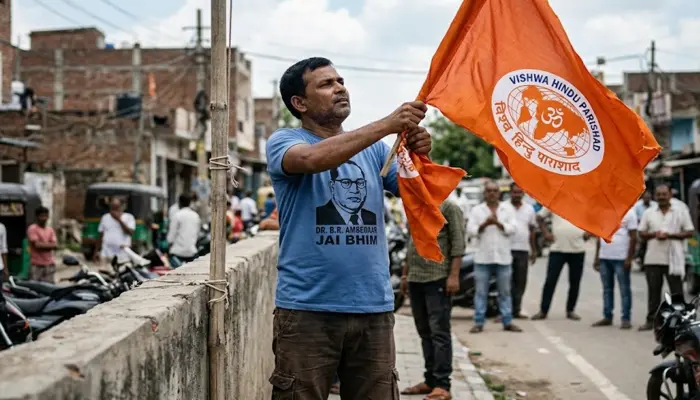
Case Summary
In the Gautam Nagar Chatti in Gopalpur, Azamgarh district, tensions escalated in the area after a dispute broke out over the removal of a Vishwa Hindu Parishad (VHP) flag and its replacement with that of the Bhim Army at the memorial gate (Smriti Dwar). The incident came to light on 12 April 2026, around 9:15 a.m., when local residents noticed that the Vishwa Hindu Parishad (VHP), a Hindu organisation, had its flag installed at the Late Babu Uday Singh Memorial Gate, which had been taken down and replaced with the Bhim Army Flag, prompting immediate objections. The situation rapidly deteriorated into a heated argument between two groups, which soon escalated into physical confrontation, with both sides engaging in stone-pelting and brick-throwing, even as police personnel attempted to intervene. Police from the Menhnagar station immediately reached the scene. Initially, they tried to pacify the crowd, but called for reinforcements due to the intensity of the clash. Additional forces from multiple nearby police stations were deployed to restore order in the area. Senior administrative officials, including the Sub-Divisional Magistrate and Circle Officer, also arrived at the location to manage the situation. The Bhim Army flag was subsequently removed by the authorities in an effort to de-escalate tensions. CCTV footage from the surrounding area was taken up for examination to identify those involved in removing the original flag and installing the new one, as well as those who participated in the violence. According to police officials, no formal complaint had been submitted by either side at the time, though authorities indicated that action would be initiated based on available evidence, including the registration of a case against individuals from both groups involved in the clash. As a precautionary measure, a significant police presence was maintained in the area, with regular patrols conducted to prevent any further flare-up.
Why it is Hate Crime ?
This incident has been added to the tracker under the category- Attack on Hindu religious representations. Under this, the first subcategory selected is- Desecration of Hindu religious symbol. Icons and symbols or a religious representation of a spiritual ideal are widely revered in Hinduism. Iconography is of vital significance in the Hindu milieu. It helps connect people’s spiritual beliefs with the real world. Iconography within the Hindu faith takes several shapes and forms. Murtis are of most significance to Hindus, to which daily rituals, prayers and offerings are done. Besides the murtis, there are several other symbols which have deep significance in the Hindu faith – the Om and Swastika for example. Since these Hindu religious symbols hold paramount importance in Hinduism, any desecration of symbols, icons, murtis, religious representations and manifestations, is driven by animosity towards the faith itself which manifests itself through these murtis, icons and symbols. Therefore, any desecration of these Hindu religious symbols and representations is considered religiously motivated hate crimes under this category. The other sub-category selected here is - Defiling religious customs. Sanatan Dharma is not a religion of one book, which is to say that while it has religious scriptures that form the central tenets of the faith, there are several traditions followed through thousands of years, mostly passed from generation to generation orally. There are several such customs and traditions that are followed by various Hindus and Hindu sects. Defiling of these traditions and customs is a breach of an individual or group’s religious practices. Such practices can range from dietary restrictions like not eating non-vegetarian food for a certain period of the year, not eating non-vegetarian food at all, not eating beef since the cow is considered holy in Hinduism, the sanctity of religious customs followed in the house (like many ISCKON devotees), etc. Any malicious action leading to the breach of such traditions or defilement of these traditions owing to animosity towards the faith or for the sake of activism stems not only from the lack of faith in the religion itself but also from disregard for the faith of the devotees who follow the customs/traditions and implicit bias against the faith, the tradition itself. Since these specific traditions are central to the faith of the devotees of that specific sect of Hindus, any non-compliance with these traditional rules would be considered a religiously motivated hate crime. This case has been added to the tracker because the act of removing the flag of the Vishwa Hindu Parishad and replacing it with that of the Bhim Army at a public memorial gate constituted a direct interference with a visible symbol associated with Hindu identity and religious expression in the locality. In the Hindu context, flags, particularly those associated with Hindu religious or cultural organisations, are not merely ornamental but serve as markers of collective faith, presence, and community assertion. The deliberate removal of such a flag and replacing it with another disrupted this symbolic representation and insulted the Hindu religious sentiments. Although the dispute took the form of a clash between two groups, the originating act, removing the flag of the Vishwa Hindu Parishad and installing the flag of the Bhim Army in its place, represented a direct insult and desecration of the Hindu religious symbol. The VHP flag was a marker associated with Hindu identity and religious-cultural assertion, carrying significance beyond its physical presence. Its removal and replacement amounted to the desecration of a symbol tied to Hindu religious sentiment, as such symbols are not merely decorative but represent the faith, continuity, and collective identity of the community. The Vishwa Hindu Parishad is a Hindu organisation that works towards the protection and promotion of Hindu religious, cultural, and social interests. Symbols associated with such organisations often hold deep resonance within local Hindu communities, representing not only organisational presence but also broader religious identity. Interference with such a symbol at a public and culturally significant site therefore demonstrated hatred towards Hindu organisations and Hindu religious symbols, impacting the collective religious sentiments of the community. It is important to note that the VHP flag was replaced with the Bhim Army flag. While the Bhim Army presents itself as a champion of Dalit rights, its actions and affiliations often contradict this claim. Dalits are very much Hindus, yet the Bhim Army frequently targets Hindu symbols, festivals, and practices, including those held sacred by Dalits themselves. This pattern suggests that the organisation’s agenda is less about genuine Dalit upliftment and more aligned with broader anti-Hindu narratives that seek to divide and weaken Hindu society from within. This becomes particularly apparent when the Bhim Army aligns with leftist and Islamist platforms, where identity politics is weaponised against Hindus. In such spaces, the micro identities of caste, region, and language are secondary; what matters most is religious identity. It is the Hindu identity, regardless of caste, that often becomes the target of animosity. As seen in cases where Dalit families were attacked for displaying Hindu symbols or worshipping deities, the hostility stems not from caste differences, but from a disdain for Hindu religiosity. For example, on May 19, 2020, reports emerged in which a Dalit family in Bihar’s Kishanganj district accused the local Bhim Army unit of attacking them for their beliefs, desecrating a temple as they object to their reverence for Hindu deities and saffron flags. Similarly, on June 29, 2021, in Saharanpur, Uttar Pradesh, a Hindu named Saurabh Sharma was reportedly attacked by Bhim Army members over political differences. The assailants used swords and rods, causing severe injuries, and threatened to eliminate the Brahmin community from the area. Moreover, Bhim Army chief Chandrashekhar Azad has repeatedly made statements and taken positions that reflect his anti-Hindu stance. For instance, he has publicly endorsed conversion as a political weapon, invoking B.R. Ambedkar’s decision to leave Hinduism, and has actively supported movements that call for a rejection of Hindu festivals and practices. In fact, Chandrashekhar Azad's political trajectory has strongly focused on building a Dalit-Muslim alliance, a strategy that became particularly visible during his active participation in the anti-CAA (Citizenship Amendment Act) protests that culminated in the Delhi anti-Hindu Riots 2020. His brand of politics, under the banner of Dalit-Muslim unity, has contributed to narratives that vilify Hindu traditions and exacerbate targeted attacks against Hindus. Thus, by attacking Hindu symbols and aligning with forces hostile to Hinduism at large, the Bhim Army effectively turns against the cultural and spiritual traditions of the Dalit community itself. In doing so, it reinforces the very forces of division and religious antagonism that marginalise Dalits, not as a caste, but as Hindus. This contradiction reveals that, despite its stated mission, the Bhim Army’s trajectory increasingly serves an anti-Hindu, rather than a pro-Dalit, agenda. Given that the incident involved the removal and replacement of a symbol closely tied to Hindu identity, this case has been added to the tracker.


Case Status
Complaint not filed


Perpetrators Details
Perpetrators
Unknown
Perpetrators Range
Unknown
Perpetrators Gender
unknown
 Sources




