Sacred Hindu symbol of worship 'Shivalingam' mocked, desecrated, abused and violated by West Bengal politician through social media
 West Bengal, India
  17 February, 2015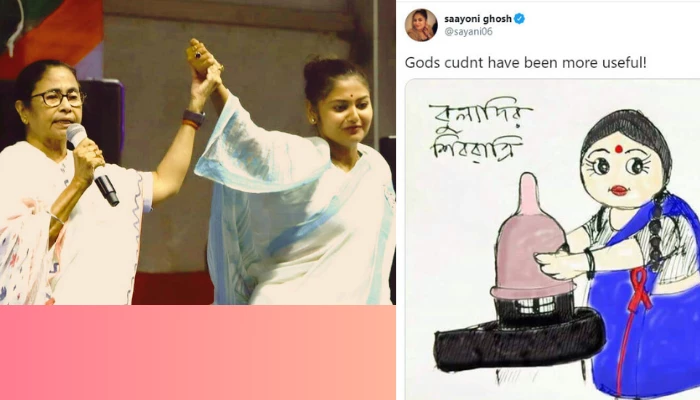
Case Summary
In West Bengal, a Hindu symbol representing a deity was mocked, desecrated, and subjected to abuse through a derogatory social media post by a Trinamool Congress (TMC) leader. The incident came to light on 4 April 2026, when, during a public meeting held ahead of the West Bengal Vidhan Sabha elections, Trinamool Congress (TMC) MP Saayoni Ghosh sang lines in praise of Medina and Kaaba. In a video that later surfaced on social media, she sang, “Ekbar chede de nouka majhi jabo Medina” (Rower, let the boat move, I will go to Medina). “Amar hriday majhe Kaaba, nayane Medina” (Kaaba is in my heart, Medina is in my eyes). The public meeting took place in the context of the upcoming state elections in West Bengal. This incident drew renewed attention to Saayoni Ghosh’s earlier social media post from 18 February 2015. On that date, she had posted an image showing a female character placing a condom over a Shivling, a sacred symbol in Hinduism. Along with the image, she had written, “Gods couldn’t have been more useful.” The post had been made around the occasion of Maha Shivratri, which had been observed on 17 February that year. After the 2015 post resurfaced in the public domain, Saayoni Ghosh issued an apology and stated that her social media account had been hacked. Following the circulation of the video from the April 2026 public meeting, the earlier Shivling post and the present remarks were discussed together across social media and news platforms.
Why it is Hate Crime ?
This case has been added to the tracker under the primary category- Attack on Hindu religious representations. The sub-category selected is: Iconoclastic representation of Hindu Gods/Goddesses. An icon is a symbol of someone or something that is revered, or a religious representation of a spiritual ideal. Iconography is of vital significance in the Hindu milieu. It helps connect people’s spiritual beliefs with the real world. Iconography within the Hindu faith takes many forms. Murtis are of most significance to Hindus, to which daily rituals, prayers and offerings are done. Besides the murtis, there are several other symbols which have deep significance in the Hindu faith – the Om and Swastika, for example. Any iconoclastic representation of these symbols, images and murtis is an affront to the religious beliefs and faith of the Hindu community itself since the symbols and icons are deeply religious in nature. In this sub-category of crime, we would record hate crimes and iconoclastic representations, in words, art, or any other form of representations of symbols that hold religious significance for the Hindu community. Since these symbols, icons and murtis are central to the Hindu faith, any iconoclastic representation of these symbols is born out of animosity towards the faith itself, manifesting itself through these symbols, and therefore, these representations would be considered religiously motivated hate crimes. The other subcategory selected is- Desecration of Hindu religious symbols. Icons and symbols, or a religious representation of a spiritual ideal, are widely revered in Hinduism. Iconography is of vital significance in the Hindu milieu. It helps connect people’s spiritual beliefs with the real world. Iconography within the Hindu faith takes many forms. Murtis are of most significance to Hindus, to which daily rituals, prayers and offerings are done. Besides the murtis, there are several other symbols which have deep significance in the Hindu faith – the Om and Swastika, for example. Since these Hindu religious symbols hold paramount importance in Hinduism, any desecration of symbols, icons, murtis, religious representations and manifestations, is driven by animosity towards the faith itself, which manifests itself through these murtis, icons and symbols. Therefore, any desecration of these Hindu religious symbols and representations is considered a religiously motivated hate crime under this category. The other sub-category is -Defiling religious customs. Sanatan Dharma is not a religion of one book, which is to say that while it has religious scriptures that form the central tenets of the faith, there are several traditions followed through thousands of years, mostly passed from generation to generation orally. Several such customs and traditions are followed by various Hindus and Hindu sects. Defiling of these traditions and customs is a breach of an individual or group’s religious practices. Such practices can range from dietary restrictions like not eating non-vegetarian food for a certain period of the year, not eating non-vegetarian food at all, not eating beef since the cow is considered holy in Hinduism, the sanctity of religious customs followed in the house (like many ISCKON devotees), etc. Any malicious action leading to the breach of such traditions or defilement of these traditions owing to animosity towards the faith or for the sake of activism stems not only from the lack of faith in the religion itself but also from disregard for the faith of the devotees who follow the customs/traditions and implicit bias against the faith, the tradition itself. Since these specific traditions are central to the faith of the devotees of that specific sect of Hindus, any non-compliance with these traditional rules would be considered a religiously motivated hate crime. Another primary category selected is- Hate Speech against Hindus. The subcategory selected is- Anti-Hindu slurs, mocking faith. Anti-Hindu slurs and the deliberate mocking of the Hindu faith owing to religious animosity involve the usage of derogatory terms, stereotypes, or offensive references to religious practices, symbols, or figures. One of the common anti-Hindu slurs used against Hindus is “cow-worshipper” and “cow piss drinker”. The intention of using this term is to demean and mock Hindus as a group and their religious beliefs since Hindus consider the cow holy. Additionally, some symbols and the slurs attached to them have a historical context that exacerbates the insult, hate, stereotyping, dehumanisation and oppression against Hindus. Cow worship has been used for centuries to denigrate Hindus, insult their faith and oppress Hindus specifically as a religious group. There has been overwhelming documentation about how cow slaughter has been used to persecute Hindus, with cow meat being thrown in temples and places of worship. There has also been overwhelming documentation where cow meat (beef) has been force-fed to Hindus to either forcefully convert them to Islam or denigrate their faith. Apart from cow worship, the Swastika – which holds deep religious significance for the Hindus – has also been misinterpreted and distorted to use as a slur against Hindus. Similarly, the worship of the Shivling has been used by supremacist ideologies and religions to denigrate Hindus owing to religious animosity. Such slurs and denigration stem from inherent animosity and hate towards Hindus and their faith; therefore, it is categorised as hate speech targeted at Hindus specifically owing to their religious identity. This incident was included in the tracker because a sacred and central symbol of Hindu worship, the Shivalingam, was deliberately subjected to public desecration through a crass and sexually explicit image. The case was not recorded because she expressed devotion towards Medina or the Kaaba. The issue lay elsewhere: the conscious desecration of a Hindu deity’s sacred symbol. The expression of one faith did not require the violation of another. The injury in this case did not arise merely from the use of offensive language, but from the conscious visual distortion of a sacred Hindu religious symbol. The post depicted a condom being placed over the Shivalingam, the consecrated embodiment of Lord Shiva, one of the most revered deities in Hinduism. This was not a passing remark or abstract criticism. It was a conscious visual act of blasphemy directed at a symbol that has been worshipped with reverence through the ages. To understand the seriousness of the act, one must understand what the Shivalingam signifies in the Hindu faith. For Hindus, it is not a mere object or artistic representation. It is the sacred form through which Mahadeva, Lord Shiva, is worshipped across temples and homes, embodying the eternal cosmic principle of creation, destruction, and transcendence. It occupies a central place in ritual worship, especially during Maha Shivratri, and is approached with profound devotion, purity, and reverence. Any intentional act that vulgarises or humiliates this symbol directly injures the religious sentiments of the Hindu community. The use of a condom in relation to the Shivalingam carried a particularly degrading meaning. By placing an object associated with sexual activity and contraception upon a consecrated symbol of worship, the image stripped the deity of sanctity and reduced a sacred representation to an object of mockery. This was not merely an offensive expression; it was a deliberate attempt to profane what millions regarded as holy. The act amounted to blatant blasphemy against Lord Shiva and the wider Hindu faith. Such visual distortion of a revered religious representation struck at the symbolic core of Hindu worship. This transformed a sacred icon into a vehicle for insult, making the act far more severe than ordinary criticism or personal opinion. The subsequent apology did not erase the original intent reflected in the act itself. The creation, wording, and posting of such an image on her own social media account required conscious thought and deliberate action at every stage. The visual had to be selected or created, the caption had to be written, and the post had to be published publicly. These were not accidental steps. They collectively demonstrated intention at the time of posting. The later apology only reinforced an existing pattern: the act was first committed consciously, and the regret surfaced only after public backlash and wider circulation. In that sense, the apology did not neutralise the injury caused but rather locked in the sequence of deliberate desecration followed by damage control. The fact that the post had surfaced around the period of Maha Shivratri further aggravated its impact, as this was a time of heightened devotion to Lord Shiva and the Shivalingam. The timing increased the likelihood of causing maximum hurt and provocation to Hindu devotees, lending further weight to the inference that the act was intended to provoke and inflame religious sentiments. By choosing to publish such a vulgar representation in temporal proximity to a period of heightened devotion, the post did not merely insult a symbol in abstraction; it desecrated the living customs, sentiments, and ritual practices associated with Shiva worship. In effect, it defiled a sacred religious tradition that remained central to the spiritual lives of millions. Further, the wording accompanying the image and the image itself together amounted to a deliberate act of mocking the Hindu faith. The combination of the sexually explicit visual and the accompanying text did not leave room for innocent interpretation. It communicated scorn towards a core object of Hindu reverence and reduced a sacred representation to a subject of public derision. Such conduct went beyond irrelevance and entered the realm of targeted humiliation of a religious belief system and its followers. Given the deliberate public defilement of a sacred Hindu symbol, the degrading imagery used, and the conscious nature of its publication, this incident met the parameters of a religion-based hate incident and was therefore included in the tracker. Disclaimer: The Hinduphobia Tracker recorded the incident date based on the date on which the offending social media post involving the Shivalingam was originally made public, 18 February, 2015, as that marked the commencement of the victim community’s ordeal. Subsequent political events and renewed circulation of the content were treated as contextual developments for documentation purposes.


Case Status
Unknown


Perpetrators Details
Perpetrators
State and Establishment
Perpetrators Range
One Person
Perpetrators Gender
female
 Sources




