Hindus threatened for chanting "Jai Shri Ram" in West Bengal's Kolkata; Hindu voter says he was attacked with sticks by the Muslims
 Kolkata, West Bengal, India
  11 April, 2026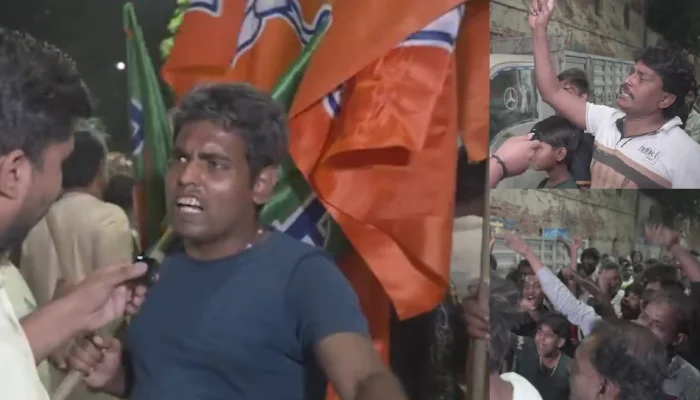
Case Summary
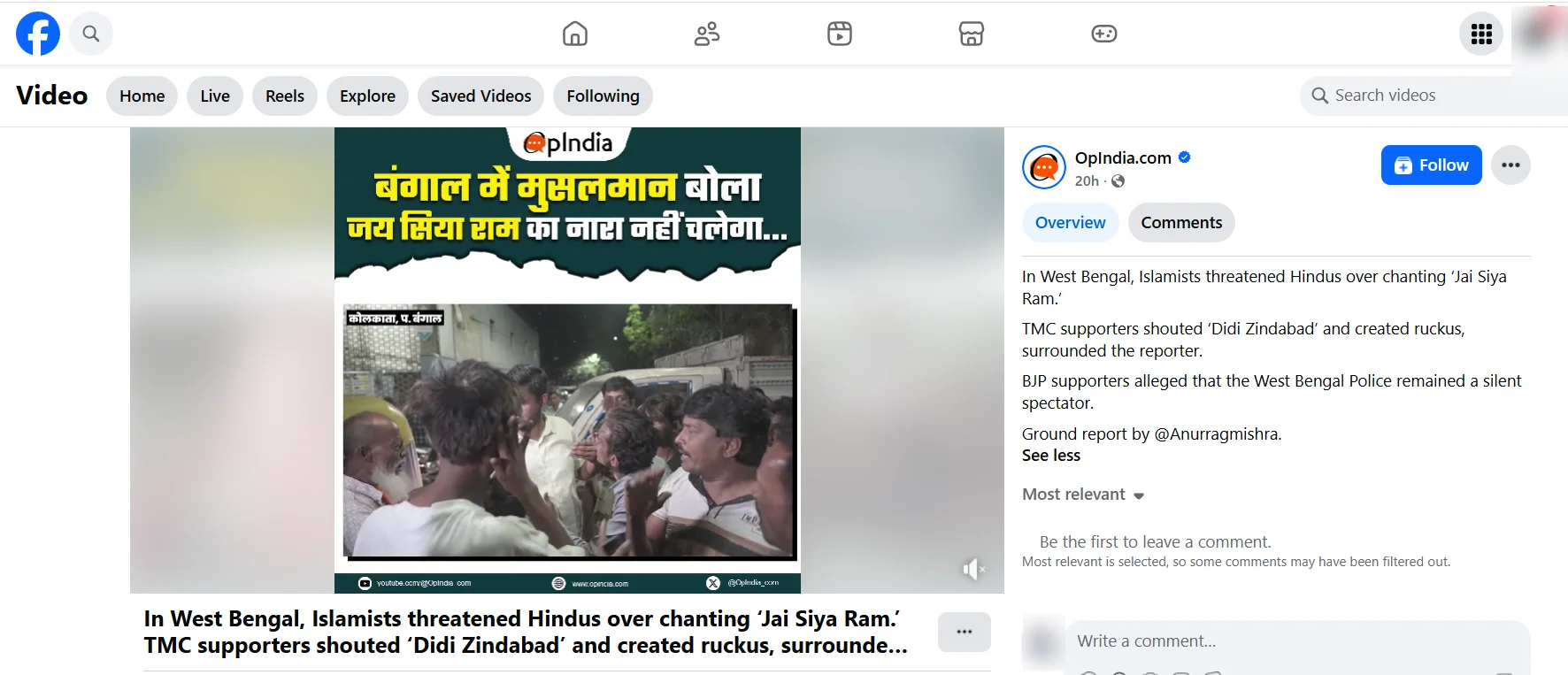
In Kolkata, West Bengal, Hindu supporters of the Bharatiya Janata Party (BJP) were threatened by Muslim workers and supporters of the Trinamool Congress (TMC) for chanting “Jai Shri Ram,” a revered religious slogan dedicated to Lord Ram. One Hindu voter stated that he was attacked with sticks by the assailants. A Hindu journalist working for OpIndia.com, an online news portal, was also gheraoed. The incident occurred while the journalist was reporting from the ground in West Bengal. At the time, Hindu BJP supporters were taking out a rally as part of election campaigning ahead of the 2026 West Bengal Assembly elections. Nupur J Sharma, Editor-in-Chief of OpIndia, shared snippets of two videos from the ground on 12 April 2026. In one of the videos, Hindu BJP supporters stated that Muslim TMC workers and supporters first threatened them, objected to the chanting of “Jai Shri Ram,” and then assaulted them with lathis. One supporter said, “They told us not to chant Jai Shri Ram,” and questioned, “Why should we not chant the name of our God?” The victim further stated that the police did not intervene and instead stood by while the assault took place. In another video, a group of Muslim men and minor boys were heard saying that it did not matter whether the BJP won or lost, but that “Jai Shri Ram” should not be chanted in West Bengal. They were also seen raising slogans such as “Didi Zindabad” and “Joy Bangla.” The same group was then seen gheraoing the Hindu journalist, Anurag Mishra, while he was reporting. It is important to mention here, that after the 2021 West Bengal Legislative Assembly elections, 40 incidents of rapes, murders and vandalism committed by TMC goons was reported. Incidents between May and July 2021 included lynching, crude bomb attacks and forced conversions. Houses of Hindus were torched, women assaulted and families fled to Assam. Victims also accused police of refusing to file complaints and issuing threats.
Case Images
Why it is Hate Crime ?
This case is added to the tracker under the primary category- Attack not resulting in death. The subcategory selected is- Attacked for Hindu identity. In several cases, Hindus are attacked merely for their Hindu identity without any perceived provocation. A classic example of this category of religiously motivated hate crime is a murder in 2016. 7 ISIS terrorists were convicted for shooting a school principal in Kanpur because they got ‘triggered’ seeing the Kalava on his wrist and tilak that he had put. In this, the Hindu victim had offered no provocation except for his Hindu religious identity. The motivation for the murder was purely religious, driven by religious supremacy. Such cases where Hindus are targeted merely for their religious identity would be documented as a hate crime under this category. Another primary category selected is- Hate Speech against Hindus. The subcategory selected is- Violent Threats. Violent threats, explicit, implicit or implied, is the most dangerous form of hate speech since it goes beyond discriminatory and prejudicial language to express the intent of causing harm to an individual or a group of people based on their religious identity and faith. There could be several different kinds of threats that are issued to Hindus based on religious animosity. An explicit threat would mean the direct threat of violence towards an individual Hindu, a group of Hindus or Hindus at large. Physical violence, death threats, threats of destruction of property belonging to Hindus and threats of genocide would mean explicit threats against Hindus for their religious identity. Implicit threats may not be a direct threat but implied through the use of symbols of actions – for example – in the Nupur Sharma case, other than explicit threats, there were also implicit threats when Islamists took to the streets to burn and beat her effigies. It implies that they want to do the same to Nupur Sharma – thereby is considered an implicit threat. Violent threats can be delivered in person, through letters, phone calls, graffiti, or increasingly through social media and other online platforms. It would be important to understand that a threat – explicit or implicit, online or offline – to an individual who happens to be a Hindu does not qualify as a religiously motivated threat. Such a threat, while vile and dangerous, could be owing to non-religious reasons and/or personal animosity. To qualify as a religiously motivated threat, it would need to exhibit an indication that the individual is being targeted for religious reasons and/or owing to his/her religious identity as a Hindu. This case stands as a stark example of a religiously motivated hate crime, where Hindu supporters of the Bharatiya Janata Party in Kolkata suffered brutal assaults at the hands of Muslim Trinamool Congress workers and supporters solely for chanting "Jai Shri Ram", a sacred slogan honouring Lord Ram. The violence erupted not from any provocation or conflict but purely because the victims expressed their Hindu faith through this devotional chant, marking their religious identity as the direct trigger. The Muslim perpetrators singled out these Hindus, attacking them with lathis in a calculated show of intolerance, driven by deep animosity towards Hindu religious expression rather than political rivalry alone. This targeted brutality against individuals for voicing a benign spiritual phrase reveals a pattern of hostility aimed at intimidating and subjugating the Hindu community, fitting the precise definition of a hate crime fuelled by religious prejudice. The "Jai Shri Ram" slogan carries immense significance in Hinduism as a powerful invocation of Lord Ram, the embodiment of dharma, righteousness, and victory over evil, chanted by millions during festivals like Ram Navami, temple processions, and daily prayers to affirm faith and cultural pride. For devout Hindus, it symbolises unwavering devotion and communal unity, resonating deeply as a call to preserve Hindu traditions amidst modern challenges. Chanting it publicly asserts religious identity without aggression, yet in this incident, it provoked savage retaliation, underscoring how the Muslim perpetrators weaponise opposition to this innocent religious expression to suppress Hindu visibility and devotion. The attack on Hindu BJP supporters over mere chanting of "Jai Shri Ram" exposes that the violence stemmed not from personal or political feuds but from the victims' overt religious identity as Hindus. When individuals face brutality exclusively for voicing a non-violent expression of their faith, it constitutes clear religious animosity harboured by the Muslim perpetrators towards Hindus, their faith and traditions. This assault sends a chilling message to the entire Hindu community, instilling fear and insecurity by demonstrating that proud, open displays of Hinduism invite violent reprisals, thereby eroding the right to practise faith freely and fostering a climate of suppression. Following the assault, Muslims explicitly declared, "Does not matter if BJP wins or loses; do not chant Jai Shri Ram in West Bengal," before raising slogans like "Didi Zindabad" and "Joy Bangla," revealing deep-seated religious animosity, Islamic supremacism, and a deliberate drive to suppress Hindu voices. This transcends political differences, as issuing ultimatums against a sacred Hindu chant equates to enforcing dominance over religious expression by any means necessary. Such extreme, violent threats from Muslims to the Hindu community highlight pure bigotry and intolerance towards Hinduism, where even peaceful devotion becomes a target, cementing this as a religiously motivated hate crime. Police inaction during the assault, where officers stood by without intervening as Muslim perpetrators beat Hindu supporters, exemplifies institutional bias and discrimination against Hindus. By failing to act against the Muslim aggressors and allowing the violence to unfold, law enforcement effectively sided with the Muslim attackers, signalling to Hindus that their lives, safety, and faith hold no value. This impunity emboldens perpetrators, perpetuates religious hatred, and deepens the Hindu community's distrust in state protection, turning a hate crime into a systemic failure that normalises anti-Hindu aggression. This was not the first time such institutionalised prejudice against Hindus had been demonstrated by West Bengal state authorities. The bias of the state extended beyond inaction. There were increasing instances where the state actively suppressed Hindu religious expression. Hindus had been arrested simply for chanting “Jai Shri Ram”, a phrase vilified by the administration and the ruling party. Permission for Hindu processions, especially during festivals like Ram Navami or Hanuman Jayanti, was routinely denied on grounds of "law and order concerns", while Muslim religious gatherings faced no such hurdles. Moreover, over the years, the Mamata-led government had issued numerous prejudicial directives, like orders restricting Durga Puja immersions, citing Muharram processions. Inaction on anti-Hindu mob violence in areas like Dhulian, Islampur, and Kaliachak. Public endorsements and appeasement of radical Muslim clerics and Islamist leaders, while dismissing concerns raised by Hindu groups as “communal provocation”. The systematic suppression of Hindu voices, the denial of communal violence, and the criminalisation of Hindu identity expressions such as “Jai Shri Ram” reflected not just administrative failure but a deeper ideological hostility toward the Hindu community. Overall, this case meets several parameters of an anti-Hindu hate crime. Therefore, it is added to the Hate Crime database of the Hinduphobia Tracker. Disclaimer: The Hinduphobia Tracker records an incident based on when the crime occurred rather than when it is reported by the media. In this case, media reports did not state the exact date when the incident occurred; henceforth, the date when it was posted on social media, 12 April 2026, has been selected as the indicative incident date. This is recorded for documentation purposes only. In this case, the total number of victims was not specified. Only one Hindu supporter, who stated that Muslims beat him and police took no action, was mentioned. Henceforth, for documentation purposes, a conservative victim count of one has been recorded.
Victim Details
Total Victim
1
Deceased
0
Gender
- Male 1
- Female 0
- Third Gender 0
- Unknown 0
Caste
- SC/ST 0
- OBC 0
- General 0
- Unknown 1
Age Group
- Minor 0
- Adult 1
- Senior Citizen 0
- Unknown 0


Case Status
Unknown


Perpetrators Details
Perpetrators
Muslim Extremists
Perpetrators Range
Unknown
Perpetrators Gender
male
 Sources




