Hindu temple targeted and illegally encroached upon in Deh, Rajasthan
 Nagaur, Rajasthan, India
  7 April, 2026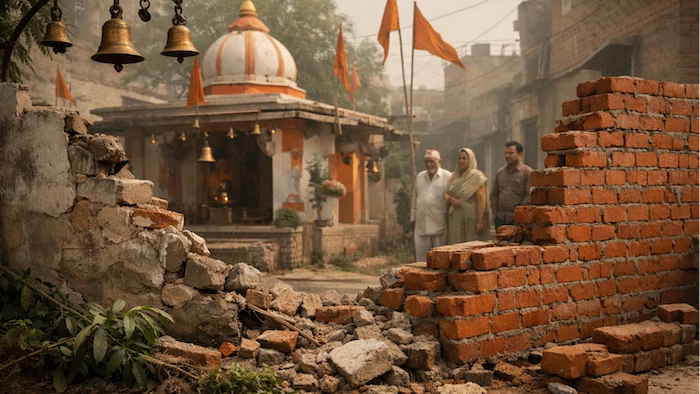
Case Summary
In the town of Nagaur district, Rajasthan, land associated with the Banshiwala temple was illegally encroached upon by a cement company. The disputed land was identified as doli land attached to the temple and had traditionally been associated with its religious use and customary rights. The incident came to light when local Hindu residents and persons connected with the temple raised objections to the occupation of the temple land. The land in question formed part of the Banshiwala temple’s doli land and had been used in connection with the temple’s religious functions. As per the report, the cement company had extended its activities onto the temple’s doli land without authorisation. The encroachment affected land belonging to and traditionally attached to the Hindu place of worship, thereby interfering with property linked to the temple. Following this, residents and concerned persons approached the local administration and revenue authorities seeking intervention. Complaints were submitted requesting official demarcation of the temple land and removal of the encroachment. The matter remained pending before the administrative authorities at the time of reporting.
Why it is Hate Crime ?
This case is being added to the tracker under the primary category- Attack on Hindu religious representations. The selected subcategory is: Encroachment or illicit takeover of temple land or land near the temple. In Hinduism, a temple is the abode of the Deity. The Deity in the Temple is consecrated, thereby making it a real, breathing entity. Hindus believe that not just the Deity but the temple premises itself are sacred, since they hold that the entire Temple space is an amalgamation of the deity's divine energy. Not only the Temple, but the Temple premises in their entirety, are considered sacred by Hindus. In several cases, the premises of the Temple and/or religious centre are illegally taken over by institutions of other faiths, such as the Waqf board or the Church. Other times, the temple property, land or the property of religious centres are illicitly encroached upon by non-Hindu groups. Any illicit takeover or encroachment is a crime an initio; however, when non-Hindu groups illicitly take over or encroach on the sacred land of Hindus, it is an affront to the Hindu community and is therefore classified as a religiously motivated hate crime under this category. This incident was recorded under the Hinduphobia Tracker because land attached to the Banshiwala temple, identified as its doli land, came under encroachment by a cement company. The encroachment did not concern an ordinary parcel of land in isolation; it concerned land intrinsically linked to a Hindu place of worship and its continued religious functioning. In Hindu tradition, temple land extends beyond the sanctum or the principal shrine structure. The surrounding land forms part of the temple’s religious and cultural ecosystem. It enables devotees to assemble, conduct processions, perform customary rituals, and access the temple without obstruction. In many traditional settings, such land also hold ceremonial significance and is tied to long-standing patterns of worship and community use. Therefore, any encroachment upon such land directly affects the manner in which religious practices had been carried on over generations. The act of extending commercial or industrial activity onto temple land had the effect of restricting the temple’s functional space. Even where worship inside the structure had not been expressly prohibited, the shrinking or occupation of temple land materially constrained access, movement, and religious use. Such interference weakened the community’s ability to practise worship in the full and customary sense. Further, Article 25 of the Constitution of India guarantees the freedom to profess, practise, and propagate religion. This protection has consistently been understood to include access to places of worship and the performance of essential religious practices. When land attached to a temple was encroached upon, the impact was not merely proprietary in nature; it bore directly upon the exercise of religious freedom by Hindu devotees. Moreover, the State had a constitutional obligation, rooted in the principle of secularism, to ensure that religious spaces remained protected from unlawful occupation and interference. Failure to secure temple land and preserve its accessibility undermined this constitutional responsibility and left the Hindu community vulnerable to disruption of its religious life. It is pertinent to mention here that such encroachments are not just isolated incidents or routine land disputes. They reflect a broader pattern where Hindu religious spaces are often not treated with the seriousness and respect they deserve. Temple lands, even when clearly linked to religious use, are frequently seen as available for commercial use or occupation, showing a lack of regard for their sanctity and importance to devotees. This points to a mindset where interference with Hindu places of worship is more easily overlooked or normalised. By allowing such encroachments, religious practices are pushed aside for other interests, and the rights of devotees are weakened. It is this repeated disregard for Hindu religious spaces and the impact it has on the community’s ability to practise their faith that explains why such incidents occur. Overall, the encroachment upon the Banshiwala temple’s doli land disrupted the continuity of worship, affected the sanctity and usability of temple space, and diminished the devotees’ ability to freely access and use a sacred site. Therefore, this case was recorded under the tracker. Disclaimer: The Hinduphobia Tracker records incident dates based on when the victim’s ordeal or the incident came to light, rather than when it was later discussed. In this case, the report did not specify the exact date on which the encroachment began. Therefore, 8 April 2026, the date on which the report was published, has been recorded as the indicative incident date for documentation purposes.


Case Status
Complaint filed


Perpetrators Details
Perpetrators
Others
Perpetrators Range
Unknown
Perpetrators Gender
unknown
 Sources




