Hindu woman converted to Islam and married through nikah; beaten, poisoned and evicted by Muslim in-laws
 Banda, Uttar Pradesh, India
  10 April, 2014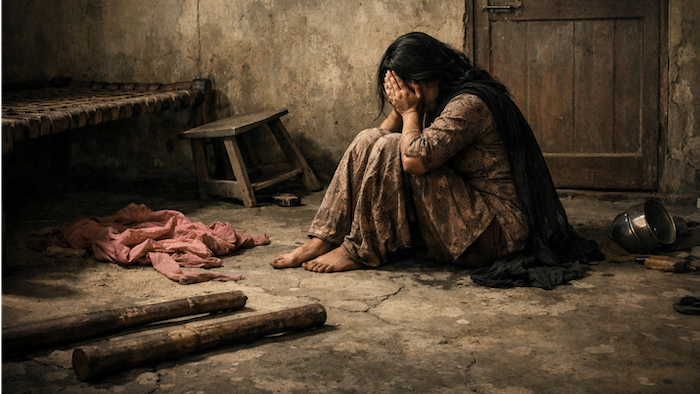
Case Summary
A Hindu woman named Nisha, also known as Neetu, in the Civil Lines police station area of Uttar Pradesh, was converted to Islam and married through nikah approximately 12 years ago by a Muslim man named Shanu after he cultivated a friendship with her. Following her conversion, her own family severed all ties with her. After she gave birth to three daughters, her in-laws subjected her to sustained physical and mental abuse, attempted to kill her with a poisoned injection, tried to harm her daughters, and ultimately evicted her from the marital home. A First Information Report [FIR] was registered against six named accused, and an investigation was launched. Shanu cultivated a friendship with the Hindu woman approximately 12 years before the complaint was filed. He then converted her to Islam and married her through nikah. As a consequence of the conversion, her family of origin severed all ties with her, leaving her entirely dependent on her husband and his family with no external support network. Following the nikah, the woman gave birth to three daughters. The absence of a male child angered her in-laws, who began subjecting her to sustained physical and mental abuse. The in-laws began pressuring Shanu to divorce her and remarry, and regularly beat her. In an attempt to kill her, her in-laws administered a poisoned injection to her. They also made attempts to harm her three daughters. She was then beaten and evicted from the marital home while two of her daughters were kept inside the house against her will. Left without shelter, family support, or any means of assistance, Nisha was forced to wander without a fixed place to stay. She expressed serious fear that her in-laws intended to have her killed. She filed a complaint with Civil Lines Kotawali police, on the basis of which an FIR was registered against her husband Shanu, and five others named as Shahid, Babu, Zayda, Yamin, and one unidentified individual. Kotwal Omkar Singh confirmed that an investigation was underway.
Why it is Hate Crime ?
The primary category for this case is "Crimes against women in relationships and other sexual crimes". The sub-category here is "Brainwashed and/or groomed". The tertiary categories here are "Rape and sexual assault/harassment" and "Victim said she was brainwashed/groomed". In our database, we have not added incidents where women have converted to another religion of their free will and no allegations of forced/involuntary conversion have been made. However, there are certain cases of conversion where the consent itself is a result of the brainwashing or grooming of a minor by the non-Hindu perpetrator trying to victimise a woman for her Hindu religious identity. The phenomenon of grooming points to non-Hindu perpetrators identifying their Hindu victims’ vulnerabilities and exploiting them over months and sometimes years, to extract the supposed ‘consent’ in order to convert their religion. In most cases of grooming, the victims are minors or the grooming started when the victim was a minor. In other cases of grooming, the non-Hindu perpetrator brainwashes and grooms a minor victim to extract their trust and then proceeds to rape them repeatedly with the intent of converting them to their faith. It is pertinent to understand here that when the victim is a minor, the ‘consent’ to convert or enter into a romantic relationship with an adult itself is redundant – addressed by POCSO. While every case of conversion of a minor and incidents of establishing a physical relationship with a minor by an adult is a crime, for the purpose of this database, a case would be considered a hate crime only if there is a distinct religious angle to the grooming. For example, in the UK, if a Hindu minor is targeted by Pakistani grooming gangs, it would be considered a hate crime because the victims are specifically targeted owing to their non-Muslim religious identity with the perpetrators being Muslim. In other cases, if a Hindu minor is brainwashed into entering a physical relationship with the non-Hindu adult perpetrator and the family alleges grooming/brainwashing of the minor to convert her religion, it would form a part of this database. If the victim is a Hindu adult, the case would form a part of this database only if the victim herself says that she was brainwashed/groomed to convert her religion. However, if the victim is deceased (murdered or otherwise), the case would form a part of this database if her family/friends provided testimony that the victim was brainwashed/groomed to convert her religion. Since these crimes have a distinct religious angle where the victim is being targeted owing to her Hindu religious identity, these cases are considered a hate crime. Another sub-category for this case is "Forced conversion before marriage". The tertiary category for the case is "Forced to do Nikah". In such cases, a non-Hindu man is in a relationship with a Hindu woman when the pressure to convert her religion begins to manifest. In such cases, typically, two patterns emerge. First, when the relationship is consensual, and the religious identity of the perpetrator is known to the Hindu woman in the relationship, however, at some point during the relationship, the non-Hindu man starts to force the victim to convert her religion and give up her Hindu religious identity. The second is when the woman gets into a marriage with the man pretending to share her faith. Later, when the truth is revealed, the man starts pressuring the woman to convert her religion and give up her religious identity. In both the situations, the methods used to force the victim to convert her religion often revolve around force-feeding beef, forcing her to wear hijab, forcing her to read the Kalma or even pressurizing the victim to do ‘Nikah’, which is marriage under Islamic law, with a prerequisite being conversion to Islam. Cases where a Hindu woman consensually converts to Islam in a relationship will be left out of the hate crime database, even though it could be argued in several cases that the conversion was a result of religious brainwashing. One other sub-category for this case is "Assault or threat upon refusal to convert". When Hindu women are in a relationship with non-Hindu men, there are cases where the woman faces threats or assault after she refuses to convert and change her religious identity owing to pressure/force by the non-Hindu man. Such relationships may be consensual with the religious identity of the non-Hindu man known to the victim. Somewhere along the relationship, the non-Hindu man starts pressurizing the Hindu woman to convert to Islam and upon her refusal, assaults or threatens the victim. Such cases are driven by specific religious motivations and against the religious identity of the victim and are therefore qualified as hate crimes. Cases where the Hindu woman converts to Islam and does not file a complaint about the force or threat, are not considered a part of the hate tracker, even though, it may be argued that the woman was brainwashed or threatened to convert to Islam. Another sub-category for this case is "Torture of family to force woman to convert". When Hindu women are in a relationship with non-Hindu men, there are cases where the woman is forced to convert her religion. Several methods are used for such forced conversion. The non-Hindu man is often documented to issue threats and even employ violence. One of the ways used by such perpetrators is threatening and/or torturing the family members of the Hindu woman to pressure her to convert. The perpetrators in such cases issue threats to harm or torture the family of the woman. In some cases, there is also violence directed towards the family to force the Hindu woman to convert. Such crimes aim to blackmail the victim into changing her religion by inducing fear of harm to her family. Such cases are driven by specific religious motivations and against the religious identity of the victim and are therefore qualified as hate crimes. This case qualifies as a religiously motivated hate crime in which a Hindu woman named Nisha, also known as Neetu, was groomed into a relationship by a Muslim man named Shanu, converted to Islam, married through nikah, severed from her family of origin as a consequence of the conversion, and then subjected to twelve years of sustained physical and mental abuse, an attempted murder through a poisoned injection, and ultimately evicted from her marital home while her daughters were retained as hostages. The religious motivation of this case was not incidental. It was the organising principle of every act of harm that followed the initial conversion. The grooming of the victim through a cultivated friendship is the foundational religious marker of this case. Shanu did not approach the Hindu woman with an open declaration of his intentions. He cultivated a friendship with her over a period of time, manufacturing emotional trust and dependency before drawing her into a relationship that culminated in her conversion to Islam and nikah. The deliberate use of friendship as the mechanism of religious entrapment reflects a structured strategy of gradual manipulation in which the victim's consent was manufactured through sustained emotional investment rather than secured through honest disclosure of the perpetrator's true intentions. The forced conversion to Islam and the nikah are the second religious marker. The conversion was not a free act of religious choice made by an informed adult. It was the outcome of a grooming process that had been specifically designed to bring a Hindu woman to the point of religious transformation through emotional dependency. The nikah that followed the conversion formalised the victim's absorption into an Islamic household and simultaneously severed her from the legal and social protections of her Hindu family, placing her entirely within the control of her husband and his family with no external support network. The severing of the victim's family ties as a consequence of the conversion is the third religious marker. Following her conversion to Islam, the victim's family of origin severed all ties with her. This severance was itself a direct consequence of the conversion and left her in a position of total social and familial isolation. A Hindu woman who had been converted to Islam and married through nikah, and whose own family had subsequently cut all contact with her, was a woman with no means of seeking help, no place of refuge, and no social network outside her husband's family. This isolation was the condition that made twelve years of sustained abuse possible. The sustained physical and mental abuse following the birth of three daughters is the fourth religious marker. The in-laws' anger at the absence of a male child and their subsequent campaign of physical and mental abuse reflects the imposition of Islamic patriarchal expectations on a Hindu woman who had been absorbed into a Muslim household through conversion. The abuse was not random. It was a punishment administered to a Hindu woman for failing to meet the reproductive expectations of the Muslim household she had been converted into, and it escalated systematically over the years. The attempted murder through a poisoned injection is the fifth and most acute religious marker. The administration of a poisoned injection to the victim with the intent to kill her represents the most extreme expression of the violence directed at her within the forced conversion marriage. The in-laws' simultaneous pressure on Shanu to divorce her and remarry confirms that the attempted murder was motivated by a desire to remove a Hindu woman who had failed to produce a male heir from the household, replacing her with a more suitable partner. The victim's life was treated as disposable within the framework of the forced conversion marriage she had been groomed into twelve years earlier. The retention of two of the victim's daughters inside the marital home following her eviction is the sixth religious marker. After evicting the victim from the home, the in-laws retained two of her three daughters inside the house. This act served a dual purpose. It deprived the victim of her children and simultaneously ensured that two children born of a Hindu woman and raised within a Muslim household remained under Muslim family control. The use of the victim's daughters as instruments of coercion and retention reflects the broader religious dimension of a case in which a Hindu woman's reproductive output was treated as an asset of the Muslim household she had been forcibly absorbed into. Given that this case met the parameters of a religiously motivated hate crime, it was added to the hate crime database of the tracker. Disclaimer: The HinduPhobia Tracker records incident dates based on when the crime occurred rather than when it was reported or published. This case involves a sustained course of conduct spanning approximately 12 years. The grooming and subsequent forced conversion and nikah began in approximately 2014, representing the start of the criminal conduct. The most recent and acute acts, the attempted murder through a poisoned injection, the physical eviction from the marital home, and the retention of the victim's daughters, occurred shortly before the complaint was filed. As the publication date of 11 April 2026 reflects the most recent and documentable phase of the incident and the filing of the FIR, it has been used as the primary incident date for documentation purposes, with 2014 recorded as the start date of the grooming and forced conversion. The date 11th April 2014 was recorded for documentation purposes only.
Victim Details
Total Victim
4
Deceased
0
Gender
- Male 0
- Female 4
- Third Gender 0
- Unknown 0
Caste
- SC/ST 0
- OBC 0
- General 0
- Unknown 4
Age Group
- Minor 3
- Adult 1
- Senior Citizen 0
- Unknown 0


Case Status
Complaint registered


Perpetrators Details
Perpetrators
Muslim Extremists
Perpetrators Range
One Person
Perpetrators Gender
male
 Sources




