Hindu homes, shops targeted and attacked by Muslim mob over unrelated pretext amidst ongoing persecution of Hindus in Bangladesh
 Rangpur, Rangpur District, Bangladesh
  10 April, 2026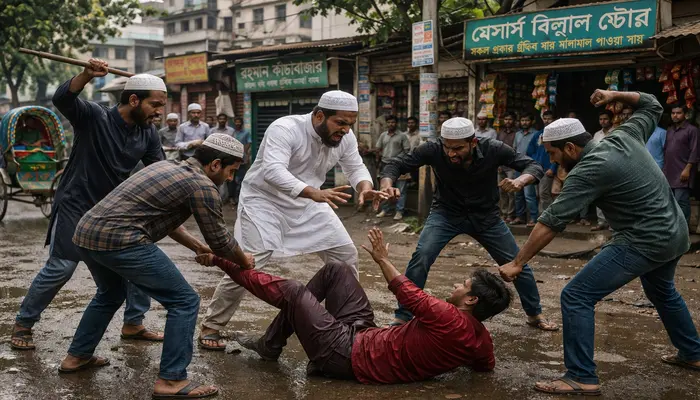
Case Summary
Hindu homes, shops, and settlements were targeted and attacked by a Muslim mob in the Rangpur district of Bangladesh. The Hindu minority were attacked following the murder of a Muslim spiritual figure, Rakib Hasan, by a Muslim man named Mohammad Momin. According to reports, on 11 April 2026, in the Daspara Bazar area of Rangpur, the Muslim spiritual figure, Rakib Hasan, was murdered by a Muslim man named Mohammad Momin due to a personal rivalry. Despite this, and despite the victim’s mother, Noorjahan Begum, explicitly stating that the Hindu community had no involvement and that there was no dispute with them, an enraged Muslim mob launched a coordinated attack on Hindu households and businesses in the locality. Eyewitness accounts described widespread vandalism and attempted looting of Hindu homes, shops and settlements. Over a hundred Hindu families resided in the area and were affected and left in fear. Meanwhile, Rangpur Police Commissioner Mohammad Majid Ali claimed that the violence constituted a deliberate attempt by third parties to divert attention from the actual murder investigation. He said that the perpetrators involved in targeting Hindus had been identified and would face action. This attack comes at a time when Hindus are facing a fresh wave of attacks in Bangladesh following the 13th National Parliamentary Election 2026 in Bangladesh, reinforcing a recurring pattern of post-poll violence targeting Hindu minorities. Within days of the announcement of results, Hindu families in districts such as Noakhali, Rangpur, Nilphamari, Sylhet, Thakurgaon, and Dinajpur reported coordinated attacks involving arson, looting, assault, and vandalism of temples and homes. In several instances, Hindu homes were selectively targeted, looted, and families were threatened with displacement. This escalation of violence against Hindus in Bangladesh unfolded in three distinct phases: first, following the ouster of Sheikh Hasina’s government in August 2024; second, after the death of Sharif Osman Bin Hadi in December 2025; and third, in the immediate aftermath of the 13th National Parliamentary Election 2026. This electoral violence unfolded against the broader backdrop of sustained anti-Hindu hostility that had persisted since the ouster of the Sheikh Hasina government in August 2024. During that period, multiple reports documented attacks on Hindu homes, temples, and religious institutions, alongside intimidation campaigns, arson, and mob assaults targeting minority neighbourhoods. The Hinduphobia tracker has recorded 336 such incidents against the Hindu minority, underscoring the scale and persistence of anti-Hindu violence during this period. A further escalation occurred following the death of Sharif Osman Bin Hadi, a Muslim political activist and student leader known for his anti-Hindu and anti-India rhetoric. Hadi had been involved in political unrest after the fall of the Hasina government and was killed in Dhaka on 18 December 2025 during clashes. In the aftermath of his death, Hindu communities were blamed and subsequently targeted in retaliatory violence. Hindu homes were selectively set ablaze in multiple localities, forcing families to flee and leaving many displaced. The attacks appeared patterned rather than sporadic, with Muslim mobs focusing on Hindu neighbourhoods, properties, and religious symbols. Among the victims was Dipu Chandra Das, who was lynched to death and his body was set ablaze by a Muslim mob over false blasphemy allegations. The Hinduphobia tracker documented 51 incidents of anti-Hindu violence in the period following Hadi’s death alone. Such incidents underscore the vulnerability of the Hindu minority amid rising communal hostility and the weaponisation of religious accusations. Reports further indicated that posters and written materials calling for the extermination of Hindus were displayed in public spaces, signalling an alarming normalisation of genocidal rhetoric. When combined with acts of arson, vandalism, assault, and targeted intimidation, these developments suggest a coordinated environment of hostility aimed at terrorising the Hindu community and reinforcing majoritarian dominance.
Why it is Hate Crime ?
This case has been added to the tracker under the primary category of - Attack not resulting in death. Within it, the sub-category selected is - Attacked for Hindu identity. In several cases, Hindus are attacked merely for their Hindu identity without any perceived provocation. A classic example of this category of religiously motivated hate crime is a murder in 2016. 7 ISIS terrorists were convicted for shooting a school principal in Kanpur because they got ‘triggered’ seeing the Kalava on his wrist and tilak that he had put. In this, the Hindu victim had offered no provocation except for his Hindu religious identity. The motivation for the murder was purely religious, driven by religious supremacy. Such cases where Hindus are targeted merely for their religious identity would be documented as a hate crime under this category. The other sub-category selected is - Communal clash/attack. Communal clash is a form of collective violence that involves clashes between groups belonging to different religious identities. For a communal clash between Hindus and non-Hindus to qualify as a religiously motivated hate crime, the trigger of the violence itself would have to be anti-Hindu in essence. For example, if there is a Hindu religious procession that comes under attack from a non-Hindu mob and after the initial attack, Hindus retaliate in self-defence, leading to a communal clash between the two religious communities. While at a later stage, both communities are involved in the clash/violence, the initial trigger of the violence was by the non-Hindu mob against the Hindus and therefore, it could safely be termed as an anti-Hindu violence. Further, the trigger would also have to be religiously motivated. In the cited example, the attack by the non-Hindu mob was against religious processions and therefore, can be concluded to be religiously motivated. In some cases, the trigger may be non-religious, however, it develops into religious violence against Hindus at a later stage. In such cases too, the foundational animosity towards Hindus becomes the motivating factor of the crime and therefore, it would be classified as a religiously motivated hate crime against Hindus under this category. This case has been added to the tracker as a clear instance of a religiously motivated hate crime, where Hindu families, their shops, and settlements were selectively targeted by a Muslim mob in the Daspara Bazar area of Rangpur following the murder of a Muslim spiritual figure, Rakib Hasan. While the police investigations confirmed that Hasan was killed by Mohammad Momin due to a personal rivalry, with no involvement of the Hindu community, despite this, a Muslim mob proceeded to single out the Hindu minority and launched a violent, large-scale attack on Hindu homes. The deliberate targeting of Hindu properties, despite clear knowledge of their non-involvement, demonstrates that the violence was not a spontaneous reaction to the murder but was rooted in religious hatred, directed at the community because of their religious identity. The triggering incident in this case was the murder of Rakib Hasan by Mohammad Momin, both of whom were Muslims, with the crime arising out of a personal rivalry and bearing no connection to the Hindu community. Despite the absence of any Hindu involvement, a Muslim mob proceeded to launch violent attacks against Hindu homes and businesses in Rangpur. This disconnect between the cause of the incident and the choice of victims highlights that the violence was not a reaction to the crime itself but was rooted in underlying religious hostility. The readiness with which the Muslim mob turned against an unrelated minority community demonstrates the extent to which Hindus are perceived as convenient targets, simply because of their religious identity, even in situations where they have no role whatsoever. The selective nature of the attacks, directed exclusively at Hindu households while others remained unaffected, further reinforces the communal character of the violence. Such selectivity indicates that the unrest was not indiscriminate but based on religious identity, where an unrelated pretext was used by the Muslim mob to justify targeted aggression against the Hindu minority. The nature of the attack further reinforces its communal character. Such actions indicate that the Muslim mob did not target individuals connected to the crime but instead chose to collectively punish an entire religious community, without any fault of their own. The indiscriminate nature of the destruction within Hindu localities, combined with the absence of any targeting of others, highlights a pattern of selective aggression where Hindu identity alone became sufficient grounds for violence. This form of collective targeting is consistent with patterns of mob mobilisation in Bangladesh, where unrelated trigger incidents are used as pretexts to unleash violence against vulnerable Hindu populations. It is particularly significant that the attack took place even after members of the victim’s own family publicly rejected any Hindu involvement. This eliminates the possibility of misinformation or confusion as the sole driver of the violence and instead points towards a deeper, pre-existing religious hostility. The fact that the Muslim mob proceeded despite clarity regarding the actual perpetrator demonstrates that the murder functioned merely as a pretext, while the underlying motivation for the violence lay in animosity towards the Hindu minority. Such conduct reflects a pattern where Hindus are treated as a collective target, irrespective of individual culpability. This incident must also be understood within the broader context of recurring violence against Hindus in Bangladesh, where minority communities have repeatedly faced attacks on their homes, businesses, and places of worship following unrelated trigger events. Such patterns reveal a systemic vulnerability, where any localised conflict or crime can be weaponised into a communal assault on Hindus. The Rangpur incident fits squarely within this pattern, where a non-communal murder was rapidly transformed into an opportunity for targeted violence against a religious minority. Taken together, the selective targeting of Hindu homes and businesses, the absence of any link between the victims and the crime, the continuation of violence against Hindus despite explicit clarification from the victim’s family, and the broader pattern of anti-Hindu hostility in Bangladesh demonstrate that this was not an instance of random unrest. Rather, it constituted a deliberate act of collective punishment against Hindus because of their religious identity. Therefore, this case has been added to the hate crime database of the Hinduphobia Tracker as a clear instance of religiously motivated targeting.


Case Status
Unknown


Perpetrators Details
Perpetrators
Muslim Extremists
Perpetrators Range
Unknown
Perpetrators Gender
unknown
 Sources




