Hindu temple vandalised, religious images desecrated and thrown into river by anti-social elements in Bangladesh
 Chittagong District, Bangladesh
  8 April, 2026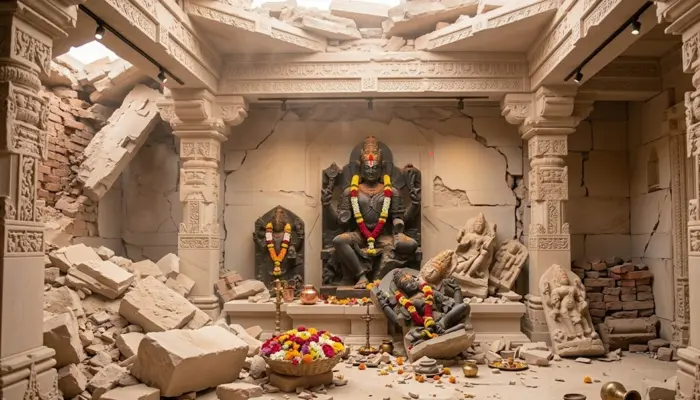
Case Summary
In Pomra Union of Rangunia Upazila in Chittagong, Bangladesh, a Shiva temple was vandalised and desecrated by a group of miscreants. According to reports, during the night of 9 April 2026, the perpetrators entered the temple premises under the cover of darkness and carried out widespread destruction within the site, damaging furniture and disrupting the sanctity of the place of worship. Furthermore, the perpetrators also took the religious images kept inside the temple and threw them into a nearby water body. The attack appeared coordinated and premeditated, as it occurred alongside the assault on another Hindu temple, the Maa Magadheshwari temple, in the immediate vicinity during the same night. The incident came to light on the morning of 10 April 2026, when the temple priest Bimal Chakravarthy came to offer his daily puja and witnessed the desecration. Seeing the dilapidated condition of the temple, he informed the locals and the police about the incident. As of the date of writing this report, a complaint was filed, and efforts were underway to identify and apprehend those responsible for the attack. Pallab Kanti Chowdhury, organising secretary of Jago Hindu Parishad, said, “Such a heinous incident has not happened in Rangunia in recent memory. We want a speedy and fair investigation into this incident and demand exemplary punishment for the culprits." This attack comes at a time when Hindus are facing a fresh wave of attacks in Bangladesh following the 13th National Parliamentary Election 2026 in Bangladesh, reinforcing a recurring pattern of post-poll violence targeting Hindu minorities. Within days of the announcement of results, Hindu families in districts such as Noakhali, Rangpur, Nilphamari, Sylhet, Thakurgaon, and Dinajpur reported coordinated attacks involving arson, looting, assault, and vandalism of temples and homes. In several instances, Hindu homes were selectively targeted, looted, and families were threatened with displacement. This escalation of violence against Hindus in Bangladesh unfolded in three distinct phases: first, following the ouster of Sheikh Hasina’s government in August 2024; second, after the death of Sharif Osman Bin Hadi in December 2025; and third, in the immediate aftermath of the 13th National Parliamentary Election 2026. This electoral violence unfolded against the broader backdrop of sustained anti-Hindu hostility that had persisted since the ouster of the Sheikh Hasina government in August 2024. During that period, multiple reports documented attacks on Hindu homes, temples, and religious institutions, alongside intimidation campaigns, arson, and mob assaults targeting minority neighbourhoods. The Hinduphobia tracker has recorded 336 such incidents against the Hindu minority, underscoring the scale and persistence of anti-Hindu violence during this period. A further escalation occurred following the death of Sharif Osman Bin Hadi, a Muslim political activist and student leader known for his anti-Hindu and anti-India rhetoric. Hadi had been involved in political unrest after the fall of the Hasina government and was killed in Dhaka on 18 December 2025 during clashes. In the aftermath of his death, Hindu communities were blamed and subsequently targeted in retaliatory violence. Hindu homes were selectively set ablaze in multiple localities, forcing families to flee and leaving many displaced. The attacks appeared patterned rather than sporadic, with Muslim mobs focusing on Hindu neighbourhoods, properties, and religious symbols. Among the victims was Dipu Chandra Das, who was lynched to death and his body was set ablaze by a Muslim mob over false blasphemy allegations. The Hinduphobia tracker documented 51 incidents of anti-Hindu violence in the period following Hadi’s death alone. Such incidents underscore the vulnerability of the Hindu minority amid rising communal hostility and the weaponisation of religious accusations. Reports further indicated that posters and written materials calling for the extermination of Hindus were displayed in public spaces, signalling an alarming normalisation of genocidal rhetoric. When combined with acts of arson, vandalism, assault, and targeted intimidation, these developments suggest a coordinated environment of hostility aimed at terrorising the Hindu community and reinforcing majoritarian dominance.
Why it is Hate Crime ?
This incident has been added to the tracker under the category- Attack on Hindu religious representations. Under this, the first subcategory selected is- Attack on Temples. In Hinduism, a temple is the abode of the Deity. The Deity in the Temple is consecrated, thereby, making it a real, breathing entity. Hindus believe that not just the Deity but the temple premises itself are sacred to Hindus since Hindus hold the faith that the entire Temple space is an amalgamation of the divine energy of the deity. Given the central significance of Temples in Hindu Dharma, any attack against a Hindu Temple or its peripheral premises is an attack on the faith itself and is born out of animosity towards the faith, of which, the Temple is a central tenet. Any manner of attack against a Temple and/or its premises would therefore be considered a religiously motivated hate crime. The other subcategory selected is- Desecration of Hindu religious symbol. Icons and symbols or a religious representation of a spiritual ideal are widely revered in Hinduism. Iconography is of vital significance in the Hindu milieu. It helps connect people’s spiritual beliefs with the real world. Iconography within the Hindu faith takes several shapes and forms. Murtis are of most significance to Hindus, to which daily rituals, prayers and offerings are done. Besides the murtis, there are several other symbols which have deep significance in the Hindu faith – the Om and Swastika for example. Since these Hindu religious symbols hold paramount importance in Hinduism, any desecration of symbols, icons, murtis, religious representations and manifestations, is driven by animosity towards the faith itself which manifests itself through these murtis, icons and symbols. Therefore, any desecration of these Hindu religious symbols and representations is considered religiously motivated hate crimes under this category. This incident qualified as a religiously motivated hate crime because it involved the targeted vandalism and desecration of a Hindu place of worship, a Shiva temple, in Pomra Union of Rangunia Upazila in Chittagong, Bangladesh. The temple was not merely a physical structure but a consecrated religious site where devotees regularly engaged in worship, rituals, and spiritual practices. The deliberate intrusion into such a sacred space and the destruction carried out within it constituted a direct affront to the religious identity, faith, and dignity of the Hindu community. Temples hold profound significance in Hinduism as sanctified spaces believed to embody the presence of the divine. The act of entering the temple premises and vandalising its interior, including damaging furniture and disturbing the sanctity of the space, represented more than ordinary property damage. It amounted to a violation of a sacred environment that serves as a focal point of devotion and community life. Furthermore, the removal of religious images from within the temple and throwing them into a nearby water body further underscored the intent to desecrate and insult Hindu religious symbols, reflecting a conscious act of disrespect towards the faith. In Hindu belief, temples and the religious images housed within them are integral to the practice of faith and the expression of devotion. Any act that interferes with or damages these elements is perceived as an attack on the religion itself. The desecration of the Shiva temple therefore, extended beyond material damage, impacting the collective religious sentiments and sense of security of the Hindu community in the area. The absence of any clear personal dispute or incidental trigger, combined with the specific targeting of a place of worship and the desecration of religious objects within it, reinforced the conclusion that the act was driven by hostility towards the Hindu faith. The deliberate act of throwing religious images into a water body carried symbolic significance, as it represented not only physical destruction but also an attempt to degrade and dishonour objects held sacred by devotees. This incident also aligned with a broader pattern of recurring attacks on Hindu temples and religious symbols in Bangladesh, where the Hindu community, as a religious minority, has faced repeated instances of violence, desecration, and intimidation. When such incidents occur in conjunction with attacks on multiple temples within the same locality, they reflect a pattern of targeted aggression rather than isolated acts. The coordinated vandalism of the Shiva temple, along with the simultaneous desecration of another Hindu temple nearby, demonstrated a sustained hostility towards Hindu religious institutions. As such, this case met the criteria of a religiously motivated hate crime and was included in the Hinduphobia Tracker database.


Case Status
Complaint filed


Perpetrators Details
Perpetrators
Unknown
Perpetrators Range
Unknown
Perpetrators Gender
unknown
 Sources




