Hindu temple illegally encroached upon, leading to disruption and halting of sacred religious rituals in Ballia, Uttar Pradesh
 Ballia, Uttar Pradesh, India
  10 April, 2026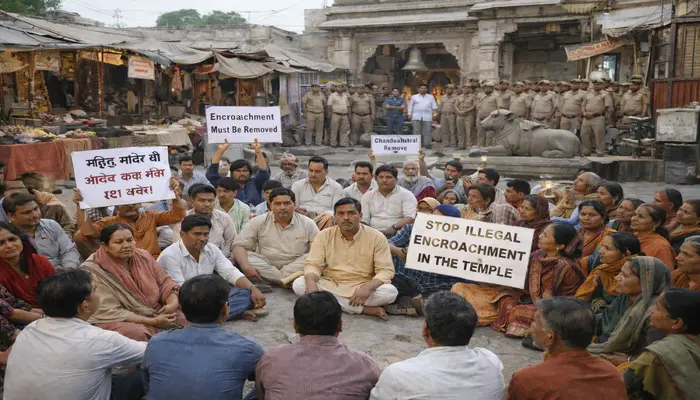
Case Summary
A Hindu temple named Dashavat Brahma Baba temple in Bansdih, Ballia, Uttar Pradesh, faced disruption to its religious practices due to illegal encroachment within the temple premises. The encroachment affected preparations for a scheduled Radha Krishna and Hanuman Maha Yagya. Regular worship activities, including morning and evening aarti, were stopped. The issue centred on the Dashavat Brahma Baba temple complex at the Kachari intersection in Bansdih. Preparations were underway for the Radha Krishna and Hanuman Maha Yagya scheduled for 18 April 2026. Members of the Sri Krishna Bal Jyoti Sangh Samiti stated that encroachments within the temple premises obstructed arrangements for the religious event. The Hindu community, led by committee president Chandrabali Verma, raised objections to illegal shops within the temple complex. These obstructions affected access and space required for organising the yagna. In response, the committee announced a halt to religious activities, suspending morning and evening aarti at the temple. On 11 April 2026, at approximately 4 pm, committee members and local Hindu residents began a sit-in protest outside the temple premises. The protest continued late into the night. Participants reiterated that the encroachment must be removed to allow the yagna to proceed, stating that the Maha Yagya scheduled for 18 April 2026 would not be conducted otherwise. Multiple Hindu community members attended the protest, including Pratul Kumar Ojha, Pankaj Tiwari, Jaiprakash Pandey, Rakesh Mishra, Bharat Ji Gupta, Anil Tiwari, Abhishek Mishra, Mintu, Awadhesh Gupta, Ganesh Gupta, Chhote Rishikesh Pandey, Shravan Kumar, Saral Singh, Avnish Mishra Sintu, and Omprakash Gupta. The protesters demanded immediate administrative action to remove the encroachments. After learning of the protest, administrative officials arrived at the site. Sub-Divisional Magistrate Abhishek Priyadarshi, Circle Officer Jaishankar Mishra, Tehsildar Nitin Kumar Singh, and Inspector in Charge Praveen Kumar Singh held discussions with the protesters. The Hindu community reiterated their demand for the removal of the illegal shops from the temple premises. The Sub-Divisional Magistrate stated that discussions had taken place with both sides and efforts would be made to remove the encroachment. He added that the administration aimed to ensure the yagna scheduled for 18 April 2026 proceeded peacefully. The matter remained under administrative consideration, with the protest highlighting the ongoing dispute over the temple site encroachment.
Why it is Hate Crime ?
This case has been added to the tracker under the primary category - Attack on Hindu religious representations. Within this, the subcategory selected is - Encroachment or illicit takeover of temple land/land near temple. In Hinduism, a temple is the abode of the Deity. The Deity in the Temple is consecrated, thereby, making it a real, breathing entity. Hindus believe that not just the Deity but the temple premises itself are sacred to Hindus since Hindus hold the faith that the entire Temple space is an amalgamation of the divine energy of the deity. Not only the Temple but the Temple premises in its entirety are considered sacred by Hindus. In several cases, the premises of the Temple and/or religious centre are illicitly taken over by institutions belonging to other faiths – like the Waqf board or the Church. Other times, the temple property, land or the property of religious centres are illicitly encroached by non-Hindu groups. Any illicit take over or encroachment is a crime an initio, however, when non-Hindu groups illicitly take over or encroach the sacred land of Hindus, it is an affront to the Hindu community and is therefore classified as a religiously motivated hate crime under this category. This case qualifies as a religiously motivated hate crime because the Hindu community’s place of worship was illegally encroached upon in a manner that directly disrupted religious practices. The encroachment occurred within the temple premises and interfered with scheduled rituals. The Hindu devotees were prevented from conducting aarti and preparing for a major religious event. Religion was central because the obstruction targeted a functioning Hindu religious site and its rituals. The Dashavat Brahma Baba temple in Bansdih, Uttar Pradesh, stands as the sacred heart of the local Hindu community, embodying centuries-old devotion to Lord Brahma, Radha Krishna, and Hanuman within its sprawling premises at the Kachari intersection. This temple complex and its surrounding land hold profound religious significance, serving not just as a place of worship but as a living ecosystem where daily rituals nurture the spiritual life of families who have prayed there for generations. Illegal encroachments by outsiders invaded this holy ground, setting up shops that choke the space needed for vital ceremonies like the Radha Krishna and Hanuman Maha Yagya. This is no mere land dispute; it represents a direct assault on the temple's sanctity, where perpetrators deliberately target Hindu religious spaces, eroding the faith's core practices and signalling deep-seated animosity against the Hindu community. By encroaching on this revered site, they undermine the very ecosystem of devotion that binds villagers in prayer and unity, turning a beacon of peace into a battleground for religious hatred. The illegal encroachment halted all sacred rituals at the Dashavat Brahma Baba temple, directly disrupting its ecosystem as a centre of Hindu worship. Morning and evening aarti, essential daily ceremonies symbolising renewal, protection, and divine connection, were stopped, preventing devotees from performing these core practices that sustain the temple's spiritual function and community gatherings. Preparations for the Radha Krishna and Hanuman Maha Yagya were obstructed by structures seizing space and access, halting this key fire ritual for prosperity and strength. This targeted interference fractures temple operations, denies faith practices, and is an assault on Hindu shrines with clear religious hatred. Such acts reveal a calculated religious animosity, where stopping village sacred temple rituals through encroachment wounds the deepest religious sentiments of Hindus, fragmenting their sacred temple ecosystem and communal bonds. This disruption goes beyond physical space; it strikes at the soul of a faith that thrives on uninterrupted worship, making it a textbook case of religiously motivated hate crime that demands urgent protection for these vulnerable shrines. Given that this case met the parameters of a religiously motivated hate crime, it was added to the hate crime database of the tracker. Disclaimer: The tracker records incident dates based on when the crime occurred rather than when it was reported. In this case, the exact date of the incident is not specified in the available sources. Therefore, 11 April 2026 has been used as the indicative incident date based on the article’s publication date. This date has been selected for documentation purposes only and does not represent a confirmed date of occurrence.


Case Status
Unknown


Perpetrators Details
Perpetrators
Unknown
Perpetrators Range
Unknown
Perpetrators Gender
unknown
 Sources




