Hindu patients pressured for religious conversion through medical incentives by Christian women in Raipur
 Raipur, Chhattisgarh, India
  10 April, 2026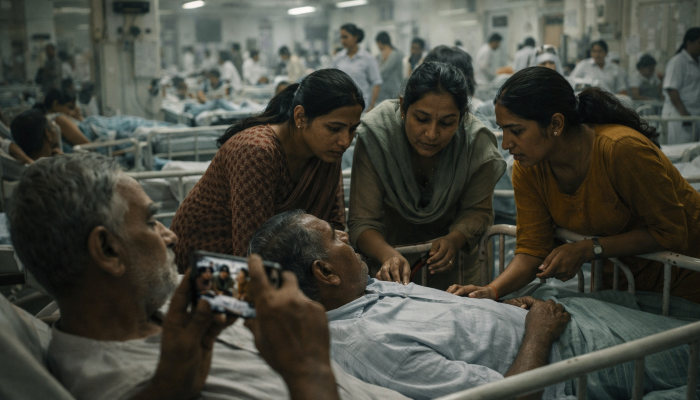
Case Summary
Hindu patients receiving medical treatment at Ambedkar Hospital in Raipur, Chhattisgarh, were targeted for forced religious conversion by three Christian missionary women. They entered the hospital wards and exploited the vulnerability of ill and hospitalised Hindus by offering them promises of better healthcare facilities as an inducement to convert to Christianity. According to media reports, on 11 April 2026, Hindu patients lying in hospital wards, weakened by illness and dependent on institutional care, were deliberately identified and approached by the three Christian women as targets for conversion. They offered Hindu patients medical incentives to convert to Christianity. During this incident, a Hindu patient captured the conversion activity on video and immediately sent it to Bajrang Dal workers. Bajrang Dal worker Brijendra Verma stated that the organisation received information at 9 am that Christian missionary women were propagating Christianity among patients inside Ambedkar Hospital. By the time workers arrived at the hospital, the three perpetrators had already fled the premises. Hindu activists searched the hospital complex for approximately half an hour but were unable to locate them. Bajrang Dal workers alerted security guards on duty and instructed them to remain vigilant and report any recurrence of such activities. Hospital management was informed that the responsibility for protecting patients from conversion targeting within the hospital compound rested with the institution and that concrete preventive steps were required. In protest at the targeting of vulnerable Hindu patients, workers recited the Hanuman Chalisa, a devotional hymn dedicated to Lord Hanuman, at a temple outside the hospital complex and demanded strict action. The video of the three Christian women was circulated on social media by Bajrang Dal workers, with a public appeal for anyone who spotted them to report their location immediately so that legal proceedings could be initiated. Workers noted that the Chhattisgarh state government had recently enacted the Dharma Swatantrya Vidheyak, the Religious Freedom Act, under which inducement-based conversion carried provisions for rigorous imprisonment and heavy financial penalties.
Why it is Hate Crime ?
The primary category of this case is "Predatory Proselytisation". The sub-category here is "Conversion/attempts to convert by inducement". Predatory Proselytisation is not just limited to threat, harassment, force and violence, but it also has contours of stealth. In several cases, the Hindu victim is exploited to convert, with non-Hindus taking advantage of their poverty. In such cases, the Hindu victim who is suffering financially is offered monetary benefits, including lucrative offers for jobs, health treatment, education, etc, to induce the victim into changing his/her religion. In such cases, the religious identity of the victim and the aim to disenfranchise him from his faith form the heart of the crime. Also, taking advantage of and exploiting an individual’s economic vulnerabilities is widely acknowledged as exploitation, forms of which are often penalised by law. Such cases therefore are considered religiously motivated hate crimes since the victim’s religious identity forms the very heart of the crime itself. This case qualifies as a religiously motivated hate crime in which three Christian missionary women entered the wards of Ambedkar Hospital in Raipur, Chhattisgarh and deliberately targeted hospitalised Hindu patients with inducement-based conversion activity, exploiting their medical vulnerability to forcibly convert them to Christianity. The perpetrator's act was not opportunistic. It was a calculated and structured act of predatory proselytisation directed at Hindus in a condition of acute physical and psychological vulnerability. The deliberate targeting of hospitalised Hindu patients is the primary religious marker of this case. The three missionary women did not conduct their activities in a public space or a neutral social setting. They entered a government hospital and approached Hindu patients in the wards, people who were ill, weakened, dependent on institutional care, and separated from their normal support networks. The choice of a hospital ward as the site of missionary activity reflects a deliberate strategy of identifying and accessing Hindu people at their most vulnerable point, when their physical suffering makes them most susceptible to promises of medical incentives and assistance. This is not incidental. It is a recognised pattern of Christian proselytisation that specifically targets spaces of Hindu vulnerability. The second religious marker is the use of medical incentives to encourage Christian conversion. This clearly demonstrates that these actions were not motivated by kindness or charity. Instead, they were calculated attempts to exploit vulnerable Hindus specifically because of their religion. By offering healthcare inducements to hospitalised Hindus to change their faith, the Christian perpetrators effectively emotionally blackmailed those desperate patients reliant on treatment. Such instances appear in many cases where Christian missionary groups target ill, socially, and economically vulnerable Hindus to advance their conversion agenda. This coercion strips Hindus of their agency and dignity while enforcing predatory conversions. These are not random or isolated incidents, but premeditated efforts to undermine the Hindu faith, persuade Hindus to abandon their traditions, and convert to Christianity. Such acts stem from deep religious animosity towards Hindu victims and their faith, constituting a religiously motivated hate crime. The pattern of targeting Hindus as a community is the third religious marker. The missionary women did not approach individual patients on the basis of personal relationships or casual encounters. They entered the hospital wards with the specific purpose of identifying and approaching Hindu patients as a community of targets. This institutional approach to conversion targeting, entering a government hospital to systematically approach Hindu patients across multiple wards, reflects an organised strategy of community-level conversion rather than individual religious outreach. The deliberate selection of a government hospital serving a predominantly Hindu patient population confirms that the targeting was directed at Hindus as a religious community. The flight of the missionary women upon discovery confirms the deliberate and covert nature of the operation. When the patient recorded the activity on video and alerted Bajrang Dal workers, the three women immediately fled the hospital premises before the workers could arrive. This panicked escape reflects their clear awareness that targeting sick Hindu patients for conversion with medical incentives was wrong and predatory. Their flight was not the reaction of people engaged in innocent outreach. It was the instinctive response of those who knew they would face exposure and consequences for such unethical targeting inside a government hospital. Overall, since this case met several parameters of a religiously motivated hate crime, it was added to the hate crime database of the tracker.


Case Status
Unknown


Perpetrators Details
Perpetrators
Christian Extremists
Perpetrators Range
From 2 To 5
Perpetrators Gender
female
 Sources




