Hindu saints conducting religious congregation in ashram threatened and forcibly evicted by TMC municipal councillor
 Kolkata, West Bengal, India
  9 April, 2026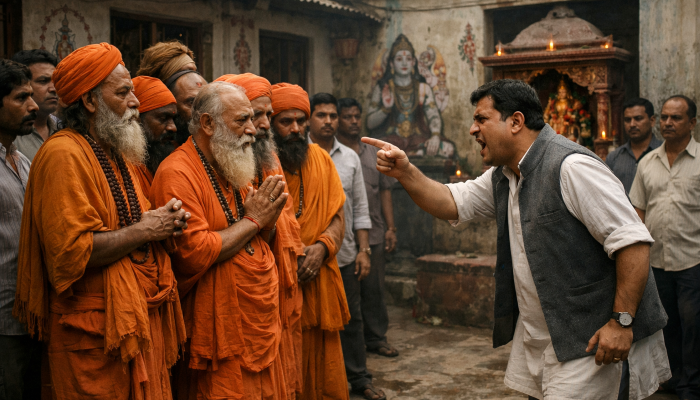
Case Summary
Hindu saints visiting the Bholananda Giri Ashram in Bhawanipore, Kolkata, West Bengal for a religious congregation were forcibly evicted by Trinamool Congress [TMC] councillor Ashim Basu of Ward No 70 of the Kolkata Municipal Corporation, who entered the ashram, accused the sadhus [Hindu holy men] of political activities, threatened to assault them, and threatened to cut the power and water supply to the ashram. The saints maintained that they were present solely for religious purposes and had been spreading Hindu teachings through visits to local homes and religious events. Hindu sadhus from various parts of West Bengal had gathered at the Bholananda Giri Ashram in Bhawanipore for a religious congregation. The ashram was a legitimate Hindu religious institution, and the saints' presence at it for a religious gathering was entirely lawful. During their stay, they had been visiting local homes, distributing religious leaflets, and holding religious events to spread Hindu teachings in the area. Ashim Basu entered the ashram and confronted the assembled sadhus, demanding to know who they were and why they were present. When the sadhus told him they were there to spread Hindu religious messages, he told them they had no right to be at the ashram and ordered them to leave. He accused them of visiting local homes under false pretences, alleged they were part of a political conspiracy, and suggested they could be thieves disguised as sadhus. He threatened to assault them and warned that he would cut the power and water supply to the ashram if they did not leave. He also threatened to file a police case against them. Basu himself posted a video of the confrontation on Facebook, in which he was seen questioning the sadhus about their presence and accusing them of making videos of local homes and distributing leaflets as part of a political propaganda campaign. The sadhus stated to the media that they were not affiliated with any political party and had been visiting homes solely for religious purposes.
Why it is Hate Crime ?
The primary category for this case is "Restriction/ban on Hindu practices". The sub-category for this case is "Administration restricting religious practice". In several cases, it is seen that the administration/state disallows a religious practice owing to prejudicial orders and concerns, targeted specifically against the Hindu community. Such restriction/prohibition would be considered documented as a hate crime because the orders are often a result of pressure by groups that harbour animosity towards Hinduism and Hindus. Often, the restriction by the authorities is driven by bias, hostility, or prejudice against the specific community being stopped from holding a religious practice, by pressure groups that harbour animosity towards Hindus, intrinsic to their faith. Since practices are intrinsic to the faith of the Hindus, such prejudicial restriction is considered a curtailing of the fundamental rights of the Hindu community. In several cases, for example, the authorities ban a Hindu religious practice due to pressure from groups opposed to the religion. In other instances the prohibition is selectively enforced against one religious group (Hindus) while others are allowed to proceed. There are still other cases where the authorities preemptively restrict a religious practice by Hindus because those who hold animosity towards Hindus may get “provoked” leading to them being violent, thereby assuaging the sentiments of those who hold animosity towards Hindus by curtailing the religious rights of Hindus. Such acts and orders are prejudiced, indicating discriminatory motives owing to the capitulation to groups that harbour animosity towards Hindus and therefore, would be categorized as a religiously motivated hate crime since the original pressure leading to the order itself is a result of hatred/bias/prejudice/religious hate against Hindus. Another primary category for this case is "Attack not resulting in death", and within this, the subcategory selected is- "Attacked for supporting/being part of perceived Hindu party/org or working for Hindu community" In several cases, Hindus are attacked specifically or tangentially for their association with parties or organisations perceived to be pro-Hindu and/or for working in favour of the Hindu community. One of the classic cases was the attack against a Bharatiya Janata Party Yuva Morcha (BJYM) worker Praveen Nettaru. Nettaru was attacked and hacked to death for his association with Hindu organizations and his work for the Hindu community. He was murdered by PFI, a terror organization which aimed to commit a genocide of Hindus, target Hindu leaders specifically and turn India into an Islamic Nation. In such cases, it is possible that the immediate trigger for the violence is non-religious – either according to the perpetrator or the police. However, there are surrounding circumstances from which the conclusion can be reached that the victim was attacked for his association with a Hindu organization. In a similar case, Rinku Sharma was attacked by radicals. He was a member of Bajrang Dal and regularly worked for the Hindu community. While the police cited a different non-religious trigger for the attack, it is true that he was associated to a Hindu organization and the family of Rinku Sharma specifically attributed his gruesome murder to him working for Bajrang Dal and raising Jai Shree Ram slogans. Such cases are intrinsically driven by religious hate and would therefore be documented as a hate crime under this category. The other category selected here is- Hate speech against Hindus, and within this, the subcategory selected is- Violent Threats. Violent threats, explicit, implicit or implied, is the most dangerous form of hate speech since it goes beyond discriminatory and prejudicial language to express the intent of causing harm to an individual or a group of people based on their religious identity and faith. There could be several different kinds of threats that are issued to Hindus based on religious animosity. An explicit threat would mean the direct threat of violence towards an individual Hindu, a group of Hindus or Hindus at large. Physical violence, death threats, threats of destruction of property belonging to Hindus and threats of genocide would mean explicit threats against Hindus for their religious identity. Implicit threats may not be a direct threat but implied through the use of symbols of actions – for example – in the Nupur Sharma case, other than explicit threats, there were also implicit threats when Islamists took to the streets to burn and beat her effigies. It implies that they want to do the same to Nupur Sharma – thereby is considered an implicit threat. Violent threats can be delivered in person, through letters, phone calls, graffiti, or increasingly through social media and other online platforms. It would be important to understand that a threat – explicit or implicit, online or offline – to an individual who happens to be a Hindu does not qualify as a religiously motivated threat. Such a threat, while vile and dangerous, could be owing to non-religious reasons and/or personal animosity. To qualify as a religiously motivated threat, it would need to exhibit an indication that the individual is being targeted for religious reasons and/or owing to his/her religious identity as a Hindu. This incident qualifies as a religiously motivated hate crime because Hindu religious activity at the Ashram was actively disrupted by the TMC councillor through intimidation and misuse of authority, specifically targeting Hindu sadhus engaged in religious work. The first marker is the direct interference with Hindu religious practice in this case. Hindu sadhus from different parts of West Bengal had gathered at the Bholananda Giri Ashram for a religious congregation and were visiting nearby homes to spread Hindu teachings. Despite this being a lawful religious activity, Ashim Basu entered the ashram and ordered the sadhus to leave, questioning their presence and denying their right to conduct such activities. This shows that the disruption was not incidental but directly targeted at an ongoing Hindu religious gathering. The second marker is the use of threats to forcibly stop this activity. During the confrontation, Ashim Basu threatened to assault the sadhus, warned them that he would file police cases against them, and stated that he would cut off the power and water supply to the ashram if they did not leave. These threats were used to pressure the sadhus into abandoning their religious activities, turning the situation into coercive suppression rather than a mere dispute. The third marker is the targeting of Hindu religious figures specifically for their role in spreading Hindu teachings. The sadhus clearly stated that they were visiting homes and organising events only to propagate Hindu dharma. However, Ashim Basu dismissed this, accusing them of being involved in political activity and even suggesting they could be thieves in disguise. This reframing of religious work as suspicious or illegitimate shows that the targeting was directly linked to their Hindu religious identity and activity. The fourth marker is the misuse of political authority to suppress Hindu religious activity. As a municipal councillor of the Kolkata Municipal Corporation, Ashim Basu invoked his position to lend weight to his threats, including the possibility of cutting essential services and initiating police action. This gave the intimidation a coercive force, as it suggested that state-linked power could be used to remove Hindu religious practitioners from a legitimate religious space. At its core, the actions of TMC councillor Ashim Basu reflect more than a simple objection to the presence of the sadhus. By forcibly entering the Ashram, questioning the legitimacy of Hindu religious activity, and using threats to drive the sadhus out, his conduct indicates a clear disregard for Hindu religious practices and those who carry them forward. The fact that the sadhus were targeted specifically while engaged in spreading Hindu teachings suggests that the objection was not neutral but directed at the assertion and visibility of Hindu identity in the area. This points to an underlying intent to suppress or delegitimise Hindu religious activity, reflecting a clear hostility towards Hindu beliefs and practices. Given that the fundamental motivation behind this incident lies in such disregard for the Hindu religion, this case has been added to the tracker under the following category. Disclaimer: The Hinduphobia Tracker records incident dates based on when the crime occurred, not when it was reported or published. The source does not specify the exact date of the incident at the Bholananda Giri Ashram, noting only that the sadhus had gathered for a religious congregation and that the confrontation occurred during their stay. Since the incident date is missing, the publication date of 10 April 2026 has been used as the indicative incident date for documentation purposes. This was recorded for documentation purposes only.


Case Status
Unknown


Perpetrators Details
Perpetrators
State and Establishment
Perpetrators Range
One Person
Perpetrators Gender
male
 Sources




