Hindus lured with inducements, manipulated, and threatened for conversion by Christian pastors in Guna, Madhya Pradesh
 Guna, Madhya Pradesh, India
  4 April, 2026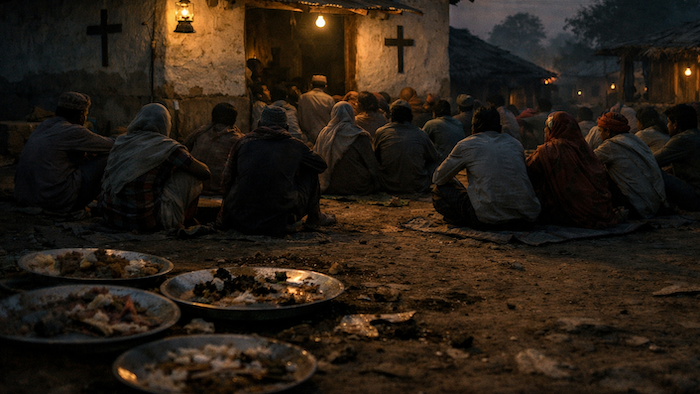
Case Summary
In Guna district, Madhya Pradesh, nearly 300-400 Hindu villagers from the Bhil tribal community were targeted for forced Christian conversion by two pastors and their associates. They were lured with inducements, false promises of disease cures, and subjected to religious brainwashing, manipulation, and threats. According to media reports, weekly prayer meetings were conducted every Sunday in Mohanpur Khurd village under the Myana police station area in Guna. These gatherings were led by Pastor Uttam Barela, Pastor Vikas Barela, and their associates. This incident came to light when around 300-400 Hindus were lured to attend these prayer meetings on 5 April 2026 under the pretext of celebrating Easter. During these meetings, the Christian pastors claimed that serious illnesses, including cancer, could be cured through Christian prayer and exorcism rituals. The Hindu tribal villagers were told that their diseases would be healed if they accepted Christianity. These claims were repeatedly presented during the gatherings to influence the attendees to convert. The Hindu tribal villagers were also offered inducements to encourage conversion. Meat, including mutton and chicken, was served at the gatherings as part of the events. The villagers were promised financial assistance and a better standard of living if they agreed to convert. These incentives were used to attract and retain participation in the meetings. Alongside inducements, threats were issued to the Hindu tribal villagers. They were told that if they refused to convert to Christianity, their illnesses would not be cured. They were also warned that they would suffer eternal punishment and burn in hellfire after death if they did not accept Christianity as their new religion. The Christian pastors further assured the villagers that their caste identity and names would remain unchanged even after conversion. They were instructed not to alter their caste status in official documents so that they could continue receiving benefits from government schemes and reservations. This assurance was presented as part of the effort to remove hesitation among the Hindu tribal community. A complaint regarding these activities was filed by Brijesh Bairagi, a resident of Karod village. Based on the complaint, a case was registered at the Myana police station against Pastor Uttam Barela, Pastor Vikas Barela, and other associates under sections 3 and 5 of the Madhya Pradesh Freedom of Religion Act, 2021. The authorities began examining evidence related to the gatherings, inducements, and threats used during the events. The investigation remained ongoing, and officials stated that strict action would be taken against those found guilty.
Why it is Hate Crime ?
This case has been added to the tracker under the primary category - Predatory proselytisation. Within this, the subcategory selected is - Conversion/ attempts to convert by inducement. Predatory Proselytisation is not just limited to threat, harassment, force and violence, but it also has contours of stealth. In several cases, the Hindu victim is exploited to convert, with non-Hindus taking advantage of their poverty. In such cases, the Hindu victim who is suffering financially is offered monetary benefits, including lucrative offers for jobs, health treatment, education, etc, to induce the victim into changing his/her religion. In such cases, the religious identity of the victim and the aim to disenfranchise him from his faith form the heart of the crime. Also, taking advantage of and exploiting an individual’s economic vulnerabilities is widely acknowledged as exploitation, forms of which are often penalised by law. Such cases therefore are considered religiously motivated hate crimes since the victim’s religious identity forms the very heart of the crime itself. The other subcategory selected is - Proselytisation by grooming, brainwashing, manipulation or subtle indoctrination. The tertiary category selected for this case is - Pattern of targeting Hindus. Religious brainwashing essentially means the often subtle and forcible indoctrination to induce someone to give up their religious beliefs to accept contrasting regimented ideas. Religious grooming or brainwashing also involves propaganda and manipulation. It involves the systematic effort, driven by religious malice and indoctrination, to persuade “non-believers’ to accept allegiance, command, or doctrine to and of a contrasting faith. Cases of such grooming or brainwashing are far more nuanced than direct threats, coercion, inducement and violence. In such cases, it is often seen that there is repeated, subtle and continual manipulation of the victim to induce disaffection towards their own faith and acceptance of the contrasting faith of the perpetrator. While subtle indoctrination is widely acknowledged as predatory, an element which is often understated in such conversions or the attempts of such conversion is the role of loyalty and trust which might develop between the perpetrator and the victim. Fiduciary relationships are often abused to affect such religious conversion. For example, an educator transmitting religious doctrine of a competing faith to a Hindu student. The Hindu student is likely to accept what the teacher is transmitting owing to existence of the fiduciary relationship. The exploitation of the fiduciary relationship to religiously indoctrinate victims would also be included in this category. Since the underlying animosity towards the victim’s faith forms the basis of predatory proselytization, such cases are considered religiously motivated hate crimes. Another subcategory selected is - Harassment, threats, coercion for conversion. Harassment covers a wide range of behaviours of an offensive nature. It is commonly understood as behaviour that demeans, humiliates, and intimidates a person, including threats and coercion. Harassment and threats, in this case, find their root on discriminatory grounds which has the effect of nullifying a person’s rights or infringing upon his freedom to exercise his right specifically owing to the victim’s religious identity. Verbal and physical threats and psychological or physical harassment are often used against Hindu victims because they choose to practice their professed religion. Religious harassment also includes forced and involuntary conversions by harassment, threats or coercion. Coercion includes intimidatory tactics like force-feeding a Hindu victim beef to convert to another religion, forceful circumcision etc. In several cases documented, non-Hindu perpetrators or those who harbour specific animosity towards Hinduism, harass victims simply based on their religious identity. Such cases often also include harassment to ensure the Hindu victim abandons his/her professed religion and adopts the religion of the perpetrator. Such cases where Hindu victims are harassed to convert to the perpetrator’s religion are rooted in animosity towards the victim’s religious identity and are therefore documented as religiously motivated hate crimes. This case represents a clear example of a religiously motivated hate crime because the Christian perpetrators targeted Hindus from the tribal Bhil community for large-scale conversion involving 300 to 400 people. These vulnerable tribal Hindus faced relentless coercion through inducements, manipulation, and outright threats. The pastors preyed on their illnesses and hardships, promising miraculous cures for serious conditions like cancer if they renounced Hinduism and embraced Christianity. They were warned of eternal damnation and hellfire if they resisted conversion, instilling fear to erode their faith. Such systematic targeting of a specific religious group with predatory tactics marks this as unambiguous religious animosity, designed to humiliate and dismantle Hindu identity on a massive scale. Hindus were lured with material incentives such as food, including mutton and chicken, alongside promises of financial assistance and a better standard of living. These inducements were not acts of kindness but calculated tools to arm-twist Hindus into converting to Christianity. The perpetrators exploited them to coerce and manipulate desperate individuals, especially those in vulnerable situations, craving basic support. By targeting economically and health-wise strained tribal Hindus with such bribes for religious conversion, the actions exposed deep-seated religious animosity towards the Hindu community. This predatory approach dehumanised Hindus, portraying their faith as inferior and ripe for eradication through bribery rather than genuine charity. The perpetrators also brainwashed Hindus by insisting that conversion to Christianity would cure their diseases, such as cancer, through prayer and exorcism rituals. These false assurances exploited the villagers' suffering, positioning Christianity as the sole path to salvation while denigrating Hindu beliefs as powerless. In this context, such manipulation served as a tool for forced religious conversion, showcasing profound religious animosity. It dismissed Hindu devotion and traditions as worthless, aiming to shatter the spiritual foundations of the victims and replace them with alien doctrines through deceit. Hindus faced explicit threats that if they did not convert, their illnesses would remain uncured and they would endure eternal punishment, burning in hellfire after death. This amounted to psychological manipulation, brainwashing, harassment, and coercion rooted in efforts to forcibly strip Hindus of their faith identity. By weaponising fear of divine retribution, the pastors sought to terrorise devotees into abandoning their ancestral religion, Hinduism. This assault on personal beliefs and identity of Hindus constitutes a hallmark of religiously motivated hate crimes, as it inflicts emotional trauma to eradicate the victims' cultural and spiritual heritage. The perpetrators conducted these prayer meetings every Sunday, systematically targeting large numbers of Hindus for conversion to Christianity. In this incident alone, they aimed at around 300-400 individuals, revealing a disturbing pattern rather than an isolated event. Such mass-scale conversion efforts indicate repeated patterns of predatory proselytisation designed to alter the religious demography of the region and sever entire Hindu communities from their roots. Aggressively rewriting their faith erodes communal bonds and alienates generations, making this a clear case of a religiously motivated hate crime through organised demographic aggression. Such instances of predatory proselytisation stem from deep-seated religious animosity towards the Hindu community and their faith. Doctrinal beliefs in Abrahamic faiths dehumanise non-adherents, viewing them as lost souls needing conversion by any means. This mindset fuels coercive tactics against Hindus, treating their ancient traditions as obstacles to be demolished. Therefore, this case has been added to the hate crime database of the Hinduphobia Tracker. Disclaimer: Two perpetrators have been specifically identified in the available information, namely Pastor Uttam Barela and Pastor Vikas Barela. However, the incident involved additional individuals who assisted in organising and conducting the gatherings, whose identities have not been confirmed. The perpetrator count has therefore been recorded as two identified individuals. This is a conservative estimate recorded only for documentation purposes.
Victim Details
Total Victim
400
Deceased
0
Gender
- Male 0
- Female 0
- Third Gender 0
- Unknown 400
Caste
- SC/ST 400
- OBC 0
- General 0
- Unknown 0
Age Group
- Minor 0
- Adult 0
- Senior Citizen 0
- Unknown 400


Case Status
Complaint registered


Perpetrators Details
Perpetrators
Christian Extremists
Perpetrators Range
From 2 To 5
Perpetrators Gender
male
 Sources




