Christian pastor and American comedian mock Hindu practices, call Hindus “cow piss drinkers” and Hinduism “insanely demonic”
 Plano, Texas, United States
  7 April, 2026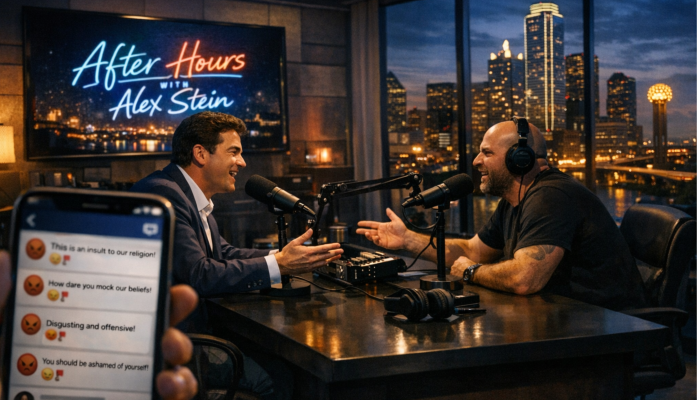
Case Summary
Hindu Americans were subjected to a fresh and public attack on their faith when American comedian Alex Stein and Christian pastor Joel Webbon used the 'After Hours with Alex Stein' podcast on 8 April 2026 to mock, vilify, and demonise Hinduism before a large Western audience. The discussion focused on perceived demographic and cultural “changes” in Texas, including H1-B visas, Indian immigration, and claims of the state turning into a “Little Mumbai.” During this exchange, when Alex Stein shifted to mocking Hindu practices, Joel Webbon, pastor and founder of Right Response Ministries, joined in by making disparaging remarks about Hinduism. The exchange formed part of a sustained pattern of Hinduphobic conduct by Stein, who had previously appeared in caricatured Hindu dress at a municipal government meeting to mock Hindu religious practices, and who regularly used public platforms to spread hatred and lies about Hindus and their faith. Hindu religious practices and beliefs were the direct target of the 8 April exchange. Stein opened the attack by falsely describing Hindus as worshipping the cow, drinking cow urine, and eating cow dung, using these deliberate distortions to ask Webbon to rank Hinduism's "craziness" against other religions like Scientology. “Hindus “like to worship the cow, they drink the cow pee, they eat the cow poop.Is that one of the most demonic religions? How does Hindu rank on levels I guess craziness of religion. Is Hinduism crazier than Scientology?” Stein asked. Webbon responded by declaring Hinduism "insanely demonic", "satanic", "very pagan", and "incompatible with Western cultural values", with Stein enthusiastically endorsing each characterisation. “Oh… Scientology is pretty crazy. Yeah. No… Hinduism is insanely demonic because it’s not monotheistic. It’s literally millions of gods. And if you’ve ever watched—there have been videos that have gone viral of Hindu temples where they’re pouring blood-looking liquid on themselves or chopping off the head of a goat and then drinking the blood—so it is very pagan, very demonic, polytheistic. Hinduism is satanic in a lot of ways,” Joel Webbon gave an equally hateful response. The Christian pastor further proceeded to contrast Hinduism with Islam, saying that both “send you to hell”, but Hinduism is “terribly pagan” and does not align with “Western cultural values.” Webbon’s diatribe triggered a backlash from the Hindu community on social media. This was not Stein's first public attack on Hindus and their faith. In February 2026, Stein appeared at the Plano City Council in Texas wearing a traditional kurta and a tilak [a sacred mark applied to the forehead as part of Hindu devotional practice] as a caricatured Hindu persona. He used the occasion to mock Hindu practices before the council, stating that he worshipped cows and begging the mayor to allow him to eat cow dung for its supposed healing properties. He described cow urine as the purest medicine straight from the gods and cow dung as a holy blessing for health and prosperity, reducing sacred elements of Hindu religious tradition to objects of public ridicule at a government meeting. Local media reported that Stein regularly used municipal government meetings to advance his Christian extremist and racist agenda. The broader context in which Stein's attacks on Hinduism occurred reflects a dramatic and documented escalation of anti-Hindu hatred in the United States since 2025. Hindu Americans have faced an unprecedented wave of online hate campaigns, temple vandalism, racist attacks, and organised institutional hostility. In October 2025, pastor Joel Webbon directed the slur "sand demons" at Hindu sacred idols in response to a Diwali greeting posted by Federal Bureau of Investigation [FBI] Director Kash Patel on his official platform, telling him to go back to India and worship his "sand demons". In September 2025, Republican Senate candidate for Texas Alexander Duncan called Lord Hanuman [one of the most widely revered deities in Hinduism] a false god and objected to the construction of his statue in the United States. In November 2025, the New York State Council of Churches [NYCOC], through its Religious Nationalisms Project, joined forces with the Islamist group Indian American Muslim Council [IAMC] to hold anti-Hindu seminars. In October 2025, three masked men carrying signs reading 'Do Not India My Texas' appeared in a suburb of Irving, Texas, where thousands of Indian technology professionals reside. Hindu Americans who have built their lives, communities, temples, and professional contributions in the United States continued to face a climate in which their faith was publicly labelled demonic and satanic by Christian extremists with large platforms, their sacred practices were mocked at government meetings, and their presence in the country was framed as an invasion by racists invoking the White Replacement Theory. The unchecked escalation of this hatred, commentators warned, risked becoming the precursor to religion-based violence against Hindus in the United States.
Why it is Hate Crime ?
The primary category for this case is "Hate speech against Hindus". The sub-category for this case is "Anti-Hindu slurs, mocking faith". Anti-Hindu slurs and the deliberate mocking of the Hindu faith owing to religious animosity involve the usage of derogatory terms, stereotypes, or offensive references to religious practices, symbols, or figures. One of the common anti-Hindu slurs used against Hindus is “cow-worshipper” and “cow piss drinker”. The intention of using this term is to demean and mock Hindus as a group and their religious beliefs since Hindus consider the cow holy. Additionally, some symbols and the slurs attached to them have a historical context that exacerbates the insult, hate, stereotyping, dehumanisation and oppression against Hindus. Cow worship has been used for centuries to denigrate Hindus, insult their faith and oppress Hindus specifically as a religious group. There has been overwhelming documentation about how cow slaughter has been used to persecute Hindus with cow meat being thrown in temples and places of worship. There has also been overwhelming documentation where cow meat (beef) has been force-fed to Hindus to either forcefully convert them to Islam or denigrate their faith. Apart from cow worship, the Swastika – which holds deep religious significance for the Hindus – has also been misinterpreted and distorted to use as a slur against Hindus. Similarly, the worship of the Shivling has been used by supremacist ideologies and religions to denigrate Hindus owing to religious animosity. Such slurs and denigration stem out of inherent animosity and hate towards Hindus and their faith, therefore, it is categorised as hate speech targeted at Hindus specifically owing to their religious identity. Another sub-category for this case is "Anti-Hindu subversion and prejudice". Hate speech is defined as any speech, gesture, conduct, writing, or display that is prejudicial against a specific individual and/or group of people, which is leading to or may lead to violence, prejudicial action or hate against that individual and/or group. Media plays a specific and overarching reach in perpetuating prejudicial attitudes towards a community owing to unfair, untrue coverage and/or misrepresentation/misinterpretation, selective coverage and/or omission of facts of/pertaining to issues affecting a specific religious group. This type of bias can dehumanise the victim group, making it easier for others to justify harmful actions against them, which aligns with the objectives of hate speech laws aimed at preventing such harm. It is often observed that the media takes a prejudicial stand against the Hindu community driven by their need to shield the aggressor community which happens to be a numeric minority, however, is the one perpetrating violence against Hindus. For example, the media is often quick to contextualise religiously motivated crimes against Hindus, omit or misrepresent facts that point towards religiously motivated hate crimes, justify and/or downplay religiously motivated hate crimes or simply present fake news to stereotype Hindus. Such media bias leads to the denial of persecution and is often used to dehumanise Hindus, leading to justification for violence against them. For example, the media covered several fake allegations of Hindus targeting Muslims and forcing them to chant Jai Shree Ram. Most of these cases were proved false and fabricated after police investigation. These fake news reports were subsequently never retracted or clarified. Such fake news led to the justification of violence and dehumanisation of Hindus based on the argument that since Hindus targeted Muslims and forced them to chant Jai Shree Ram, the dehumanisation of Hindus and violence against them was par for the course and merely a retaliation. Such media bias leads to prejudicial portrayal of Hindus and offers a justification for violence against them and therefore, is considered hate speech under this category. This case qualifies as a religiously motivated hate speech incident in which comedian Alex Stein used multiple public platforms to mock, vilify, and spread deliberate falsehoods about Hinduism and its practitioners, contributing to an escalating climate of anti-Hindu hatred in the United States. Stein's conduct was not a single act of offensive humour. It was a sustained and repeated campaign of public Hinduphobia carried out across different platforms and contexts, each instance reinforcing and amplifying the last. The public mockery of Hindu religious practices at a municipal government meeting is the first and most institutionally significant religious marker in this case. In February 2026, Stein appeared at the Plano City Council in Texas wearing a kurta and a tilak as a caricatured Hindu persona and used the occasion to mock Hindu devotional practices before elected officials and a public audience. The deliberate donning of Hindu religious dress as a costume for the purpose of ridicule is a direct act of religious desecration. The tilak is a sacred mark of devotional identity worn by Hindu men and women as an expression of their faith. Its use as a prop for anti-Hindu comedy at a government meeting reduces a living religious symbol to an instrument of contempt. The fact that this was done at a civic institution, a city council meeting, lends the mockery an institutional dimension that amplifies its harm far beyond a private act of bigotry. The deliberate misrepresentation of Hindu religious practices as evidence of demonic belief is the second religious marker. On the 8 April 2026 podcast, Stein described Hindus as drinking cow urine and eating cow dung, framing these distortions as the basis for asking whether Hinduism was the craziest religion. The reverence for the cow in Hinduism is rooted in the ancient principle of ahimsa and in the theological understanding of the cow as a symbol of abundance, motherhood, and non-violence. The traditional use of Panchagavya in specific ritual and Ayurvedic [the ancient Indian system of medicine] contexts is a defined and regulated practice, not a general custom of consuming excrement. Stein's characterisation was not a misunderstanding. It was a deliberate reduction of sacred Hindu religious practice to a grotesque caricature, designed to generate disgust and contempt among a Western audience. The framing of Hinduism as demonic and satanic in collaboration with a Christian pastor is the third religious marker. By inviting Joel Webbon onto his platform and directing the conversation toward ranking Hinduism's supposed craziness, Stein provided a platform for the explicit theological condemnation of Hinduism as insanely demonic and satanic. The theological labels of demonic and satanic carry specific and loaded meanings in the Christian evangelical tradition from which both Stein and Webbon operate. They are not merely insults. They are classifications that have historically been used to justify the suppression, persecution, and destruction of non-Christian religious communities and their sacred spaces. To apply these labels to Hinduism before a large American audience is to situate Hindu Americans within a framework of religious otherness that has historically preceded violence. The pattern of sustained and escalating anti-Hindu conduct by Stein is the fourth religious marker. The February 2026 city council appearance and the April 2026 podcast were not isolated incidents. They formed part of a documented pattern of repeated public targeting of Hinduism and Hindu Americans by Stein across different platforms and contexts. This pattern reflects a deliberate and sustained campaign rather than an opportunistic offence, and it situates Stein's conduct within the broader escalation of organised anti-Hindu hatred in the United States that has intensified since 2025. The broader context of escalating institutional anti-Hindu hatred in the United States is the fifth religious marker. Stein's conduct did not occur in a vacuum. It took place within an environment in which Hindu sacred idols were being labelled sand demons by a senior pastor, Hindu deities were being called false gods by political candidates, anti-Hindu seminars were being organised by church bodies in coalition with Islamist groups, and calls to nuke India were being normalised among Christian extremist circles. Stein's public mockery of Hinduism contributed directly to this environment by providing entertainment-format validation for the contempt that other actors were expressing in more explicitly hostile terms. The normalisation of anti-Hindu hatred through comedy is not a lesser form of harm than its expression through theological condemnation. It is a more insidious one, because it makes the hatred socially acceptable and removes the social cost of expressing it. Given that such sustained and targeted mockery can only stem from a clear disregard for Hinduism and its practitioners, this case warrants inclusion in the tracker as a documented instance of anti-Hindu hate speech.


Case Status
Unknown


Perpetrators Details
Perpetrators
Christian Extremists
Perpetrators Range
From 2 To 5
Perpetrators Gender
male
 Sources




